
Bloomberg
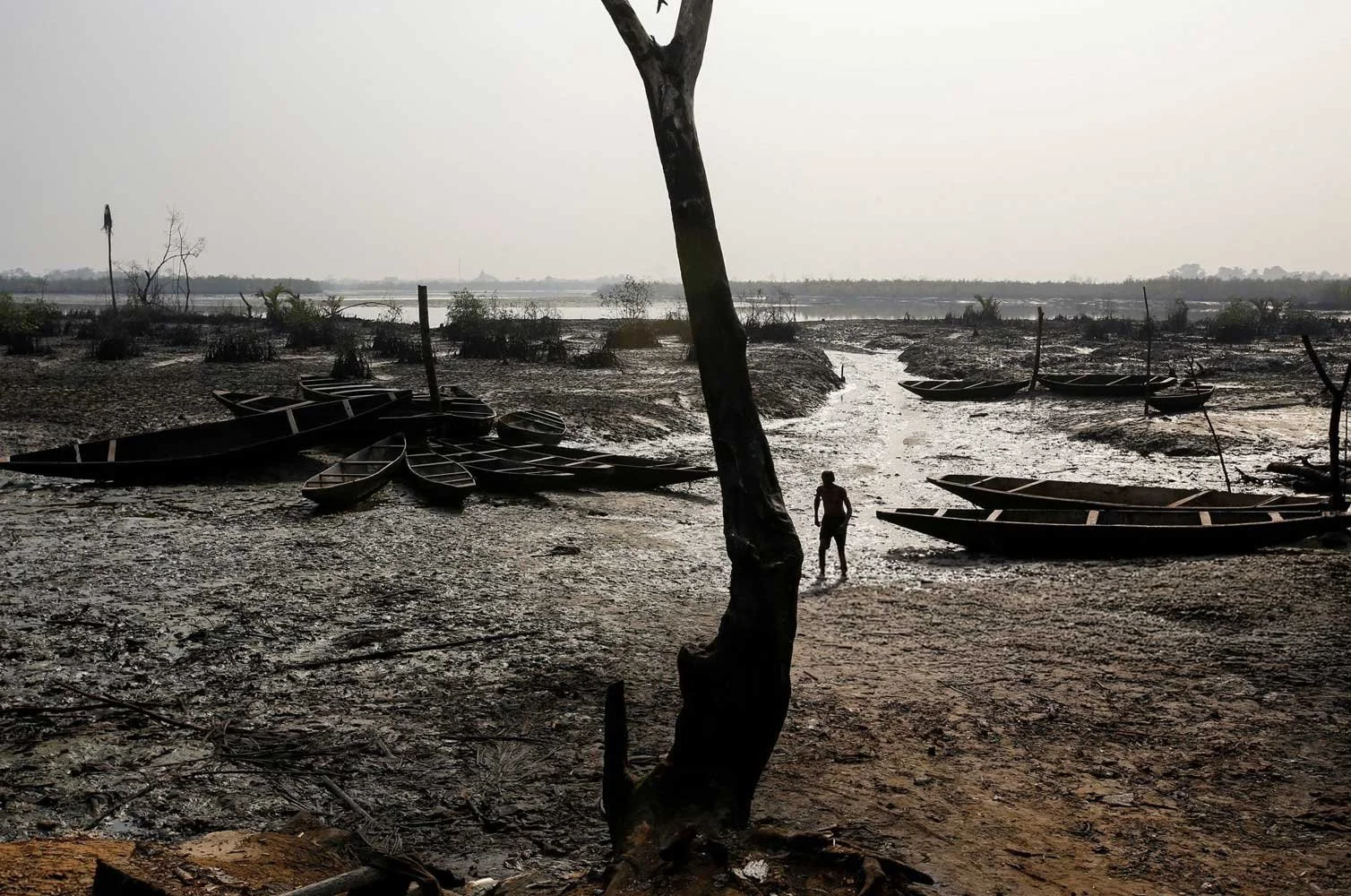
A climate crisis exists in Nigeria. Although Africa accounts for roughly 3-4% of global greenhouse gas emissions, there is a disproportionate impact on the effects of climate change. In sub-Saharan Africa, agriculture is the primary source of food, employment, and income for 60% of the population. In the Niger Delta, agricultural reliance is adversely impacted by crude oil spills.
Crude oil spills create health hazards for residents in surrounding areas, polluting water and contributing to disease. It also impacts food security. An estimated 240,000 barrels of crude oil are spilled annually into the Niger Delta. Since 2007, Shell has admitted to spilling roughly 55.8 million liters (14.7 million gallons) of oil in the Niger Delta. This is enough to fill over 22 Olympic-size swimming pools, according to 2015 data.
The Niger Delta is an important source for farmers and residents alike. It is a fan-shaped area where the Niger and Benue Rivers empty out into the Atlantic Ocean. It functions as a large floodplain. According to Amnesty International, “The Niger Delta covers around 70,000 km², roughly the size of Sierra Leone, the Republic of Ireland, or Sri Lanka.” It is home to biodiversity such as fish, helps keep the land arable, and helps produce potable freshwater. However, it is also rich in oil, which has been exploited over the years by numerous oil extraction powers, including multinational corporations and the government.
Royal Dutch Shell found oil in Ogoni land in 1958. Ever since then, an estimated $30 billion USD worth of oil has been extracted from the region. The Ogoni are a people of roughly half a million in population, living off the land as farmers and fishermen. They have received little to no benefit from this production, extraction, and profit. “Farmland that was once fertile turned to contaminated fields from oil spills and acid rain.” The Goldman Environmental Prize wrote. “Uncontrolled oil spills dotted the landscape with puddles of ooze the size of football fields. Virtually all fish and wildlife have vanished. Meanwhile, out of Shell’s Nigerian workforce of 5,000, less than 100 jobs went to Ogoni.”
In the 1990s, author, television producer, and activist Ken Saro-Wiwa led the Movement for the Survival of the Ogoni People, a movement to protect the environmental and human rights of the Ogoni People, who live in the Niger Delta. In January 1993, Saro-Wiwa led a peaceful protest of over 300,000 people. The protest was violently thwarted by Nigeria’s military government. A court sentenced Ken Saro-Wiwa and eight other men to death, known as the Ogoni Nine. They were executed on November 10, 1995.
While Shell reported that their oil operations met global standards, a 2026 investigation of Shell’s internal reports found documents of concerns raised about aging oil infrastructure, alleged collusion with oil theft, and a lack of spill monitoring. “Shell knew the risks from ageing and leaking infrastructure, including an old pipeline internally described as ‘a basket’ [case], yet kept oil flowing.” According to an Amnesty International report entitled Nigeria: Lifting the Lid. “It later decided to divest its onshore business rather than face the enormous cost of clean-up and decommissioning, including an internal US$10.9 billion decommissioning estimate.”
The Niger Delta isn’t simply home to the Ogoni people. Rather, although it only makes up roughly 7.5% of Nigeria’s total surface area, it is home to approximately 25 million people across nine states and 186 government areas. “The indigenous people are from roughly 40 ethnic groups and speak an estimated 250 dialects.” According to the National Library of Medicine.
Nigerian crude oil spills have adverse impacts on the health and well-being of those who occupy the surrounding regions. They produce “slow poisons” that can take months or years to contribute to disease or death in those they impact. This is separate from the immediate impact that oil spills can have on the body, such as nausea, contamination of food supply, water supply, and biodiversity.
However, there are international and non-governmental organizations aiming to make strides towards a cleaner, healthier, more equitable region. This is evident as at the 81st Session of the United Nations General Assembly in 2026 the Secretary of the Cross River State Diaspora Commission, Elizabeth Greene, was invited to participate and collaborate with international partners on the topic of climate action as well as financing development in the environmentally challenged region.
In 2015, Shell reached a settlement in the United Kingdom with the Bodo community due to the harm caused by two oil spills in 2008. This settlement included 35 million pounds (46.3 million USD) for 15,600 individuals, as well as 20 million pounds (26.5 million USD) for the broader community. However, there was no agreement reached to clean up the polluted land.
In an ongoing case against Shell, the Ogale and Billie communities are pursuing a case in London’s High Court against Shell due to the devastation caused by oil spills in the Niger Delta. This follows reports of bubbling water, methane, and gas leaks near former Shell oil extraction infrastructure, and one instance of methane gas igniting at a water pump in Billie. This includes claims against Shell from over 13,500 residents near the Niger Delta who have filed, as their spills have polluted their land, water, and ecosystems on which they rely.
Although accountability is sparse, strides are being made towards justice. The Niger Delta region deserves to be returned to a state of rich biodiversity.
