
Mzansi Now: Film and TV Creatives Protest in Cape Town and Pretoria Due to Underfunding and Government Backlogs
IHSAAN HAFFEJEE
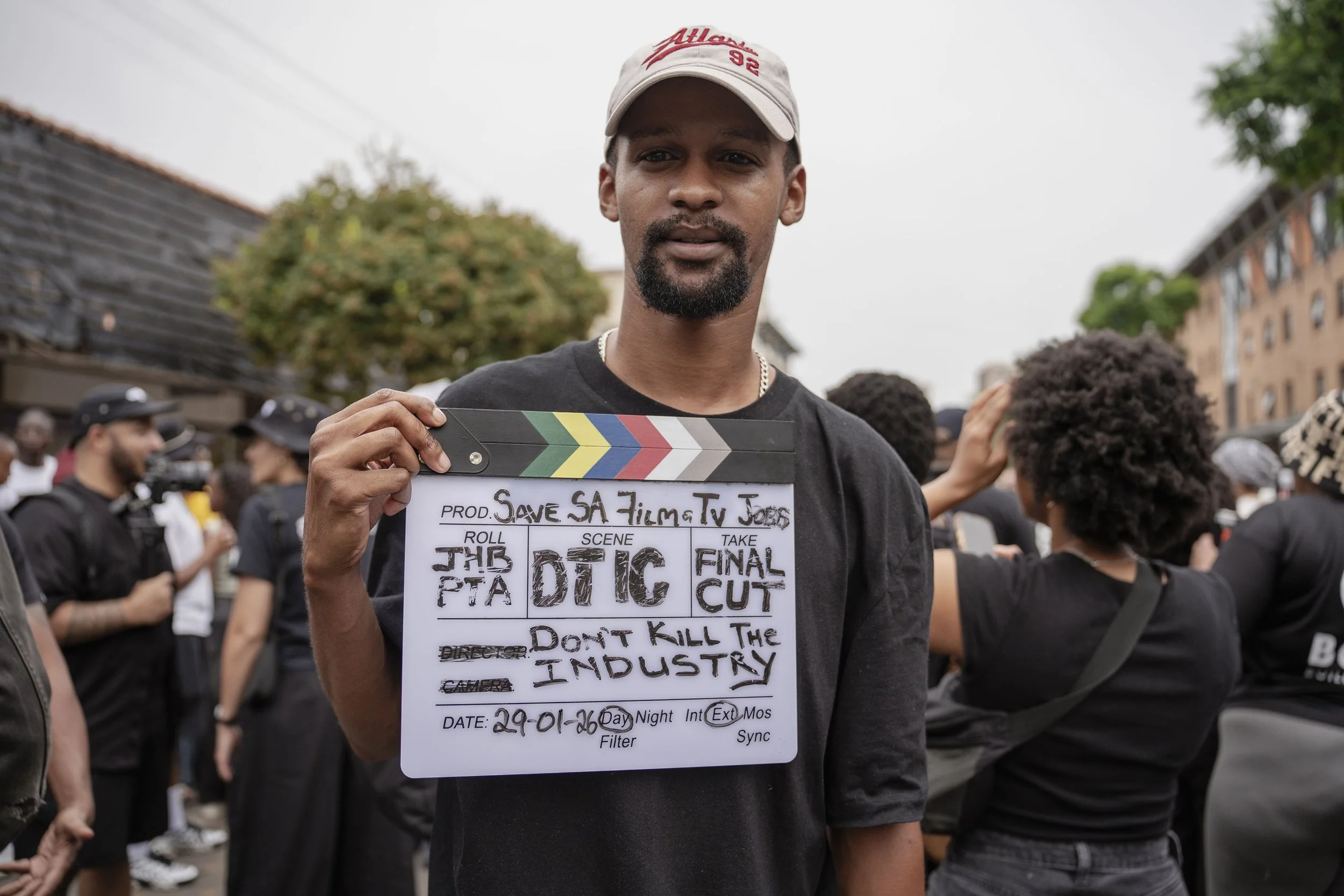
On January 28 and 29, creatives from across the nation gathered in Pretoria and Cape Town to protest the Department of Trade, Industry, and Competition (DTIC) under the banner of Save SA Film Jobs. Protesters demanded urgent reforms to the DTIC’s Film and Television Co-Production Incentive, which has failed to fulfill promises to grant rebates assisting filmmakers with production expenses.
The protests were organized by a variety of filmmaking institutions, including Animation SA, South African Guild of Actors, Independent Producers Organization, Personal Managers’ Association, Writers’ Guild of South Africa, and South African Screen Federation. Between 300 and 400 people attended the protest in Cape Town, with another significant crowd attending the demonstration in Pretoria.
Why The Industry Is Protesting
The incentives were officially introduced by the DTIC in 2004 to stimulate the local film industry by distributing grants to South African filmmakers and production companies. The program had been working successfully, with the film and TV industry employing around 60,000 individuals and generating 8-10 billion rand ($440 million-$550 million) annually. But in 2020, the DTIC repudiated around 30 projects that had already been approved, citing new guidelines for government funding. The repudiations are understood to be a result of the COVID-19 pandemic, when the economy stagnated and film productions slowed due to quarantine. Since the pandemic’s end, however, progress on the DTIC’s grants has been slow.
According to data from News24, between 2016 and 2020, the DTIC paid an average of R520 million ($29 million) annually to production companies as a part of the incentive. Between 2020 and 2023, the annual payments dropped to R333 million ($21 million), and then to R57 million ($3.5 million) between 2023 and 2024.
Simultaneously, applications for incentives accumulated into a significant backlog — at least, according to Deputy Trade Minister Zuko Godlimpi. Following similar protests that took place in March 2025, Godlimpi said that there was an oversubscription of applications compared to available funds, and had paused accepting new applications in order to address the existing backlog. But many are skeptical of this explanation, as the DTIC has not formally held any adjudication meetings since March 2024 – these meetings are held to decide which projects to approve for funding. As a result, funding approvals have been stalled by two years, where funding for already approved projects has also been delayed for years. Consequently, producers relying on rebate reimbursements to settle loans and production expenses are left in financial limbo, leading to job loss, the cancelling of projects, and the moving of productions overseas.
In March 2025, a similar demonstration was held to protest the DTIC’s idle rebates. The chairperson of the Independent Producer’s Organization, Tshepiso Chikapa-Phiri, said that productions had halted due to inadequate funding and the failure of the DTIC to fulfill promised payments. Following these protests, Chikapa-Phiri spoke with Deputy Trade Minister Godlimpi and was informed that the DTIC has been actively paying off claims from 2023, running two years behind schedule. Chikapa-Phiri also said DTIC deputy minister Zuko Godlimpi proposed a working committee to facilitate dialogue with the department, as well as bi-weekly meetings between industry and government representatives, but it is unclear if these meetings ever actually occurred.
Community Impact
Several protesters told Newzroom Afrika and News24 that crew members are being forced to sell their homes in order to pay for their children’s school fees and provide for their families. The issue especially impacts young people under 35, who make up 67% of the workforce in South Africa’s film and TV industry. One demonstrator said that fixing this industry is the “solution” to South Africa’s young unemployment problem, with a rate of 58.5% as of Q3 2025.
That same protestor said that the industry is "hemorrhaging", and that rebate programs like the DTIC’s are not uncommon in other countries, with similar government initiatives in Ireland, France, the UK, India, Japan, and the UAE, to name a few. He said that South Africa has lost its global status as a filmmaking hub due to the lack of progress in this program, a country that was once renowned for the sets found in Mad Max: Fury Road, Escape from Pretoria, Sarafina!, and Out of Africa. Simon Makwela, a South African post-production professional, said that there will not be an industry left if institutions do not address the crisis. "We are training children in film schools, and developing filmmakers for an industry that may not exist," he said, highlighting the urgency and gravity of the issue.
While these protests were ongoing, the chairperson of the Portfolio Committee on Trade, Industry and Competition, Mzwandile Masina, was engaged in a meeting about these rebates inside Parliament. He emerged to face the protesters and accepted a memorandum that listed demands for working groups with the government and regular meetings to address the backlogs and stagnant funds. Masina announced, “We are undertaking that within the next ten days we will arrange a meeting between the leadership of the sector from the different organisations that were listed here, and the minister and the ministry, together with the DG (deputy general), the deputy ministers as well as the minister,” and proceeded to sign the memorandum.
Updates on Masina’s announcement are tentative, as last year's protests also ended with a government agreement to schedule working groups, but these promises were never acted upon. The question remains of whether the DTIC will finally begin communicating transparently with the Save SA Film Jobs coalition to reanimate the sinking film industry.