
Mario Tama
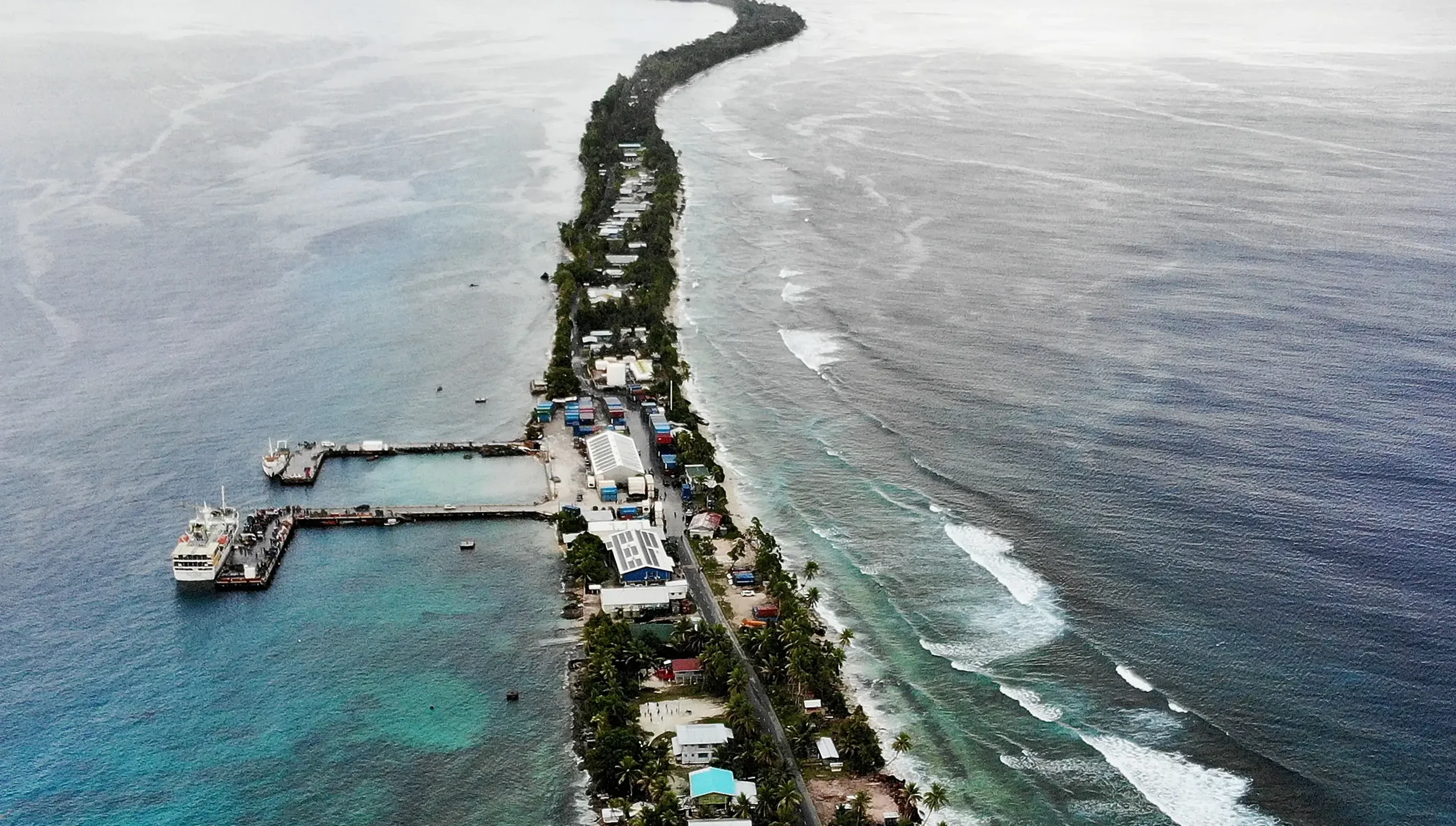
Tuvalu is a small and remote island in the South Pacific that is unsurprisingly faced with ongoing, serious climate change threats, especially sea rising levels. With only an estimated 9,646 inhabitants, limited infrastructure, and poor tourism, their ambition to combat climate change is especially interesting, highlighted in their unique and complex idea of becoming a “digital nation”. This plan was first introduced internationally at the 2022 United Nations Climate Change Conference (COP27), where they argued they should have the right to preserve sovereignty despite the potential of its territory becoming partly or fully uninhabitable. This plan sits within the government’s broader Future Now Project as well – launched in 2021.
On their official “digital nation” site they open with: By recreating its land, archiving its culture, and digitising its government, Tuvalu can exist as a nation even after its land is no more. Our digital migration has begun.’
Originally the plan seemed unimaginable as international law ties statehood to territory and further legal analysis questions the extent this plan can reach. However, more organisations and leaders are recognising and starting to back the idea that sinking nations should be able to retain maritime boundaries and statehood. Tying to digitization, the nation is also focusing on mobility with the bonuses of having a government in-spite of no land. This was seen in March 2024 with the Australia-Tuvalu Falepili Union recognizing Tuvalu’s continuing statehood even if land is inundated, and the opening of a migration path for them to Australia. Furthermore, this case is interesting as the legalities of statehood without a territory is a new and unheard of idea. As well as that, the capability of preserving history and tradition through only digitization is an untested plan that many other low-lying nations may soon adapt themselves.
What is the “Digital Nation”?
The underscoring reason for the creation of their “digital nation” plan is to preserve the core elements of their state if climate change renders their land uninhabitable. They say they want to archive their history and culture, move government sectors and functions into the digital space, and to digitally map their land. In practice, the project is still in its developmental stages, however, investments made towards digital infrastructure and planning for online public services highlight how the initiative is taking shape. A recent look at the progress of the project showed it was evolving into a broader system of digital archives, e-governance and even a potential “digital twin” of the country that would eventually serve both residents living in Tuvalu and abroad
Within the broader Future Now Project, the digital nation is one part of Tuvalu’s long-term climate survival planning. On their official website they state, “the entire country will be submerged in a matter of decades”. They also state, “Tuvalu risks becoming the first country to lose its sovereignty due to climate change”. The climate crisis is clearly on the forefront of concerns for Tuvalu and it is clear a digital nation could be the only solution to retain sovereignty.
Legal Stakes
At the center of Tuvalu’s proposal is the challenge to traditional international law. Statehood has only ever been understood to require a defined territory. However, climate change raises valid concerns about the potential disappearance of territory despite having a population. The framework is fundamentally challenged by raising the possibility that a state’s territory may become partially or entirely uninhabitable, calling into question whether legal statehood can persist without a physical land base.
Beyond the theoretical question, if a state were to inevitably lose sovereignty due to the loss of territory, they would lose rights central to economic survival and political sovereignty. For Tuvalu this includes maritime boundaries and, therefore, its exclusive economic zone which provides a significant access to fisheries and other ocean resources. We can now see that the legal definition of statehood has direct power and material consequences.
In response, Tuvalu has been actively pushing to reshape how international law approaches climate-threatened states. There are increasing signs that this position is gaining traction, with growing international support for the idea that maritime boundaries should remain fixed despite rising sea levels, and that statehood should continue even under conditions of territorial loss. While not yet fully settled, this shift suggests that Tuvalu is not only adapting to climate change, but attempting to redefine the legal foundations of sovereignty itself.
Wider Reaction and Significance
As expected, the proposal has drawn significant widespread reaction and attention. Many researchers and policy makers view this new project as an experiment for how climate change will reshape global governance and politics. If successful other low-lying atoll nations may apply the framework as well. Some scholars are now also arguing that rising sea levels will force international law to reconsider what constitutes a state.
The Future
Tuvalu’s proposal is not only about survival, but about shaping how the international community responds to the political realities of climate change. The developmental stages make the project difficult to realise, when also combined with issues around law. However, we are still witnessing the shifting of conversation from adapting to climate change to long-term survival of statehood. In the following decades, Tuvalu may be one of the first nations threatened with imminent displacement, but this experiment on statehood will be the precedent for future low-lying atoll nations and potentially the rest of the world.