
South Pacific: Kiribati’s Climate Vulnerability turned Leverage
Mike Bowers
Diplomatic Paradox
Kiribati is often portrayed as a low-lying Pacific nation slowly sinking beneath rising sea levels. However, this framing obscures a more deliberate reality: Kiribati has learned the power of utilizing existential climate risk into diplomatic leverage.
By foregrounding its vulnerability, the government has been able to secure access to climate finance through strategies such as Kiribati National Climate Financing Strategy (KNCFS), amplify its influence in multilateral forums like the UN climate negotiations, and forced early conversations about migration and sovereignty long before displacement becomes unavoidable. As competition for establishment between countries such as the US and China intensifies in the Pacific, Kiribati’s climate vulnerability has also increased its strategic value to foreign partners seeking influence in the region. With limited resources and accelerating climate impacts, Kiribati has turned survival itself into a form of statecraft – using the prospect of loss not only to seek assistance, but to shape international norms, responsibilities, and power relationships.
Threat of Climate Change
Small island developing states are considered the most climate vulnerable places on Earth for several reasons: limits on resources, population pressures, fragile socioecological context and remoteness.
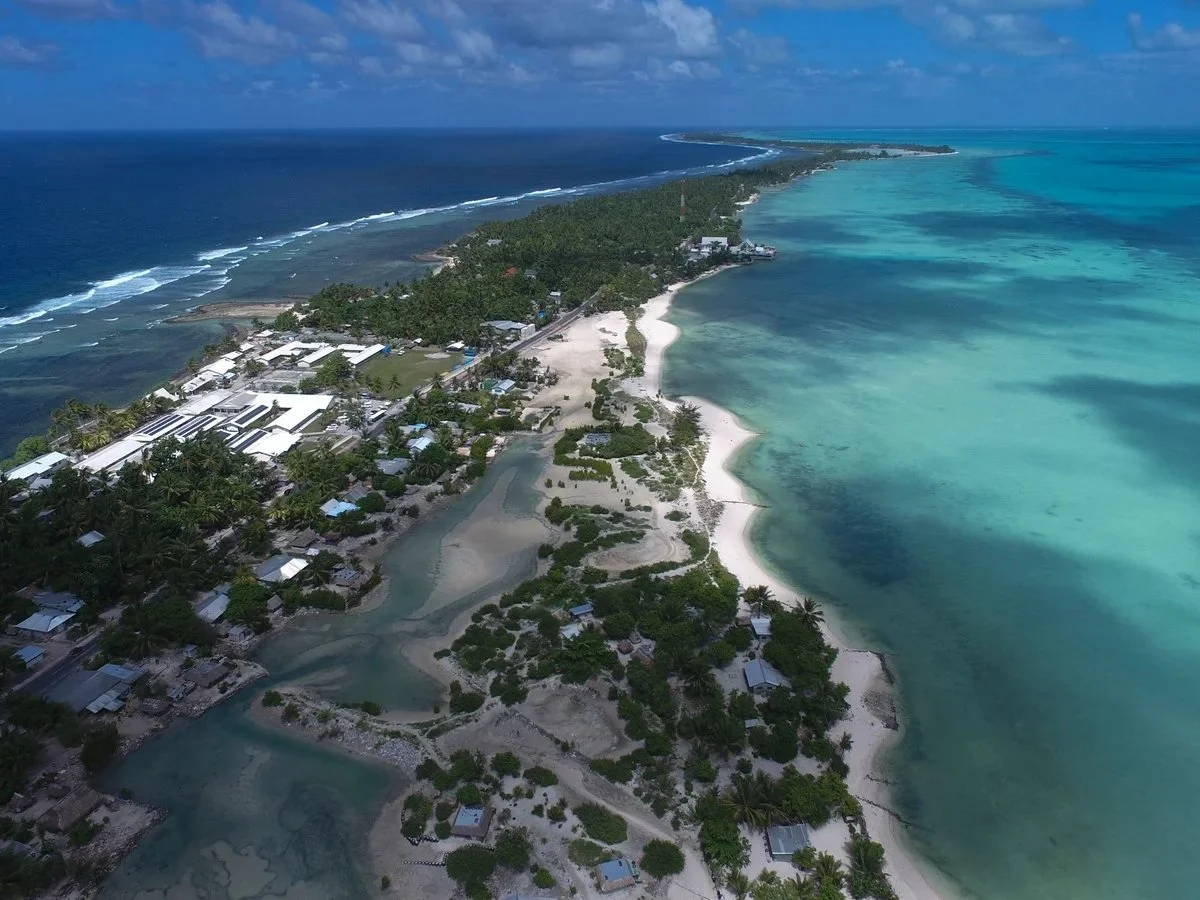
Kiribati is the largest atoll region in the world, spread across 33 atolls in the Central Pacific. Almost all of the land mass sits less than two meters above sea levels and the Pacific Ocean specifically has been increasing at a rate of 2 to 3 times the global average, therefore, the biggest issue is that Kiribati is predicted to be uninhabitable by 2050. Kiribati purchased land from Fiji in 2014, but that land is not a long term solution for migration.Their climate finance operation highlights this.
Climate Finance
Even though Kiribati has the smallest GDP in the Pacific, what distinguishes them from other climate vulnerable states is the government’s insistence on confronting it early and very publicly. With limited domestic resources and a small tax base, the government has deliberately positioned climate finance as essential to national survival. At the center of this effort is the KNCFS, launched in 2024 to strengthen the country’s capacity to access global funds and guide spending on adaptation priorities such as coastal protection, renewable energy, food security, and lower carbon. The strategy incorporates voices from the community working closely with local leaders.
It builds on institutional reforms, notably the establishment of a Climate Finance Division within the Ministry of Finance and Economic Development (MFED), which serves as the national focal point for engaging with major multilateral mechanisms such as the Green Climate Fund (GCF), Adaptation Fund, and Climate Investment Funds (CIF).
The division’s role is complex: it coordinates project proposals, works with regional partners, and ensures that Kiribati can meet the often demanding accreditation and compliance requirements of global funds.
Kiribati’s national climate policies also intentionally state financing as an imperative. The Climate Change Policy and Kiribati Joint Implementation Plan for Climate Change and Disaster Risk Management specifically mentions climate finance mobilization as a priority, directing ministries to strengthen institutional systems as well as budgeting processes to capture and manage funding. Beyond multilateral funds, bilateral and regional programs play a supporting role. For example, Pacific-focused initiatives like the Climate Finance Access Network embed regional expertise to help Kiribati and other island states design bankable projects and pipeline portfolios tailored to international investors.
These efforts have come into fruition as development partners such as the World Bank, Asian Development Bank, EU, and UNDP serve as accredited implementing entities for climate funds and support both project financing and technical assistance. In early 2025 the World Bank approved a multi-million dollar grant to improve climate-resilient infrastructure on Kiritimati Island. This deal highlights how climate finance ties to broader development goals of connectivity, economic activity and disaster readiness.
Crowded Landscape
Intensifying international competition in the Pacific is a major focal point for Kiribati's diplomatic decisions. Importantly, Kiribati’s shift to recognizing Beijing over Taiwan in 2019 has underscored how vulnerability can translate into geopolitical relevance. For the United States, islands in the Pacific have renewed strategic importance as they seek to counter China’s expanding diplomatic and economic footprint in the region. Climate change has become an accessible entry point for discussion in the region.
China, for instance, has paired infrastructure investment and development assistance with a growing diplomatic presence, positioning itself as a responsive partner to states facing immediate climate pressures.
The U.S., however, frames Pacific policy as climate resistance is both a development priority and a matter of regional stability, channeling support through multilateral institutions rather than bilateral guarantees.
The Future
Though the future of Kiribati's fight against climate change remains uncertain, their diplomacy has produced tangible results. Through important discussion at UN climate forums, they have pushed their agenda forwards: moving climate change loss and damage as a marginal grievance into an accepted pillar of global climate negotiations.
Domestically the country has pushed a new era of institutional strategy by planning to secure the best deals and funding for long-term efficacy. They are strategizing beyond the expectation of governing, and the results are institutional capacity to access climate finance, securing funding for coastal protection, water security, and renewable energy projects that extend habitability rather than concede defeat. Its long-standing emphasis on “migration with dignity” has also shifted international conversations, forcing policymakers to grapple with the legal and moral limits of existing migration regimes.
What Kiribati has achieved so far is not completion, but leverage. By refusing to frame climate change as an inevitable submergence, the government has preserved political agency in a system that often treats vulnerable states as passive victims. The next couple of decades will test whether the international community responds with structural commitments or symbolic support. Either way, Kiribati has still demonstrated that even in the face of existential threat, small states can still negotiate, influence, and shape the terms of their own survival.