
JULIEN DE ROSA
What began as small, community-oriented student protests in the town of Liège have expanded in recent weeks to a nationwide wave of protests against federal and regional budget austerity. It comes off the back of the Wallonia-Brussels Federation passing a €500 million budget consolidation plan that slashed education funding, but the grievances of the movement have expanded far beyond schooling budget cuts. Now, with major labor unions joining the student protestors, the movement has grown from fighting educational cuts meant to solve a regional deficit problem to broader resistance against budget consolidation both local and federal. The protests, which have grown to be tens of thousands strong, have brought the federal government’s budget deficit negotiations to a standstill, putting the ruling coalition at risk of collapse and the economy in a position to experience difficult increases in interest rates from international lenders.
In June, the regional body responsible for education in French-speaking Belgium, the Wallonia-Brussels Federation, passed an austerity program decree meant to address significant regional budget deficits by saving €500 million by 2029. To accomplish this, the education sector bore the brunt of the belt-tightening— the baseline cost of higher education tuition was raised by roughly 43%, climbing from €835 to €1,194 per year; public funding for free school meals was slashed by one-third, dropping its budget from €21 million down to €14 million; the €12 annual youth public transport pass for the TEC bus network was cancelled in its entirety starting in February 2027, significantly raising everyday student commuting costs; and government subsidies provided to schools for buying basic textbooks, learning technology, and classroom materials were heavily reduced. Along with this, a target was set to eliminate 1,300 full time teaching positions throughout the secondary school network, and the pathway for temporary and substitute teachers to transition into secure, permanent civil-service contracts was severely scaled back.
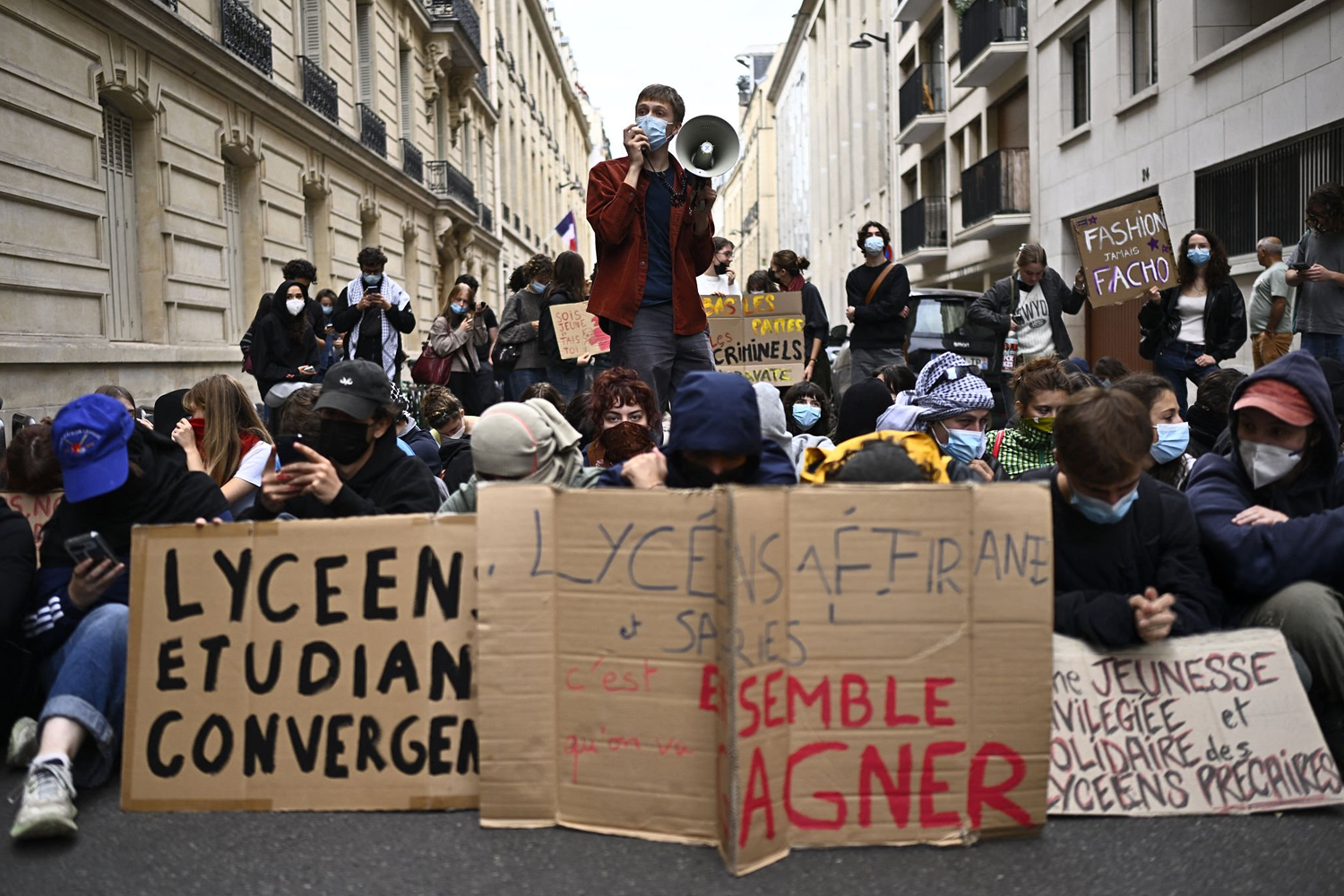
With the changes passed in the summer, the effects only began to be felt with the start of the new school year in September. By the first day of October, tensions boiled over in Liège as students walked out of class and began blockading around a dozen secondary schools. Within days, the protests had spread throughout the French-speaking region of Wallonia to major cities such as Charleroi, Mons and Verviers, as well as the capital, Brussels. By October 5, hundreds of students were protesting daily outside of schools, and by the 7, over 100 students had been arrested in Liège alone as protesters clashed with riot police, with scenes of smashed shop windows, tear gas, and water cannons dominating public news.
October 9 saw the movement take a turn as the student protestors organized with the major General Christian Trade Union (ACV/CSC) and General Labor Federation of Belgium (ABVV/FGTB) to stage a joint protest in Brussels, where as many as 30 to 50,000 people were involved. With a labor strike planned for the same day that would cripple public transit and protesters gathering around key transportation hubs like Brussels Central and South Stations, the city’s core was forced to essentially grind to a halt.
This protest marked a turning point for the movement, as it grew from a regional grievance focused on its education funding to a diverse national campaign against budget consolidation that negatively affects the social and labor systems.
The labor unions that joined the students of Wallonia were brought to the fight by a federal budget consolidation plan that has not been passed yet but is in stages of negotiation. The proposal would seek to decrease public spending and improve the federal deficit situation by targeting public services, labor protections and unemployment benefits, along with sick leave and healthcare.
In particular, the right-wing coalition driving the proposal wants to modify how the wage "index basket" is calculated or pause index adjustments that adjust wages based on inflation, which the unions view as a non-starter and a pillar of worker protections. The proposed cuts to public broadcasting, national rail transport, and civil services have also created concern among workers that these measures would ultimately lead to mass layoffs, worsening workplace conditions, and a lower quality of life for regular citizens dependent on these transit and state frameworks. The proposal’s desire to scale back healthcare reimbursement schemes, increase mandatory out-of-pocket co-payments for patients, and tighten rules on individuals out on long-term sick leave have also stoked fears that these new regulations would prey on low-income citizens who are most vulnerable.
Since October 9, the protests have continued and escalated, with universities also being blockaded and some protests turning violent, with police arresting 195 people involved in the demonstrations across Brussels and Liège over the weekend of October 17. Students at the Université libre de Bruxelles Solbosch Campus erected heavy physical barricades, hung massive banners, and blocked campus entrances, stating they would not dismantle the barricades until the Wallonia-Brussels Federation parliament reverses its June program decree on tuition hikes.
The high-profile protests have backed the ruling coalition and Prime Minister De Wever into a corner in regards to their budget consolidation negotiations. The center-left party that shares close ties with the labor unions has refused to agree to the proposed terms with their current targeting of labor protections and social systems, while the right liberal parties have refused to walk back some of the terms most controversial to the other side or add new wealth or capital taxes. As formal negotiations stalled, Prime Minister De Wever made a last-ditch attempt to gather the votes with one-on-one meetings with his coalition party leaders, but as of Thursday the 22, negotiations officially failed, with the socialist-leaning Flemish party Vooruit rejecting the latest budget proposals.
The government now sits on the brink of collapse, unable to agree and increasingly unlikely to push the budget out by its end of October deadline. Should the deadline not be met, it would force the country into an emergency mechanism called “provisional twelfths,” in which the government is restricted to spending exactly 1/12th of last year's budget each month just to keep the lights on, freezing economic momentum. It would also trigger international lenders to increase interest rates on the nation in response to what they would see as increased risk, which would immediately spike mortgage rates and dry up business loans.
As such, protests that began as a small, regional response to cuts to education funding have exploded into a nationwide movement against budget consolidation targeting labor protections and the social system, bringing immense political pressure on the government. With October heading into its final days, the country lingers on the brink of governmental failure and economic downturn, with all sides stuck in a stalemate of non-compromise.
