
Britain beyond Two Parties: Local Election Results
Gemni
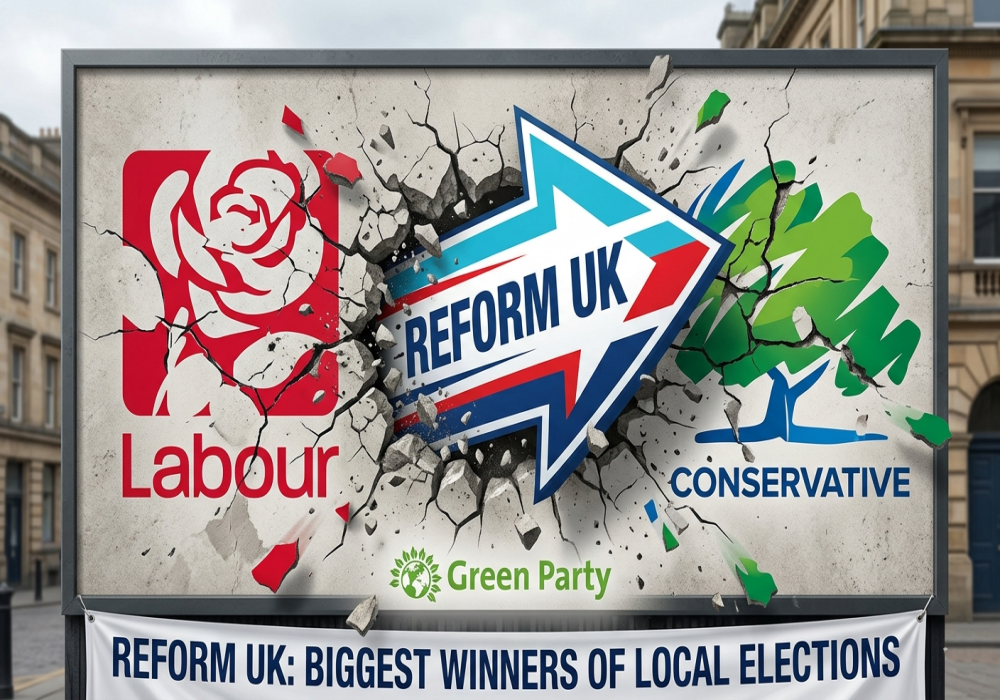
Local elections show that Britain is no longer dominated by its long-standing two party political structure. Following the results of the local elections, Labour lost suffered heavy losses whilst Reform UK and The Green Party gaining significant votes with Reform UK gaining 1,454 seats and The Green Party gaining 587 seats.
With the news of their surging voted seats, Reform UK and The Green Party have seemingly proved their relevance within Britain’s changing political sphere, and reflected the growing political frustration towards the Labour Party.
Councillor Change
Reform UK have made notable gains, including gaining Hackney as their first ever London council, taking over a coalition led by The Resident’s Association.
Rather than pointing a shift at one party in particular, these local elections provide an insight into the fragmentation of the political climate. The traditional Labour vs Conservative divide has been less favoured, showing a system of wider public dissatisfaction, rather than just an isolated surge of votes.
Seats Won In Local Elections
Reform UK’s Surge of Votes
Reform UK has gained significant control over Westminster, with their policies to tackle cultural identity politics and immigration concerns.
Reform UK has captured the attention of former Labour and Conservative voters, with 8.2 percent of former Labour voters switching to Reform UK. Reform UK has vowed to leave the European Convention on Human Rights (ECHR) in order to “restore full control over our borders” with Immigration being one of their key policies has captured the attention of former 2024 Labour voters with 62% of Reform UK (Former Labour) voters vowing that immigration is their top priority.
Whilst their surge of votes are seemingly sudden, it’s clear to see that their support reflects a distrust and dissatisfaction of the current Labour government.
Distrust of Government
The success of smaller parties outside of the two party framework cannot be acknowledged without discussing the loss of trust within Britain’s current government. Rather than favouring any of the individual parties, citizens are opting to side with a culture that appears not to tailor to the elites.
More In Common and UCL Policy Lab’s 2023 “The Respect Agenda” show crucial information that the general public’s trust in major parties has wavered. Research found that 72% of the general public thought that there is “one rule for those with wealth and status and another for everyone else.” This statement argues that scandals such as The Mandelson Scandal have fuelled a sense of distrust in mainstream politics and that it longer appeals to the public’s interest.
The Labour government and Keir Starmer in particular are seen to have gained significant distrust from not only the general public following the elections, but members of Parliament. This follows the health secretary, Wes Streeting’s resignation and his call for Starmer to resign.
The growing dissatisfaction in major parties has been detrimental to Labour and Conservative as combined support for the two main parties has collapsed from 73 per cent three years ago to just 42 per cent in 2026, suggesting voters are shying away from traditional political institutions and opting for other parties instead.
The Green Party’s Success
Reform UK is not the only party to have benefitted from voters shying away from the traditional two parties. The Green Party has also made significant gains, gaining 587 seats and securing several councils such as Lewisham, Hastings, Norwich and Waltham Forest. The party have historically ended Labour’s 24-year control of Hackney’s council, and gained their first ever directly elected mayor, marking a significant breakthrough for the party.
Unlike Reform UK, whose support echoes concerns about immigration and national security, the Green Party’s growth is rooted in their policies improving climate change and social equality being at the epicentre of their campaign. Increasingly, the Green Party is gaining traction among younger voters with their membership of the Young Greens (under 29-year-olds and students) surpassing 50,000, making them one of the largest youth political movements in Europe.
The Green Party’s success also reflects the growing distrust of Labour and offers for a more leftist alternative for voters seeking more environment focused policies. Green party leader, Zack Polanski echoed similar sentiments of The Respect Agenda, stating that the two-party politics was "dead and buried", and stated that the "new politics is Green Party versus Reform." Though both parties, Reform UK and Green Party appear as polar political opposites, both parties benefit from the declining faith in the political centre.
Division or Well Represented
The growing diverse political landscape of Britain presents both opportunities and possible division for citizens. With voters opting for other parties other than Conservative and Labour, it allows voters to feel more accurately represented within society and policies than they would with the traditional two parties. However, due to the polarizing policies of the parties, concerns of political fragmentation and instability have been raised. Due to the specific policies of each party, citizens might not settle for more broad policies surrounding climate change and national security. Rather than uniting citizens on shared sentiments, Britain risks polarizing citizens’ individual concerns.
The local elections have been a testament to the diverse political landscape that Britain has transformed into. With a more diverse set of political voices, Britain challenges the stability of the two party system it once relied on. Whether this political shift strengthens Britain’s democracy or deepens division will depend on how effectively Britain’s political institutions adapt to an electorate that is increasingly diverse in its views, priorities and expectations.