
European Central: Why NATO Partner Georgia Missed the Ankara Summit?
MUSTAFA OZER
Georgia, once one of NATO’s closest partners aspiring to membership in the Alliance, was not invited to this year’s summit in Ankara, for the second consecutive year. It is merely a surprise, given the Georgian Dream party’s consistent strategy of positioning Tbilisi at the center between Russia and the West. Despite Russia's aggression in Ukraine and protests among the Georgian public, the government does/t seem to be on a reverse.
Georgia's Path Towards NATO
Since gaining independence from the Soviet Union in 1991, Georgia has been on a steady path toward the West with its domestic and foreign politics. In 1994, the country joined the NATO so-called Partnership for Peace, and its troops have since been involved in some of the Alliance’s most high-profile operations, notably in Kosovo and Afghanistan. Following the 2003 Rose Revolution, when thousands of protesters stormed the parliament in Tbilisi, holding red roses and demanding the resignation of the then government that took part in an election that the international community recognized as rigged and falsified, successive governments have sought even greater integration with the West, including with NATO, while trying to reduce its dependence on Russia.
At the NATO Bucharest Summit in April 2008, Georgia received confirmation from the Alliance that an eventual membership was on the table. Moscow saw this as a step too far, at a time when relations between the two countries had already been tense with disputes about who should have governed the Abkhazia and South Ossetia regions. While the Kremlin’s Vladimir Putin sided with Russian separatists who took control over the two territories after the fall of the Soviet Union, Georgia’s President Mikheil Saakashvili claimed the regions belong to his country, no less because the two combined compose 20% of Georgia’s territory.
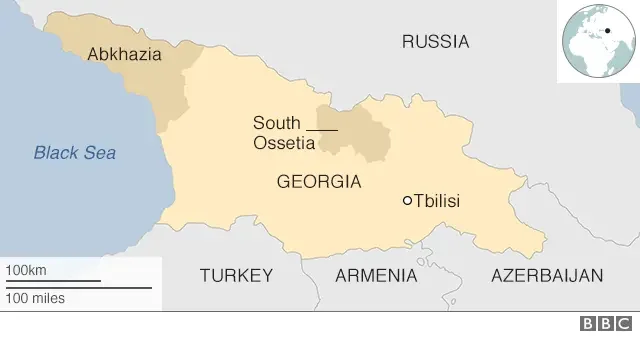
In August 2008, only a couple of months after Tbilisi’s success at the NATO Summit, the disputes escalated into what’s known as a 5-Day Russo-Georgian War, when the separatists in South Ossetia began shelling Georgian villages. Saakashvili ordered a military response with attacks on Russian troops that, in the meantime, entered South Ossetia, and fighting also quickly spilled over into Abkhazia. Despite Tbilisi’s initial advantage, the Russians began advancing into Georgia proper, at which point the two sides agreed to a ceasefire after five days. Shortly after, Russia declared Abkhazia and South Ossetia as independent states, although with little international support. Today, only a few Moscow allies agreed to the recognition, while international organizations demand that Russia reverse it, also citing gross human rights violations against ethnic Georgians living in the two territories. At the same time, there has been no decisive action from the NATO allies to Russia's actions, other than condemnation.
Domestic Politics at the Heart of Balancing with Russia
In hindsight, it looks like the Bucharest Summit marked a peak of NATO-Georgia relations. While some would have expected Georgians to turn even more westward following the short war and Russian attacks, almost the opposite happened. In the 2012 parliamentary election, a new Georgian Dream party, founded and led by billionaire Bidzina Ivanishvili, secured victory and started its now more than 14-year-long mandate in power. The party united several of smaller parties broadly westward oriented, but it quickly became obvious that the new government had, at the same time, a more Moscow-friendly agenda.
Just days into his mandate as the Prime Minister, Ivanishvili established a new position of Special Representative for Relations with Russia, whose task was to restore relations with Moscow. Announcing the appointment, he said: “Our government should manage to mend relations with our biggest neighbor. Our two countries have a long history of relations; we have lived together for a long time – before, during and after the Soviet Union. We should manage to at first mend and then to elevate bilateral relations to a new level.”
One of the first signs of improvement in relations came within a year with the lifting of a trade embargo introduced by Russia in 2006 on Georgian agricultural products, which are a key element of its exports. Early in 2023, Russia also restored direct flights between Tbilisi and Moscow, reversing a 2019 ban, and the countries also agreed on visa-free movement.
While repairing Tbilisi-Russia ties on the security front has not been as successful at first sight, Ivanishvilli’s position on the situation in Abkhazia and South Ossetia aligned with the previous government; Georgia’s closer integration with NATO also largely stalled.
Particularly in the years following the Russian full-scale invasion of Ukraine, Georgia was cautious in its criticism of the Kremlin. Unlike in 2014, when Putin ordered the annexation of Crimea and the Georgian government denounced it as a “land grab”, the 2022 attack by Russia met with a significantly less defiant response from the Dream party.
Since then, the Dream party officials have refrained from condemning Russian actions in Ukraine — In the immediate aftermath of the invasion, then-Prime Minister Irakli Garibashvili, a close ally of Ivanishvili, reportedly said that “the war is in Ukraine, and we have our own business”. The country has also repeatedly refused to join Western countries in adopting sanctions against Moscow and questioned their logic.
The International and Public Opposition
The government strategy has met with opposition both internationally and domestically. In December 2024, the US sanctioned Ivanishvili for ‘undermining the democratic and Euro-Atlantic future of Georgia for the benefit of the Russian Federation’. Within months, the European Union introduced resolutions condemning Georgia's stance on the war, while the United Kingdom later sanctioned a number of his associates within the Dream party.
Ukraine itself has also released its sanctions on Ivanishvili and 19 of his allies, who, President Vladimir Zelensky said, are “handing their country over to Putin”.
Meanwhile in Tbilisi and across Georgia, anti-government protests have been taking place every day for almost two years. Besides opposing the Dream party’s stance on the war in Ukraine, the protesters were outraged by the government’s decision to suspend accession talks with the EU in 2024 and continue to demand an end to the party’s rule after almost 14 years in power.
The latest absence of the government officials was also criticized domestically for trying to drag Georgia into political isolation on the global stage.
Foreign Minister Maka Bochorishvili instead attended a separate event in Turkey called “Allies in Ankara”. She said that this event, rather than the NATO Summit, was “an important opportunity for Georgia to present the country’s positions and regional role to partners.”
In turn, Georgian President Mikheil Kavelashvili travelled to Tehran on the occasion of the funeral of the late Ayatollah Ali Khamenei at a time of the Summit.
