
Third Way: The Case for Closing Guantanamo Bay Base
Win McNamee
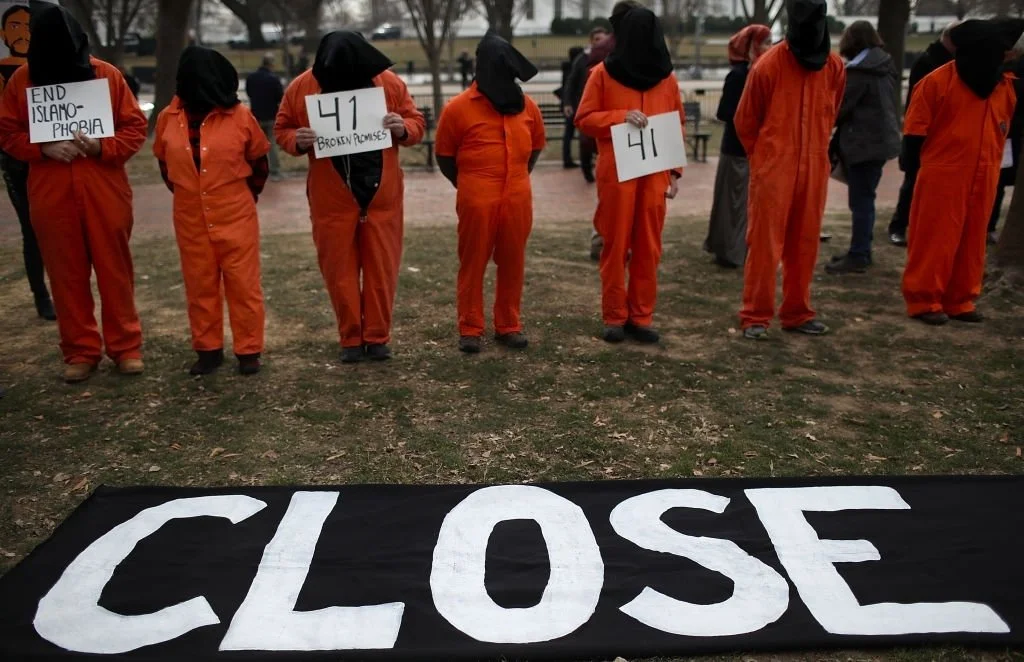
Abutting the Cuban shore just a mere 90 miles South of Florida lies a 45-square-mile military installation which, in its formation and its recent history, consistently causes controversy. First created in the aftermath of the Spanish-American War, it became a symbolic thorn-in-the-side following the revolution, a makeshift refugee shelter in the 1990s, until settling into its current state as a prison for detainees alleged to either have participated in terrorism or simply abetted in acts of terrorism. Currently, the prison still maintains 41 detainees, but with the largess of the War on Terrorism wanning and well-documented accounts of flagrant abuse of human rights, why is a military base—one just off the coast of the U.S.—still in use?
Background
Established in the wake of the Cuban War for Independence and the Spanish-American War at the dawn of the 20th century, the Guantanamo Bay (GB) military base is a long-held flashpoint in Cuban-American relations. The base is unpopular amongst the Cuban government and the Cuban people, and is a perpetual obstacle in the normalizing of relations between the U.S. and Cuba, an obstacle the Biden administration will no doubt face if it wishes to continue the Obama administration’s process of reestablishing ties.
With the onset of the War on Terror, the Bush administration was in need of a location to question and hold suspected terrorists that could safely and outside of legal boundaries maintain detainees. The solution quickly became GB due to its proximity and ability to be rapidly converted to a makeshift prison; however, the rush created a myriad of problems that plagued the early years of the base's use and continue today to some extent.
Issues such as military-control of detained individuals in a prison-like setting despite the soldiers at GB possessing no knowledge of how to manage a prison set the GB detainee experience up for failure as soon as the first detainees walked off C-17 planes.
Current State and Issues with GB closing
Currently underway, there is a sentencing hearing of an accused Al Qaeda courier, Majid Khan, for his participation with the terror group. Coincidentally, Khan was radicalized partially from an Al Qaeda propaganda film that heavily featured GB's treatment of prisoners as a call to arms. Khan is currently awaiting sentencing for his participation after 18 years toiling in a legal loophole.
The pace and measures to give some semblance of justice have increased, with the U.S. providing military commissions—in which Khan is currently in the process. However, as the ACLU notes, this does not provide for a fair and just trial as a civilian and military trial are fundamentally different in guarantees of rights and due process. Despite the federal judicial system's capability and experience in terrorism prosecution, this avenue is not taken. Further complicating the situation, the current political climate post-9/11—which the Obama administration quickly discovered—makes the transfer of GB detainees to the U.S. for trial fraught with challenges.
From hostility from congressional Republicans and trepidation from congressional Democrats, to understandable emotional reactions from the general populace and misunderstanding of the often lack of evidence of detainees’ guilt, the situation still appears to be untenable.
Argument
Despite the promise candidate Obama made on the campaign trail over a decade ago, the base remains open and houses 41 detainees—with no plan to eliminate the base’s prison altogether. With the Obama Administration unable to entirely vacate the GB base of detainees, it shifted to a slow piecemeal depletion of the facility. Granted, it did emancipate the majority of GB; however, it proved unable to fulfill the campaign promise of closing the facility.
As aforementioned, the base is unquestionably known for its torture program administered by the CIA; however, the very use of the facility is cause enough for greater calls for its closure. As aforementioned, GB was acquired post-Spanish-American War on a lease, that wherein the U.S. pays $2,000 yearly for the land-use—payment the Cuba foregoes accepting. Furthermore, morality concerning torture aside—which can be its own article—GB and its lack of judicial oversights and guarantees violates the human and legal rights of each detainee interned on the base.
As outlined within the Geneva Convention, the imprisonment of individuals under the purview of war requires humane treatment and timely release. Even by the U.S.’s expanded definition of “enemy combatant” the conditions, treatment, and lack of legal guarantees categorically breach international conventions and norms established to protect individuals. Under international law, those enemy combatants are categorized as prisoners of war, therefore entitled to all protections afforded under the Convention that the U.S. signed in 1949 and calls for other countries to uphold when the shoe is on the other foot.
Furthermore, in relation to domestic law, the indefinite internment of individuals suspected of involvement in terrorism may not violate the contorted legal framework of treatment of enemy combatants outlined in DOJ legal opinions; however, it certainly is in contravention of the spirit of the law, and protections under the Constitution. Legal protections under the 4th, 5th, 6th, 7th, and 8th Amendments in relation to due process protection are flouted chiefly due to GB existing as a physical manifestation of a legal loophole.
When taken together, these international and domestic legal breaches are sufficient to leave no room for the U.S. to maintain the prison in GB. However, beyond legal critiques of the prison's existence, the moral implications of the prison remaining open are far more devastating.
The War on Terror, the Iraq War, and the Afghanistan War produced many outgrowths that undermine the U.S. foundational principles. While it is impossible to determine the most troubling outgrowth, the continued human pain caused by detaining individuals at GB without a plan to efficiently repatriate detainees. Coupled with the fact that many of those remaining 41 detainees are actually cleared to be released by national security agencies, the continued internment of detainees is wholly unethical, illegal, and immoral.
Conclusion
The detaining of individuals in the wake of 9/11 was a mistake: a poorly planned, ill-conceived, hastily prepared, and even worse executed mistake. The decision to preemptively and indefinitely intern individuals connected to or possessing knowledge of terrorist threats to the United States has many fathers; yet the blame falls on the U.S. as a whole with the continued inaction and lack of urgency to release detainees that the U.S. justice system cannot prosecute.
If the U.S. is to continue to root out terrorism and wage an unconventional war with an amorphous enemy, it still needs to abide by basic human decency, our own legal system, and ensure that human rights are protected. Treating the enemy with respect and protecting their fundamental rights does not make one weaker but instead underwrites the values the U.S. proclaims.
