
Checkpoint: Where'd All These Socialists Come From?
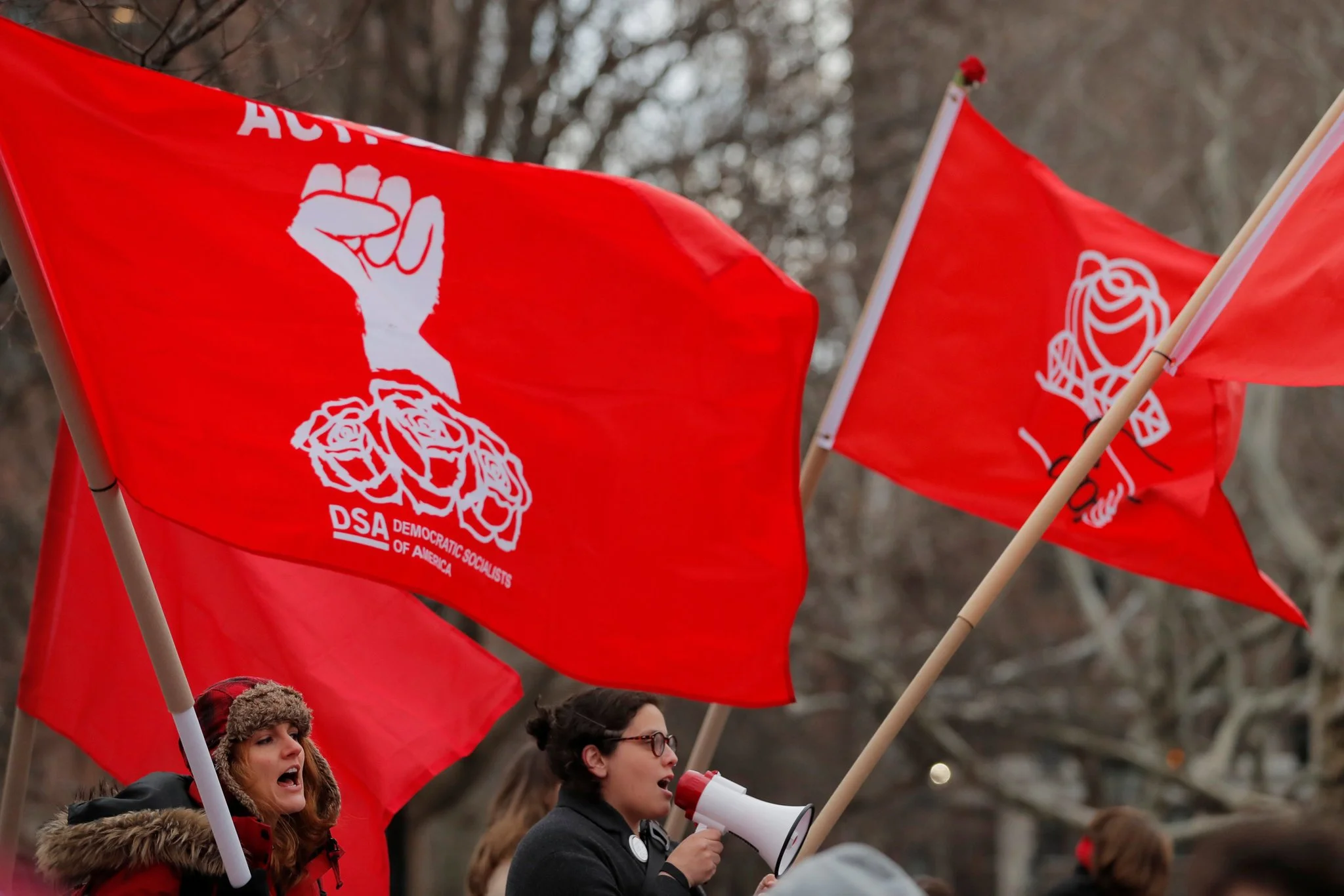
Lucas Jackson/Reuters
“The Democrat Party has never been more outside of the mainstream. They're becoming the party of socialism, late-term abortion, open borders, and crime.” That’s what President Donald Trump told his supporters at a campaign rally in El Paso, Texas, on February 11, 2019. His statement leverages the accusation that democratic socialism, a political ideology that sustained a rapid rise in popularity in the post-Trump Administration United States, is something new, radical, and dangerous.
Senator Bernie Sanders has been pushing for democratic socialist policies for decades, but until his 2016 presidential run, he and his agenda were considered fairly fringe and only a viable policy to run on in the safely blue state of Vermont. In 2018 and 2020, however, representatives Ilhan Omar, Rashida Tlaib, and Cori Bush successfully ran in red and purple states on policies characteristic of democratic socialism, proposing social reform and state intervention to protect workers from predatory corporations, and pushing for universal healthcare, higher taxes on the wealthy, and climate change legislation. The democratic socialist cohort in American politics has grown in membership since 2018, and so has the popularity of their policies. Zohran Mamdani’s 2025 arrival on the progressive political scene brought renewed optimism to an already-growing democratic socialist milieu.
The prominent progressive politicians of the last decade provide stark contrast to their conservative counterparts. Some of these left-wing actors are card-carrying members of the Democratic Socialists of America (DSA), others are self-titled democratic socialists, while others operate under the “progressive” moniker while still forwarding democratic socialist policies. The rapid ascent of the new clique of democratic socialists has provoked the narrative reflected in President Trump’s statement above, that democratic socialist policies are novel and radical, untested and reactionary. This portrait, however, ignores the long history of the philosophy of democratic socialism and its advent to American politics over a hundred years ago. It deliberately undermines the longstanding domestic tradition of democratic socialism by characterizing it as a foreign fad with temporary staying power and a close kinship with the fragile communist regimes of the past.
Untangling the association between democratic socialism and communism requires some historical overview. The philosophy of democratic socialism arose among 19th-century communists who disagreed with Karl Marx’s revolutionary, and sometimes violent rhetoric. Marxism requires a complete overhaul of capitalist structures to abolish systems of class and property ownership. Eduard Bernstein, a German theorist and politician, conceived of a more flexible ideology that allows for reform within capitalism. He theorized that communist principles like state intervention to reduce inequality could work alongside the already-existing system. Bernstein advocated for evolutionary socialism rather than revolutionary communism, with socialist policies being gradually enacted via incremental legislative changes brought about by democratically-elected officials. Bernstein’s evolutionary socialism was conceived to coexist with democratic institutions. Both communism and democratic socialism strive to eliminate class inequality, but the means are different.
After its European foundation, democratic socialism arrived in the United States and thrived among growing labor unions and under the umbrella of the Socialist Party of America. Democratic socialism continued to advance in the United States through the 1930s when President Franklin D. Roosevelt packaged democratic socialist policies into his New Deal to rescue the collapsing capitalist framework from the Great Depression. Practical socialist policies with applications centered around uplifting the economically disadvantaged brought favor and credibility to the movement.
American anti-communist sentiments reached their peak during the Red Scare, though the United States has a history of fearing and hating communism that extends as far back as the ideology has existed. On a theoretical level, communism is necessarily at odds with capitalism; communism’s success means capitalism’s failure. This is one reason for the prevalence of anti-communist sentiment in the United States. The more salient reason, however, is that the United States’ greatest adversaries of the last century have been nations adhering, or claiming to adhere to communism— Maoist China, the USSR, North Vietnam, North Korea, Castro’s Cuba. This long history of American opposition to communism has created a populace primed to reject figures associated with it.
Near the end of the 2025 New York City Mayoral race, President Trump urged Republicans in New York City to vote not for Republican candidate Curtis Sliwa, but for former New York Governor Andrew Cuomo who was running as an independent after losing to Zohran Mamdani in the Democratic primary. At the time, Sliwa was polling in the teens while Cuomo and Mamdani were within ten points of one another, so if anyone could Mamdani, it was Cuomo. Trump cited questionable concerns that if “Communist Candidate Zohran Mamdani” became mayor, it would mean “Complete and Total Economic and Social Disaster” for the city. Trump wanted Republicans to cross party lines and vote for a candidate opposed to the Republican platform, all to prevent a democratic socialist from entering office. Since Mamdani’s election, the predicted communist disaster has manifested as the launch of a free childcare program, securing over $2 million in restitution for fast food workers whose employers violated city labor laws, and streamlining the process to build affordable housing on city-owned land. Democratic socialist policies implemented in New York City thus far have sought to protect workers and reduce class inequality through collaboration, shifting budgetary priorities, and policy reform, not through communist revolution.
Raising alarm bells and false flags about the dangers of creeping communism has become a habitual rhetorical device for conservative and moderate politicians alike. On November 21, 2025, shortly after Mayor Mandani’s election, the U.S. House of Representatives passed a resolution “Denouncing the horrors of socialism” with a 285-98 vote. This resolution garnered bipartisan support with 199 Republicans and 86 Democrats voting in favor. The beginning of the resolution reads “Whereas socialist ideology necessitates a concentration of power that has, time and time again, collapsed into communist regimes, totalitarian rule, and brutal dictatorships.” Representative María Salazar, who introduced the resolution, and all those who joined her in voting for it, deceptively conflate democratic socialism with communism to present universally-beneficial and often popular reforms like socialized healthcare, free public education, and strengthened labor unions as the first stop on the slippery slope toward a communist totalitarian state. Political adversaries of democratic socialists can avoid intellectual debate simply by labeling reformists as radical communists. The accusation of communism incites fear and skepticism and discredits its antecedent. It shuts down an argument before it starts.
Democratic socialism is a return to worker-focused policies like those of the New Deal in the face of an economic downturn, rather than being a dangerous fad as some conservatives and moderates claim. Over the last decade, the progressive tent has grown to include leftmost DSA members like Representative Rashida Tlaib, to social populists like Senate Candidate Graham Platner and Mayor Zohran Mandani, to more mainstream progressive voices like Representatives Greg Casar and Pramila Jayapal, all of whom have been supported by grassroots movements and small individual donations, all of whom ran on hallmark democratic socialist policies. They do not bring a top-down communist revolution or harken a total overhaul of our capitalist structure. The new slate of democratic socialist candidates are putting fresh faces on a century-old movement that has always sought to reform an exploitative system.
