
Checkpoint: The Pope Vs. The President
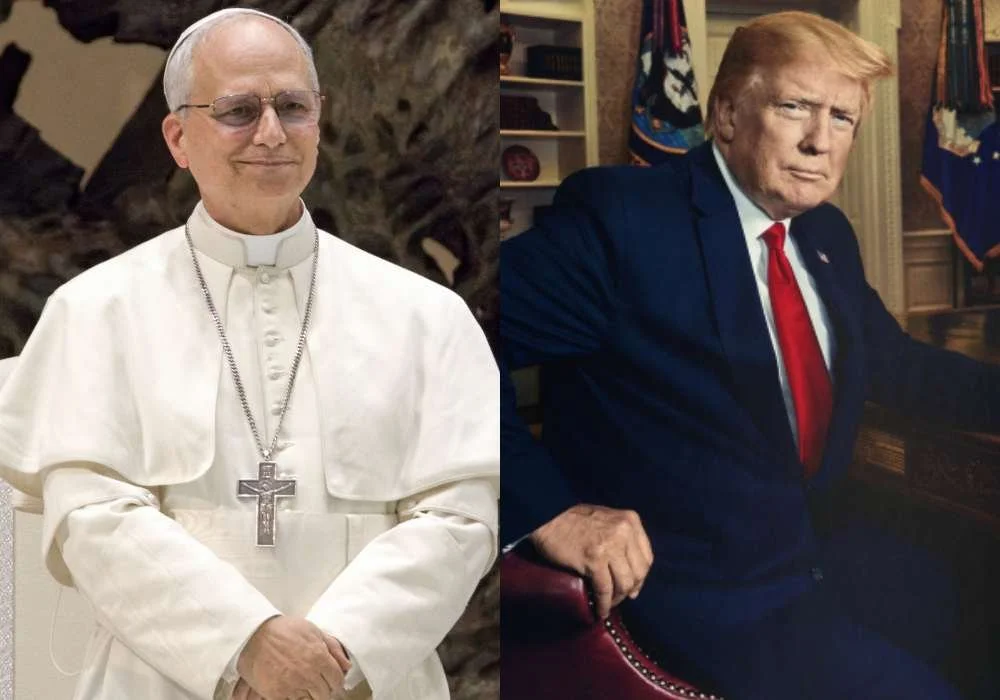
The two most prominent Catholics in the world right now, Pope Leo XIV and Vice President J.D. Vance, have found themselves at odds over the Trump Administration's recent attacks on Iran. When asked about Pope Leo’s high profile critiques of the conflict, Vance said that “It would be best for the Vatican to stick to matters of morality…and let the President of the United States stick to dictating American public policy.” Vance’s statement is representative of the compartmentalization common among Catholics, to whom faith is a personal moral compass, held apart from a secular approach to politics. By criticizing the Trump Administration’s approaches to issues of domestic and foreign affairs, from immigration enforcement to the war in Iran, the Pope is attempting to bridge a longstanding gap in the Catholic Church between issues of faith and politics.
The American political machine has long been dominated by Protestants skeptical of allowing Catholics into power due to their supposed allegiance to the Vatican. This skepticism came to a head during the 1960 presidential election, when then-Democratic nominee John F. Kennedy made multiple public speeches affirming his commitment to the separation of church and state. He promised to keep his religion out of government affairs.
“I am not the Catholic candidate for President. I am the Democratic Party's candidate for President who happens also to be a Catholic. I do not speak for my church on public matters--and the church does not speak for me.” - JFK to the Greater Houston Ministerial Association, September 12, 1960
During his presidential run, JFK was forced to broadcast to Americans his intention to compartmentalize his faith and politics. While separation of church and state is part of the bedrock of American politics, and reassurance that JFK would not act as a mouthpiece for the Vatican was a necessary promise to assuage voters’ fears, keeping politics and adherence to Catholicism completely separate is not possible without cognitive dissonance. It is one thing to promise not to take direct orders from the Church; it is another to divorce an expansive system of morals and beliefs from political decisions that directly impact people’s lives.
The Catholic compartmentalization that JFK exemplified continued well into the 2010s, when the Catholic Church’s primary issues were those of “pelvic politics,”i.e. access to abortion and contraception, and same-sex marriage. For many conservative Catholics, it was easy to feel adherent to Church teaching by falling in line on those issues, because they required no significant work or change. Opposing abortion or same-sex marriage is easy. It requires inaction— not getting an abortion, not marrying someone of your same gender. When "pelvic politics” were at the forefront, conservative Catholics got to pat themselves on the back for voting and acting the way they would have anyway. By prioritizing deeply personal and controversial issues, the Church allowed Catholics to feel pious and in line with Church teachings on social issues without making structural changes in their lives or combining principles of faith with political and economic thought. Catholics should oppose the social system built on the oppression of poor and marginalized groups and exploitation of labor. Exploitation and oppression are equally antithetical to Church doctrine as the issues of “pelvic politics,” if not moreso, considering that Jesus never mentioned abortion or same-sex marriage, while he talked about “loving thy neighbor” quite a bit.
Pope Leo XIV was elected by the College of Cardinals less than a year ago, but his papacy has already begun to shake things up in the Catholic Church. Pope Leo is both the first American pope and the first pope from the Order of Saint Augustine, both of which situate him uniquely to weigh in on American politics. The United States has never had a homegrown pope before, and Leo’s 2025 election by the conclave was an incredibly exciting moment for American Catholics. Pope Leo has outsized influence here, and, being from Chicago, he has an understanding of American politics and institutions that no previous pope would have had. The Order of Saint Augustine, who follow Saint Augustine of Hippo, prioritize prayer, community, asceticism, and service. In line with the principles of his Augustinian order, and with those of his Jesuit predecessor Pope Francis, Pope Leo has, thus far in his pontificate, forefronted issues of climate justice, international migration, economic justice, and peacemaking. As leader of the Catholic Church, Pope Leo is increasingly loudly advocating against structural injustice and inequality, making it more difficult for American Catholics, identified by pollsters and pundits as a bipartisan voting bloc, to keep issues of policy and faith compartmentalized.
From JFK in the 1960s through the “pelvic politics”of the 2010s, the Catholic Church, intentionally or unintentionally, encouraged compartmentalization. Pope Leo, expanding on the precedent set by Pope Francis, however, is breaking that mold. He, by engaging directly with American politicians and by seeking an end to war, violent immigration policies, and exploitative labor practices, is forcing the integration of faith and politics. What Pope Leo is asking for requires action and structural change, not occasional votes for an anti-abortion politician. Since the United States began a bombing and assassination campaign in Iran on February 28, 2026, Pope Leo has been an outspoken critic of war, violence, and the moneyed interests spurring them.
On March 1 he expressed great concern for the victims of the attacks on Iran and implored world leaders to pursue peace through dialogue rather than violence.
During a press conference on March 20 regarding the conflict in Iran, Secretary of Defense Pete Hegseth entreated the American people to pray for the service members deployed there.
Seemingly in response, during his Palm Sunday homily on March 29 the Pope stated that “Jesus does not listen to prayers of those who wage war.”
Later, on April 21, 2026 the Pope issued a series of tweets insinuating that the United States’ motivation for attacking Iran was control of global oil markets. He remarked that our greatest priorities ought to be “the safeguarding of creation, the rights of local communities, the dignity of labor, and the protection of public health,” but that the exploitation of resources in the Global South had caused the proliferation of violent conflicts we see today.
Pope Leo encourages Catholics to think of his opposition to the war in Iran and the motivations for it not as a political disagreement among world leaders but as an instance of the moral failure of the American government. The war in Iran was the catalyst for the public disagreement between President Trump and Pope Leo, but the true debate is for morality and peace over greed and violence. By taking on the Trump Administration in such a public fashion, Pope Leo is forcing Catholics accustomed to keeping their faith and politics separate to reckon with the notion that, to follow Catholicism ardently and honestly, the two are inextricably linked. Pope Leo calls for Catholics to practice integralism, the philosophy that faith should influence all aspects of life. He dares Catholics to abandon the compartmentalization and individualism promoted by capitalism and conservative American politics, and to embrace their faith as something powerful and dynamic that demands sacrifice, compassion, and action.
