
Third Way: Disney World, Happiest Place On Earth Or Capitalist Scheme?
Ludovic Delot
The whimsy of a child’s imagination knows no bounds. No bounds beyond those of their parents’ wallets, that is. The commodification of a child's imagination is troubling at best, dystopian at worst; yet, this is exactly what amusement parks such as Disneyland began doing in the mid to late 20th century. The culprit behind this shift? Capitalism
The pall of capitalism has hung over the world for centuries like an economic sword of Damoclease; and in the last century it has adopted a new lease on life. The capitalistic values of America and its economic culture are difficult to ignore; they seep into every corner of the American people’s lives. Like an infectious mold, it grows, watered by corporate greed and the egos of power-hungry professionals.
The philosophy behind capitalism stems from a collection of principles. Among them are laissez-faire politics, neoliberalism, and classic liberalism. The OG’s of the capitalist nature are the aforementioned laissez-faire politics and classic liberalism. Advocated for heavily by philosopher Adam Smith in the 18th century, these concepts sport two distinct ideas. Both ideas flirted with the ideology of varying levels of government intervention, though both argued for minimal at most.
These principles paved the way for what is widely considered the modern ideological standpoint of today’s capitalism: Neoliberalism. Neoliberalism, the literal translation of which is “new liberalism", at face value agrees with the concepts of free market trade championed by Smith. However, where the division occurs is in the interpretation of government regulation and intervention in private enterprise. Neoliberalism is defined as “ an economic and political theory that… [advocates] for free-market capitalism with minimal government intervention. It emphasizes the importance of private sector control over the economy, suggesting that government should primarily focus on reducing barriers to market entry rather than actively managing economic or social welfare,” according to Elton B. Stephens Company (EBSCO).
These principles can be overwhelming as a broad approach without a practical application. A modern and tangible example is that of the Walt Disney company and its amusement parks in particular.
Disney is a conglomerate that feels as though it has been around forever. In actuality, the identity of the Disney company was officially launched on October 16th, 1923, at the contract decision to distribute Walt Disney’s Alice Comedies. Then on November 18th, 1928, after years of trial and error and trademark lessons learned, the cartoon Steamboat Willie was released theatrically. Steamboat Willie featured the now beloved and iconic Disney character, Mickey Mouse.
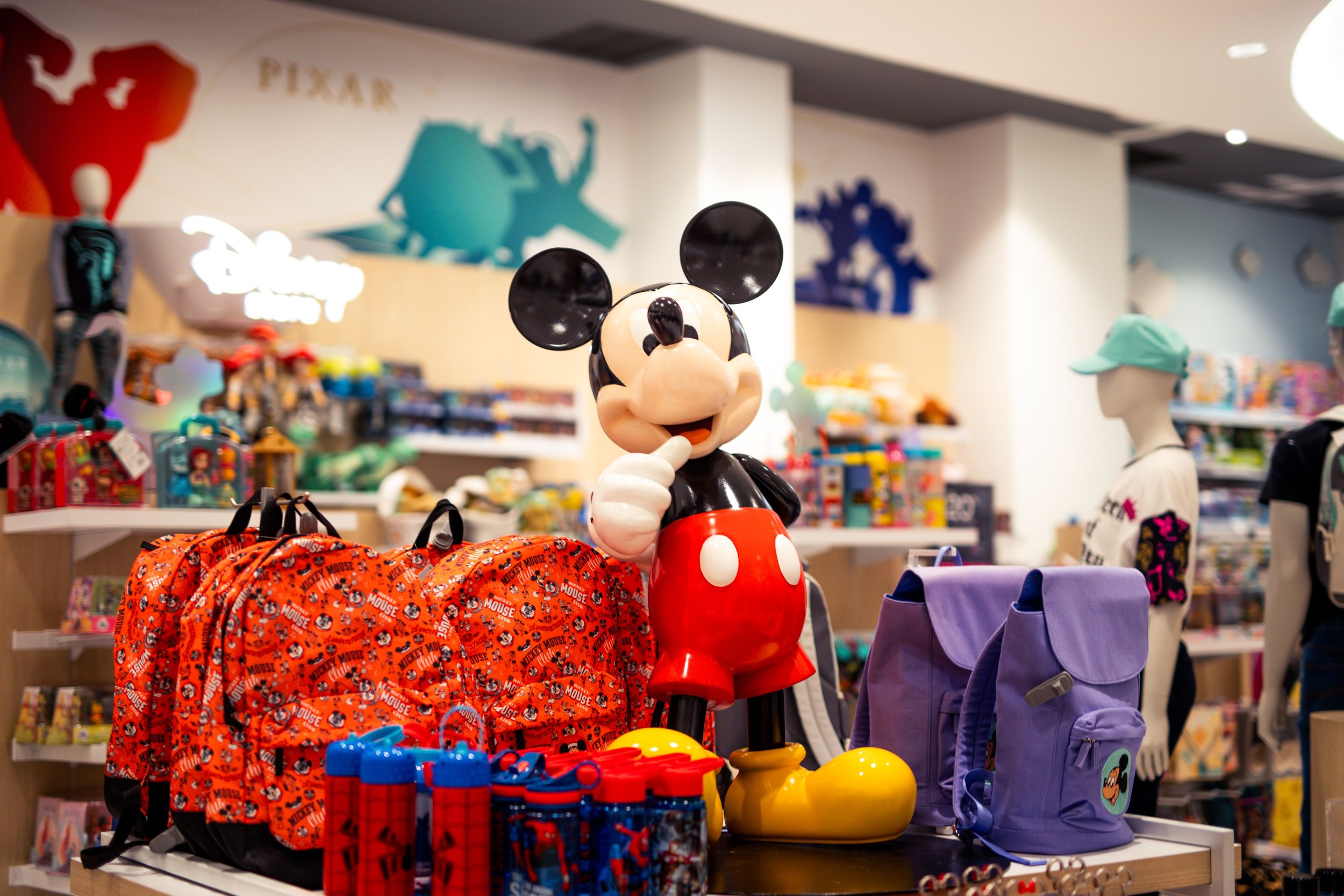
After the release of the film, the fame of Mickey Mouse skyrocketed, and Walt Disney was approached to merchandise his cartoon. In 1930, following Walt’s decision to agree to this merchandising contract, Mickey Mouse began appearing on pencils, across cartoon strips, and in books.
Moving forward roughly 25 years to July 17th of 1955, the golden gates of the first Disneyland park opened in Anaheim, California. The wonder of these parks lies not only in the magic of its heavily immersive experience, but in the expert job done to hide its seedy underbelly. The “man behind the curtain,” as it were, of Disneyland, was its perpetuation of overconsumption and, as the late Alan Bryman, a former professor of Organisational and Social research at the University of Leicester, put it, the “shopification” or “hybrid consumption” of the park.
By merchandising their characters, Disney unlocked a new method of not only turning a profit, but of reaching out to the public in an incredibly enticing way.
The creation of Main Street USA is a prime example of this. Main Street USA, located in the original Disneyland park in Anaheim, California, is a stretch of the park that features no classic attractions, but rather, shopping as an attraction. The shops that line the street feature wands, hats, shirts, stuffed animals, character-specific memorabilia, and more. The existence of this street is intended to make guests feel as though for them to truly have the full “Disney experience,” they need to immerse themselves through this “shopification”.
By instilling this belief that one's emotional satisfaction at the park relies on their purchasing of material goods, Disney has effectively thrown itself at the mercy of the commodification of emotions; and the emotions of children, no less.
None of this is to say that Disneyland or Disney World or Disney as an entity are these evil beings with the malicious intent to empty wallets and pull at your pocketbooks. However, the capitalistic nature of the conglomerate that is Disney cannot be overlooked. Particularly in that it paints a larger image of the demise of innocence even in the places one may expect it the least. When a company built on imagination sells itself out time and time again for the sake of corporate greed, that imagination dies and with it, the final shreds of its ability to connect with human beings and specifically children.