
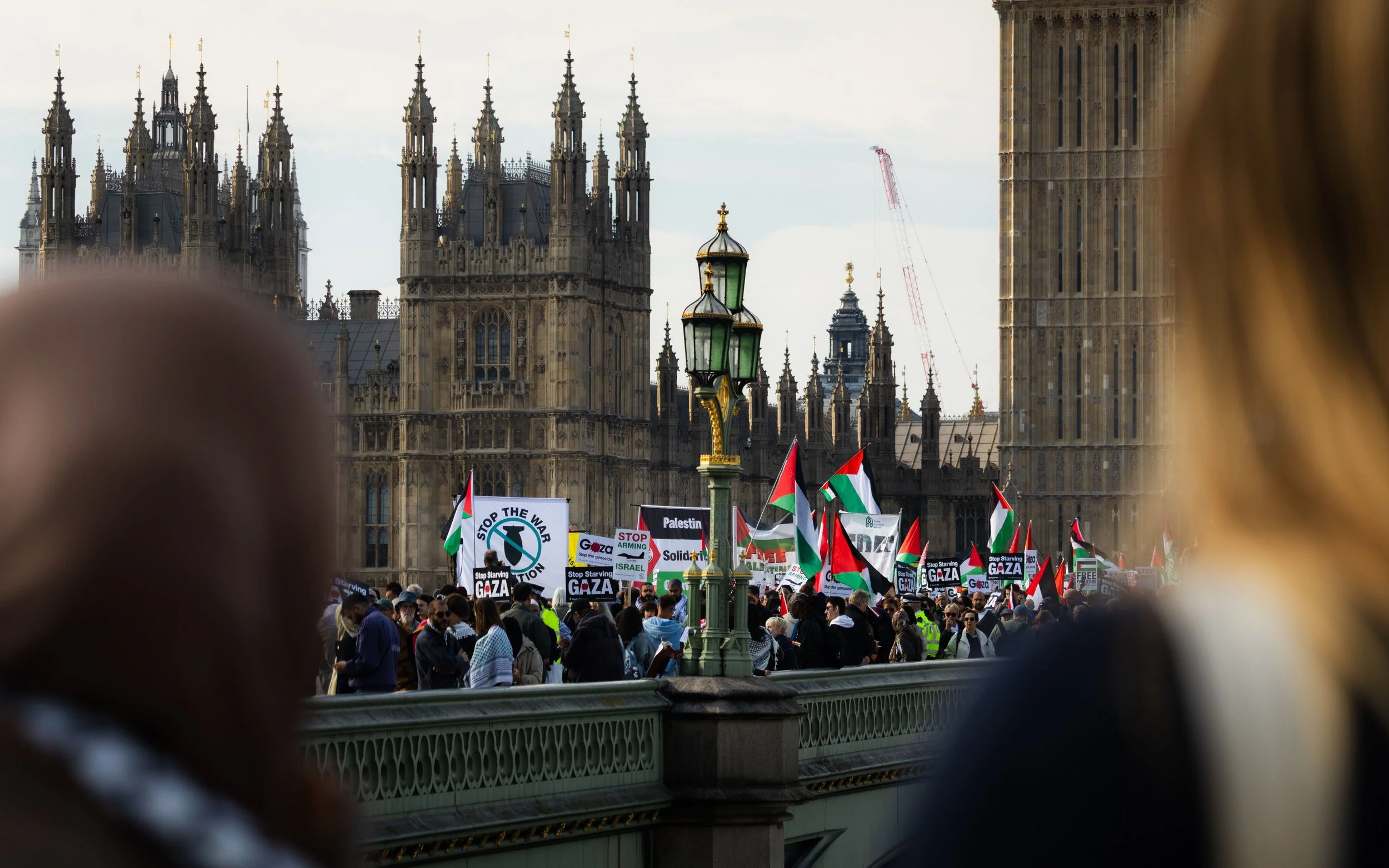
Much like with Joe Biden's leadership in the US, if there had been one issue that had, for many on the left, proved to be a fundamental break from Labour under Keir Starmer's leadership, it was perhaps the question of Israel and Palestine. The former Prime Minister's proscription of Palestine Action, and the continued arming and support for Israel, whilst bombs still rained down on Gaza, proved for many to be the final straw, with Starmer in their eyes arguably being complicit in genocide.
Even prior to his becoming Prime Minister, Starmer had, as leader of the opposition, proved to be unacceptable for many after he'd suggested that Israel had the right to go as far as cutting off water, electricity, and other essentials to the civilian population in Gaza, as part of their war against Hamas. This led to a marked drop in support for Labour by British Muslims, who turned to numerous independent candidates that were explicitly pro-Palestine at the 2024 election. Senior figures within Starmer's government, such as his deputy, David Lammy, have since stated that Starmer had got Labour off to “a bad start” with his comments on Gaza, adding that whilst Labour had achieved a lot on the issue once in power, “those initial steps were problematic.”
Whilst Starmer's government made the move to formally recognize the state of Palestine following the election, he nevertheless continued to lose support from the progressive left over this issue, with explicitly pro-Palestine parties such as the Greens benefiting, as the government maintained its arming and financing of Israel. Whilst there was a partial arms ban, sales for jet parts continued, and calls for full embargoes were resisted. The proscription of Palestine Action, which was placed on a par with far-right terror groups, was widely condemned as harmful for freedom of speech, following images of pensioners and vicars being arrested simply for protesting. This position has remained unchanged, even as the numbers of Palestinians killed by Israel has continued to rise in spite of the supposed ceasefire. As Starmer departed 10 Downing Street, he had not only activists, but also charities such as Save the Children, accusing him of complicity in the deaths of thousands in Palestine.
His departure however soon raised questions around whether the new leadership would offer any meaningful change on this issue. Whilst new Prime Minister Andy Burnham had previously made various pro-Israeli comments in the years prior to the October 7th attacks, having been a member of the Labour Friends of Israel group, he had also been clear following October 7th that Labour "didn't get it right” when initially responding to the conflict, issuing an apology on behalf of the party in the run up to his taking the leadership. Whilst he was clear in his condemnation of Hamas's attacks, Burnham also stated that the UK “was too slow to call for a ceasefire.”
"Labour's initial response to the treatment of Gaza caused huge hurt. We got it wrong and I am sorry for that,” he added on social media. He went on to state that the UK had to strengthen its approach in ensuring Israel “adheres to international law and to keep the prospect of a two-state solution alive." He also accused Israel of breaking its agreements under the ceasefire, and called for further sanctions against the settlements being created by Israelis in the West Bank, which are against international law.
Whilst this could easily have been simply an attempt to win over Labour members in his bid for the leadership, this is a line that Burnham and his government have in fact appeared to have stuck to since Burnham has become Prime Minister. Ed Miliband, since becoming Foreign Secretary, has branded the situation in Gaza as “horrific,” going on to social media last week to denounce the blocking of vital medicines for children, and stating that the UK government has “to act and act more decisively than we have.” He went on to add that the government will be looking at imposing "comprehensive” sanctions against the new settlements being planned by Israel in the E1 section of the West Bank, something Miliband has stated “risks making a Palestinian state unviable". Miliband's comments have led him to even be accused of “Jew hate” by Trump's ambassador to Israel - this, in spite of Miliband himself being of Jewish heritage.
Meanwhile, though Burnham has stopped short of joining countries like Spain in publicly denouncing Israeli actions as genocide, he has similarly denounced plans to expand Israeli settlements in the West Bank. Indeed, this expansion by Netanyahu's government, in spite of the supposed ceasefire, and likely done with one eye on upcoming Israeli elections, appears to have prompted a much wider condemnation from European countries more generally, with the UK joining France, Germany, Italy, and others in condemning the proposed settlements. In a joint statement by the European government's, the E1 settlement project was described as “unacceptable” and “harming the territorial contiguity of the Palestinian Territories.” Burnham's office has been clear that settlements in the West Bank are against international law and has urged the Israeli government to retract its plans.
The UK government has also issued separate statements denouncing individuals such as Itamar Ben Gvir, the Israeli National Security Minister, who had earlier in the month called for “targeted assassinations” of, in his words “30 to 40” Gazans “every night,” including those who do not “pose an immediate threat.” The UK Foreign Office has stated that these comments were “abhorrent” and “dehumanising,” adding that it called on the Israeli government “to take action” against such inflammatory speakers, as well as settler violence.
Last week saw the government seemingly putting its words into positive action, with Miliband announcing before the commons that they would be pressing ahead with a boycott on imports from illegal settlements, and sanctions against businesses trading with them. Miliband took the step of describing the actions of Israeli settlers as not only illegal, according to international law, and as a fundamental threat to any two-state solution, but also as amounting to “ethnic cleansing.” Miliband even took a shot at the previous administration, stating that Burnham had been “right to say that the Labour government has not done enough in the face of what is happening”.
Burnham then went on to defend the statements of his foreign secretary at Prime Minister's Question's, adding that “we will always stand up for the underdog.”
These actions certainly signal an extremely welcome move from the government. In a media environment where even prominent Jewish figures such as Miliband can be accused of antisemitism just for calling out Israeli actions for what they are, and with these actions already raising questions about how they will affect US-UK relations, then even modest sanctions are certainly not nothing, and mark a positive change in position by the government. Any action the government can take against Israel's flagrant disregard for the rights of Palestinians are to be welcomed. However, whether this truly signals a meaningful shift in policy from Starmer's government remains to be seen.
Whilst Burnham may be taking action on trade with illegal settlements, this is, as noted, currently largely in keeping with wider European opinion. And whilst these settlements have been widely condemned, as have far-right demagogues like Ben-Gvir, there has so far been little mention of Gaza, and the government has not yet appeared to have budged in its policy on providing arms to Israel more generally. In fact, it has been reported that at least ten military flights have been deployed from RAF bases to Israel in the period since Burnham became Prime Minister.
Parties such as the Greens, as well as Your Party MP's Zarah Sultana and Jeremy Corbyn, have continued to call for an end to this practice, with the Greens deputy leader Mothin Ali stating "it is unconscionable that the Labour government continues to enable a genocide that at least five of its own ministers have recognised." Ali went on to add that whilst the proposed trade bans with illegal statements are “a welcome first step,” such bans still will “not come close to fulfilling Britain’s legal obligations to prevent genocide in Gaza and withhold any support that sustains Israel’s unlawful occupation.”
Meanwhile, the proscription of groups such as Palestine Action remains in force, in spite of an ongoing appeal by activists against the labelling of them as “terrorists.” As with Starmer therefore, this then will for many remain the true test for the new Prime Minister. Burnham has an opportunity to truly stand up to ongoing war crimes by Israel, and, perhaps more importantly, considering the little impact the UK realistically has, to at least demonstrate that these are not actions that the UK stands behind. But with much of the media and opposition already labelling his proposals as a threat to “national security” and to British Jews, and with warnings of retaliation from both the US and Israel, it remains to be seen whether Burnham will go this far, or whether, for all his bold rhetoric, this will mark another area of continuity with his and Starmer's government.
