
Latin Analysis: Youth-Led Protests Highlight Mexico’s Enduring Security Crisis
AP
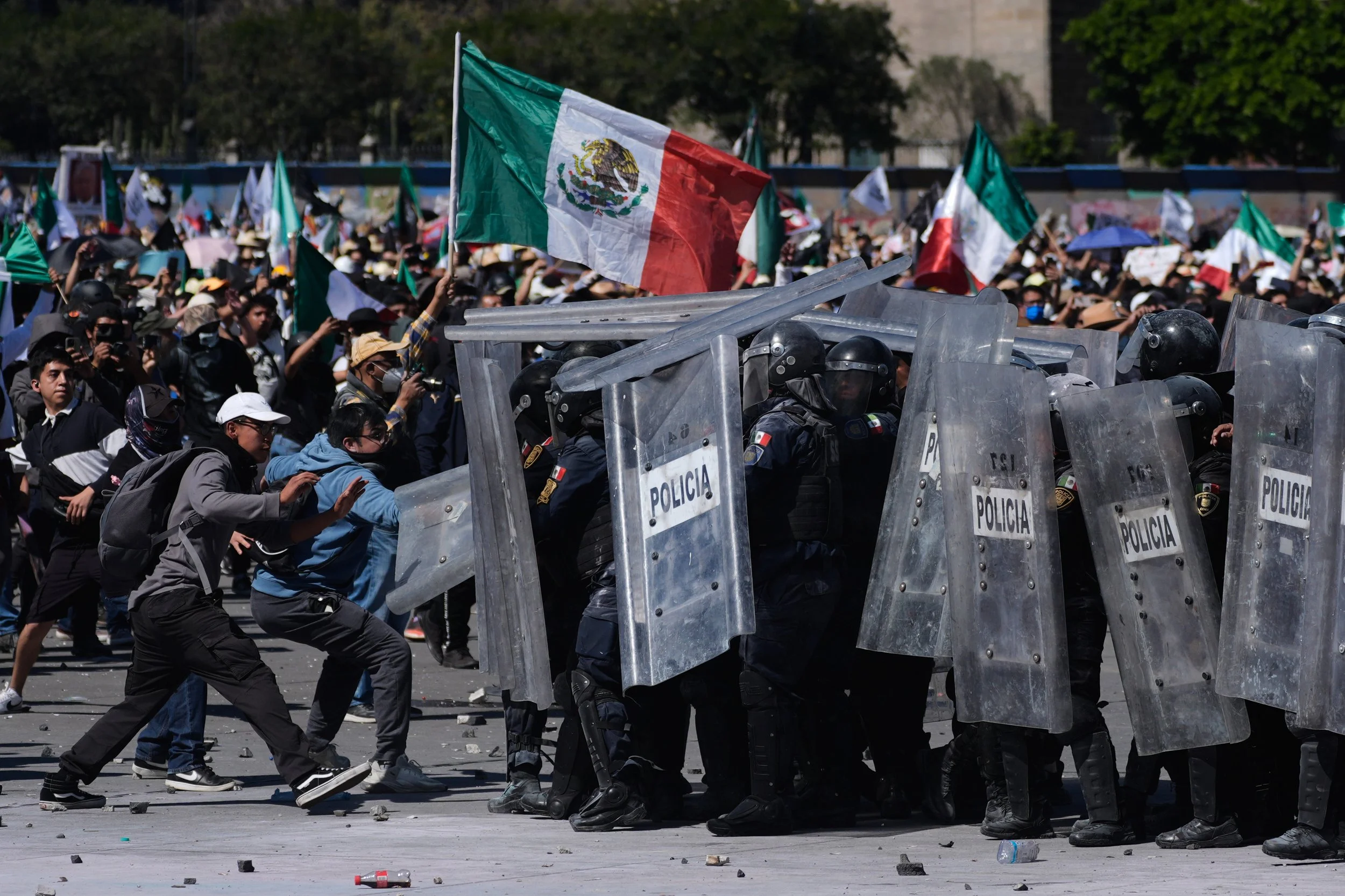
In November 2025, demonstrations against violent crime and corruption erupted across Mexico, evolving into some of the most disruptive protests the country has seen in recent years. Beginning as peaceful marches expressing frustration with inadequate public safety, the demonstrations escalated into clashes with police in multiple cities and re-opened national debate on issues of political violence and public safety. The unrest has intensified criticisms of President Claudia Sheinbaum over her national security strategy, while the Mexican government grapples with entrenched criminal violence and instability.
How The Protests Unfolded
The protests that swept across Mexico in mid-November were initially organized by youth groups and members of Gen Z to demonstrate their rising frustration over how the government has handled violent crime and corruption. Demonstrations took place in more than 50 cities across the country, from border cities in the north to Oaxaca in the south, and ultimately drew participants from a wide range of age groups, despite the movement’s branding as a “Gen Z” protest. Organizers framed the marches as non-partisan expressions of frustration with persistent insecurity, extortion, and political violence.
In Mexico City, thousands gathered in Zócalo, the main square home to the National Palace where President Sheinbaum resides. On November 15, the day with the most significant and widespread mobilization, demonstrations began peacefully but gradually became more violent – protesters dismantled parts of the metal barricades surrounding the palace, and riot police reportedly threw stones and used tear gas against protesters. By the end of the day, authorities reported at least 120 people to have been injured, including roughly 100 police officers, while 20 people were arrested in Mexico City on charges including robbery and assault. The unrest was not confined to the capital. In Guadalajara, Mexico’s second-largest city, authorities detained 47 people and reported 13 to have been injured.
Mexico’s protests erupted in the context of a broader wave of youth-led anti-corruption movements globally, including similar movements in Indonesia and Nepal in August, as well as in Peru, Madagascar, Togo, Morocco, and the Philippines in the following months. Cross-cultural Gen Z references have also appeared in this global wave of anti-corruption protest. In Mexico, many young demonstrators carried pirate flags referencing the Japanese manga One Piece – these flags are intended as a symbol of freedom and the fight against corrupt systems, and have also been flown in the other youth-led protests across the globe this year.
A unifying figure during the protests in Mexico was Carlos Manzo, the mayor of Uruapan in the state of Michoacán, who was assassinated on November 1 while attending Day of the Dead festivities. Protesters were seen waving signs that read “We are all Carlos Manzo” and wearing cowboy hats in tribute to the mayor’s distinctive accessory, to decry the risks faced by local officials who call for action against criminal activity.
In response to the dissent, President Sheinbaum affirmed support for freedom of expression, but also questioned the origins of the protests – she claimed that political opponents and bots online played a large role in promoting the demonstrations, and accused right-wing actors of attempting to exploit the youth movement. These remarks, combined with images of clashes circulating widely on social media, intensified public debate over the government’s handling of dissent.
The Case Of Michoacán
While the protests were triggered by specific events including Carlos Manzo’s death, they are rooted in a broader security crisis that has shaped Mexican politics for nearly two decades. Violent crime and political assassinations have remained persistent features of the national landscape, despite successive governments pursuing containment strategies. These dynamics are especially visible than in Michoacán, the home state of Mayor Manzo and a focal point of recent unrest.
Michoacán is a major agricultural producer, particularly of lemons and avocados grown for export markets in the US. But criminal organizations have become entrenched in these supply chains, mainly through the extortion of lemon and avocado growers and price control – armed groups increasingly resemble quasi-state actors, dictating how farmers in Michoacán harvest and sell their produce, imposing “levies” on producers, and enforcing compliance through violence.
The roots of this security crisis in Michoacán can be traced back to the mid-2000s. In 2006, Michoacán’s governor formally requested federal intervention as criminal groups were consolidating their presence. This led to one of the first major deployments of federal forces under then-president Felipe Calderón, as a part of the opening phase of what became known as Mexico’s own “war on drugs”. Yet, rather than stabilizing the region, the strategy coincided with a sharp escalation in violence as cartels fragmented and competed for territory.
National homicide figures illustrate the long-term scale of the security crisis. Under Calderón’s administration from 2006 to 2012, organized crime-related killings rose sharply, with 15,273 such murders recorded in 2010, up from 9,616 the previous year. More recently, between 2019 and 2021, under Andrés Manuel López Obrador, Mexico recorded approximately 109,059 murders, underscoring the persistence of high levels of violence.
Political violence, in particular, has become increasingly common. At least 150 mayors, former mayors, and local officials were killed between 2000 and 2017. More recently, in 2024, around 330 incidents of violence targeting political figures were recorded by ACLED between March and June 2024. In the first quarter of 2025 alone, there were 104 reported incidences of political violence, constituting a 59% increase from the same period in 2024. These attacks are significant because they reflect the vulnerability of municipal leaders whose authority can threaten criminal profits and territorial control.
Carlos Manzo’s killing fits squarely within this pattern. He had publicly criticized cartel influence and demanded harsher measures against armed groups and even clashed with President Sheinbaum over her security approach. Manzo’s assassination had followed the murder of a young leader of a local agricultural association in October, which had also triggered demonstrations mainly in the state capital, Morelia. Both killings reinforced the perception that criminal groups in Michoacán seek to eliminate figures who challenge their economic and territorial control.
Mounting Pressure On Sheinbaum’s Security Strategy
The November protests intensified scrutiny of President Sheinbaum’s security policies, at a time when her administration is attempting to promote signs of progress. Since taking office in October 2024, Sheinbaum has maintained approval ratings above 70% and has emphasized gains in cooperation with the United States on fentanyl trafficking. However, the recent high-profile killings and the persistence of regional instability complicate the narrative of progress that the Mexican government intends to project.
In response to the violence in Michoacán, Sheinbaum condemned Mayor Manzo’s assassination and announced a new “Plan Michoacán,” involving federal deployments, coordination with state prosecutors, intelligence sharing, and expanded social programs.
Critics questioned the plan’s scope and funding – they also note that Sheinbaum’s own party has governed the state for several years, during which criminal influence deepened. The president has rejected the characterization of her approach as militarization, despite its reliance on the use of federal forces and centralized security operations.
Another point of contention is how the government has been presenting the security crisis. According to official figures released in December, the average number of daily murders fell by 37% between the start of Sheinbaum’s presidency and November 2025, dropping from nearly 87 killings per day to around 55. The administration has cited these numbers as evidence that its national security strategy is working.
However, while the decline is notable, experts argue that homicide figures alone may obscure other forms of violence – particularly forced disappearances. Data from the think tank Mexico Evalúa indicate that while murders dropped by more than 20% in the first ten months of 2025 compared with the same period in 2024, forced disappearances increased by 15% nationwide, and by as much as 200% in some states. The Mexican government’s political strategy to present selective indicators of national security risks undermining public trust, especially when Mexicans’ lived experiences do not align with these official narratives. The frustration evident in the November protests can be seen as a reflection of that disconnect.
The youth-led protests this November have exposed a broad disillusionment with the government’s security strategy during a period of persistent regional violence and significant public distrust. As armed groups continue to exert control in key states such as Michoacán, the longer-term challenge for the Mexican government will be translating tactical responses into durable reductions in crime and a sense of security among the population.