
Latin Analysis: Mercosur Faces Delays on EU Trade Deal
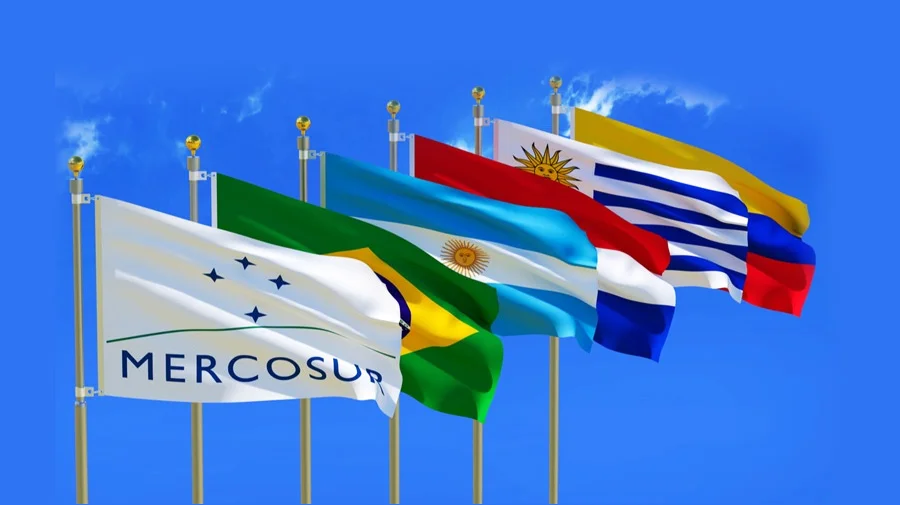
After more than 25 years of negotiations, the trade agreement between Mercosur and the European Union once again failed to reach the finish line, with the latest delay confirmed at a summit this month. For the Mercosur countries involved – Brazil, Argentina, Paraguay, and Uruguay – the postponement reflects how external political constraints continue to shape Mercosur’s economic ambitions. As Mercosur leaders weigh the deal’s potential gains, the prolonged uncertainty also serves as a test for the bloc’s internal cohesion, as national priorities vary and questions remain over whether Mercosur should continue its pursuit of the deal with Europe, or prioritize partnerships elsewhere.
Negotiations Stall At The Mercosur Summit
The long-anticipated trade deal between Mercosur and the EU was meant to be signed on December 20, 2025, at the 67th Mercosur Summit in Brazil. However, when leaders gathered in Foz do Iguaçu, the summit resulted in disappointment and frustration after the EU confirmed it could not secure enough internal backing to sign before the end of the year. The impasse resulted from opposition from France and Italy, driven largely by pressure from agricultural unions. Farmers across Europe fear a flood of cheap agricultural imports – produced under the more relaxed agricultural standards of South American countries – will result in unfair competition. European farming unions have therefore been lobbying their governments to delay the deal, in the hope that stricter safeguards for farmers will be put in place. European Commission President Ursula Von der Leyen requires support from at least two-thirds of EU member states to move forward with the deal, and both Italy and France’s opposition led to the December signature being vetoed.
As Brazilian President Lula’s six-month occupancy of Mercosur’s rotating presidency approached its end this month, he had hoped to close the agreement by the December 20 deadline. And while Lula accepted the Italian Prime Minister Meloni’s request for a delay into January, his frustration was clear as he reportedly told her in a phone call: “Without political will and courage from leaders, it won’t be possible to finish a negotiation that has dragged for 26 years.”
At the summit, Paraguay formally assumed the role of Mercosur president as Brazil’s rotation drew to a close. This change in leadership is notable as the member states do not all possess identical approaches towards the EU free trade deal and Mercosur’s trade relationships more broadly. Taking on a stricter approach, President Santiago Peña said Mercosur would no longer wait indefinitely for the EU, and would prioritize alternative trade partners, including Singapore and the UAE, while opening talks with India, South Korea, and Central Asian states. Peña also signalled his desire for a multi-speed approach that would allow individual member states to activate trade agreements once ratified domestically, instead of waiting for consensus among entire trade blocs.
More visible political rifts from within Mercosur were also apparent at the summit. Lula used his outgoing speech to warn against external military pressure in Venezuela, while Argentinian President Javier Milei instead praised US pressure on Caracas. Milei also criticized Mercosur as being overly bureaucratic and not open enough to global markets, citing the negotiations with the EU as confirmation that a collective approach costs member states real economic opportunities.
What A Deal With The EU Could Achieve
From the perspective of Mercosur, the deal with the EU represents an important step – it would be the bloc’s first comprehensive external trade deal with a major economic power, and progress towards deeper global integration. If ratified, it would cover a market of around 780 million people and roughly a quarter of global GDP, progressively removing duties on almost all goods traded between the two blocs.
The potential gains for Mercosur economies are concentrated in agriculture and small-scale industries. The EU would reduce or eliminate tariffs on exports such as beef, poultry, sugar, ethanol, footwear, and textiles – sectors that employ millions across Brazil, Argentina, Paraguay, and Uruguay. Proponents of the deal argue this would diversify Mercosur exports beyond raw commodities and lock in access to one of the world’s largest consumer markets. Taking Brazil as an example, the potential benefits look promising. The EU is Brazil’s second-largest trading partner, and European firms account for nearly half of foreign direct investment in the country. The Institute for Applied Economic Research estimates the agreement could lift GDP by around 0.5% and investment by 1.5% annually, with agribusiness among the biggest beneficiaries.
However, from the viewpoint of Mercosur leaders, the complexity of negotiations with the EU might just overshadow the potential gains. For Mercosur, the delays feed into a longer-term narrative of missing out on global integration. Talks with the EU began in 1999 and, since then, have experienced shifts in ideology, economic crises, and competing strategies among Mercosur countries that at times prioritized ties with China and BRICS partners over Europe. During the years of stalled negotiations, China in fact overtook the EU as Mercosur’s largest trading partner, reshaping the region’s economic landscape. And while the agreement was legally concluded in December 2024, creating hope for the signing of the deal, ratification remains a complex endeavour. The latest delay only reinforces concerns that Europe’s internal politics can indefinitely stall a deal that already commands broad support within the bloc, dictating Mercosur’s economic future.
Local Impacts Among Mercosur Countries
Mercosur is a large, but asymmetric, bloc comprising Argentina, Brazil, Paraguay, Uruguay, and Bolivia, with more than 285 million people and a combined GDP of nearly $3 trillion. Brazil and Argentina alone account for nearly 95% of Mercosur’s GDP and over 90% of its population, a structural imbalance that at times fuels political tension and has in some ways shaped national positions on the EU deal. Brazil has been its most consistent champion, viewing it as a way to anchor multilateralism and reduce dependence on China and the US. Argentina’s President Milei also supports the swift conclusion of the deal, particularly to boost agribusiness exports, but simultaneously criticizes Mercosur’s collective rules and has threatened to leave the bloc if it blocks independent trade deals. Paraguay and Uruguay, smaller economies within the bloc, have also pushed for greater flexibility – Uruguay has repeatedly argued for looser rules that allow bilateral agreements outside Mercosur, while Paraguay’s Peña’s desire to pivot toward alternative partners signals a similar approach.
Beyond the macroeconomic impacts stressed by Mercosur governments, NGOs and grassroots organizations point to the profound social implications that the deal could engender. Critics argue that expanded agribusiness exports would concentrate land and wealth, intensifying pressure on indigenous communities whose territories overlap with agricultural frontiers. Indigenous groups also fear evictions, land rights violations, and worsening poverty as export-driven agriculture expands. Additionally, environmental groups fear accelerated deforestation in the Amazon – although the agreement includes commitments to prevent further deforestation after 2030, environmental groups worldwide argue these provisions lack enforceable mechanisms and could still encourage forest clearing as agricultural exports expand.
Opposition stemming from Europe has also pointed to labour rights issues within Mercosur economies, where informal labour and weak enforcement remain widespread. The European Trade Union Confederation has argued that the agreement contains no enforceable labour clauses or sanctions for companies that violate workers’ rights. Therefore, European investment could potentially flow into sectors characterized by dangerous working conditions without meaningful accountability.
Lastly, small and medium-sized businesses and family farming may struggle to compete for public procurement contracts or survive increased competition from large multinational corporations, potentially widening social disparities even if the headlines point to the broader economic benefits. Therefore, for the societies within Mercosur, the deal may promise growth, but these gains are unlikely to be evenly distributed.
The delay to the EU-Mercosur free trade negotiations therefore landed in a complex political landscape. As Paraguay’s presidency begins with an explicit warning that Mercosur will not wait forever, the deal has become a test of Mercosur’s cohesion and relevance in a shifting global trade landscape. The prolonged uncertainty has raised questions over whether continued engagement with Europe justifies the opportunity cost of stalled integration elsewhere. But whether January finally brings a signature or another postponement, the debate it has triggered within Mercosur is unlikely to fade.