
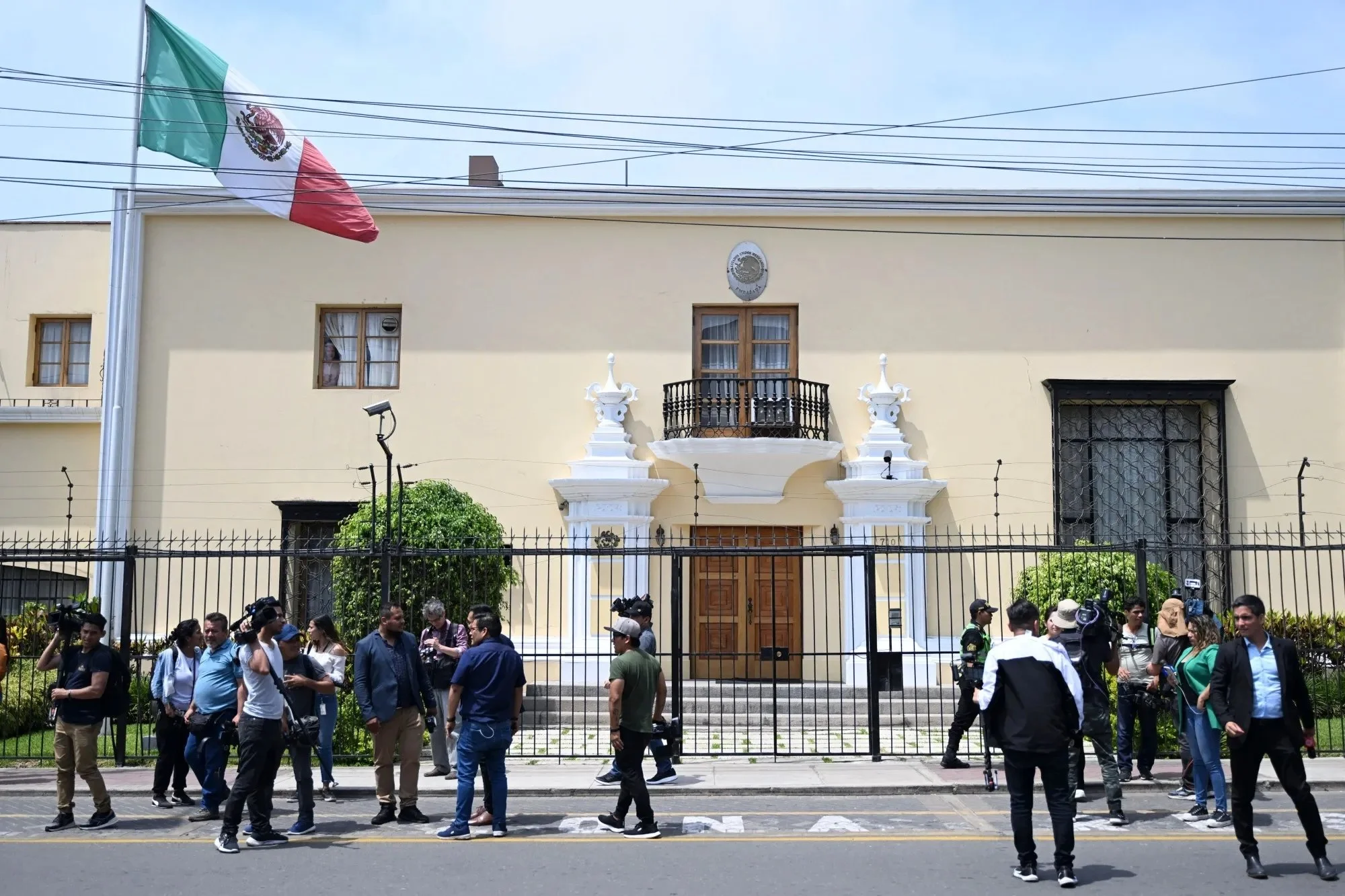
Brazil’s flag now flying above Mexico’s embassy in Peru is a small but telling image of a significant diplomatic rupture. While the arrangement is routine under international law, it reflects how a bilateral dispute can escalate into a diplomatic standoff with broader regional resonance.
A Widening Diplomatic Rift
In the latest development in what has become a strained relationship between Peru and Mexico, Brazil’s foreign ministry announced on January 25 that it would be taking over Mexico’s diplomatic interests in Peru. The Brazilian flag now flies over the Mexican embassy in Lima, after Brazil took charge of the building with the consent of the Peruvian government. Under the Vienna Convention on Diplomatic Relations, a third country can step in to safeguard premises, archives, and citizens’ interests when two nations cut diplomatic ties. Brazil’s representation accordingly entails the safekeeping of the Mexican embassy’s premises, the residence of its Head of Mission, and its assets and consular files.
The move comes amid a deepening diplomatic rift between Peru and Mexico in recent months. Peru broke off relations with Mexico in early November 2025 after President Claudia Sheinbaum granted asylum to former Peruvian prime minister Betssy Chávez. Chávez, who was given refuge and still resides in the Mexican embassy in Peru, faces charges over her alleged role in an attempt by then-President Pedro Castillo to dissolve Congress in 2022.
In light of President Sheinbaum’s decision, which the Peruvian foreign minister Hugo de Zela denounced as an “unfriendly act”, she was declared persona non grata – or unwelcome in the country – days later by the congress in Peru, in a significant diplomatic rebuke. The declaration was passed in a 63-33 vote, and marked an escalation in the tensions between the two countries. The Peruvian government also depicted Sheinbaum’s decision as the latest of many acts of interference in its internal affairs. Mexico’s foreign ministry, in turn, rejected Peru’s decision to sever ties as “excessive and disproportionate”. Mexican officials defended the act of granting asylum to Chávez as consistent with international law, and refuted the claim that it counted as intervention in Peru’s internal affairs.
The initial spark in tensions can be traced to the removal of former Peruvian president Castillo in December 2022. He was arrested and then impeached - actions ordered by the Congress and Public Ministry - after attempting to dissolve Congress and install an emergency government. The Peruvian government later classified the act as an attempted “self-coup.” Mexico's then-President, Andrés Manuel López Obrador, expressed support for Castillo and granted asylum to his wife and children, setting off the tensions that continue to define relations years later. In March 2025, Castillo went on trial facing charges of rebellion, abuse of authority, and disrupting public peace.
Having served as prime minister under Castillo’s government in late 2022, Betsy Chávez is now at the centre of the diplomatic crisis. She is accused of being a “co-author” of Castillo’s failed attempt to dissolve Congress, allegations she denies. She moved into the Mexican embassy in Lima after Mexico granted her political asylum on November 3, 2025.
Later that same month, Chávez was sentenced to 11 years and six months in prison for conspiracy to commit rebellion. She continues to reside in the Mexican embassy, and remains there following Brazil’s takeover, which doesn’t affect her legal situation because embassy premises are “inviolable.” Peruvian law enforcement cannot enter the building to arrest her without permission from the Head of the Mission there, so the physical sentence cannot be carried out. In order to take full advantage of her asylum in Mexico, she would require a “safe conduct pass” in order to travel there, which the Peruvian government has delayed granting. She is therefore considered a ‘fugitive from justice’ under Peruvian law.
For now, Brazil’s intervention ensures that Mexico’s diplomatic presence in Lima remains intact, even as relations between Peru and Mexico remain frozen. But as the dispute drags on, it raises broader questions about shifting norms and power dynamics in Latin American diplomacy.
Regional Implications
The rupture between Peru and Mexico fits into a broader pattern across Latin America in which governments have more frequently resorted to cutting diplomatic ties as a tool of political signalling. Over the past two years, ideological disputes, reactions to international conflicts, and accusations of interference in domestic affairs have produced a series of diplomatic ruptures across the region. Mexico broke with Ecuador in 2024, after Ecuadorian police entered the Mexican embassy in Quito to arrest a former vice-president. This presents similarities to the Peru-Mexico episode, with asylum being a flashpoint in polarised political contexts.
Also in 2024, following his disputed re-election, Venezuelan President Nicolás Maduro ordered the withdrawal of diplomatic staff from seven Latin American countries after they questioned the election results. While these breaks may be temporary, their growing frequency points to a more fragmented and volatile regional diplomatic environment.
The diplomatic tension marks a sharp departure from the Peru-Mexico relationship before late 2022, which was generally stable and cooperative, and reinforced by their shared participation in regional trade bodies and political frameworks. The current situation, contrastingly, points to widening ideological divides, with President Claudia Sheinbaum continuing a foreign policy that openly supports leftist leaders across the region, while Peru’s post-Castillo governments have adopted a more defensive, sovereignty-focused stance.
Despite the friction, however, trade has not been halted. Both nations are members of the Pacific Alliance and the Comprehensive and Progressive Agreement for Trans-Pacific Partnership (CPTPP), which provides a legal framework that keeps markets open. Officials in Lima have been clear that commerce should carry on regardless of the diplomatic freeze, and there is little evidence of immediate disruption to supply chains or market access.
The core economic rules of the Pacific Alliance, including the elimination of tariffs on 92% of goods and services traded between them, remain in effect. In the past, however, diplomatic tensions have spilled into these multilateral forums – in 2023, former Mexican President Andrés Manuel López Obrador refused to transfer the rotating presidency of the Pacific Alliance to Peru in light of the rift between the two countries. Obrador condemned the removal of his leftist ally, Castillo, and perceived his impeachment as an illegal, elite-sponsored coup. Therefore, while trade blocs like the Pacific Alliance may offer some stability in the midst of political tensions, they are not immune to the ups and downs of international relations. Furthermore, prolonged political hostility risks eroding investor confidence, complicating cooperation on security and organised crime, and weakening the credibility of regional institutions designed to promote stability and integration.
Brazil’s assumption of Mexico’s diplomatic interests in Peru adds another layer of geopolitical significance. Acting as a ‘protecting power’ under the Vienna Convention allows Brasília to present itself as a neutral intermediary, trusted by both Peru and Mexico, and capable of managing crises between its neighbours without escalating tensions. For President Lula, the move is consistent with his efforts to position Brazil as a bridge across ideological divides, maintaining dialogue with governments on both the left and the right while emphasising regional cooperation.
Brazil’s intervention helps manage the immediate diplomatic fallout, but it does not resolve the political rupture between Peru and Mexico. With neither side moving to rebuild trust, the dispute risks further weakening regional cooperation at a time of growing uncertainty in the Western Hemisphere. Whether the fallout remains contained will depend on whether pragmatism prevails over ideological confrontation.