
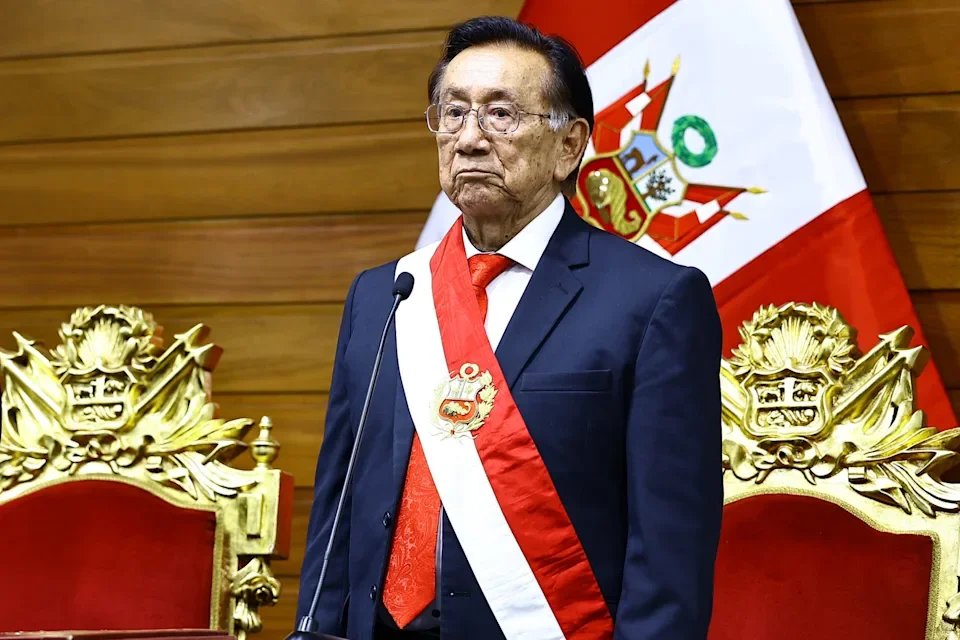
On February 17, Peru’s Congress voted to remove President José Jerí from office and the next day elected José María Balcázar to become the nation’s interim president. Balcázar thus became Peru’s ninth president in the span of a decade, Jerí’s ousting follows in the footsteps of several similar transitions over the past decade. The “revolving door” of presidents has therefore become a unique feature of Peruvian politics, and one that has engendered an instability that has serious knock-on effects on the country’s ability to govern and as a consequence, its society.
A Revolving Door Of Presidents
Jerí was impeached after just four months at the helm of Peru’s government, following a political scandal that centred around a series of secret meetings with two Chinese businessmen. Initially popular among the population at large due to his tougher stance on fighting crime, he was meant to remain in office until July, but his mandate was cut short due to the corruption allegations. The scandal – dubbed “Chifagate” after the Peruvian-Chinese fusion cuisine, chifa, popular in Peru – emerged after security-camera footage showed Jerí attending these undisclosed meetings, which were outside of his official agenda, in one instance attempting to disguise himself using a hood. One of the businessmen is allegedly involved in an illegal logging network, known as Los Hostiles de la Amazonia, while the other holds active government contracts, raising suspicions of influence peddling. While Jerí later insisted the meetings were to organize a Peruvian-Chinese festivity, the scandal caused a huge blow to his approval rating with his opponents accusing him of corruption and calling for his resignation. Lawmakers in Congress thus voted 75 votes to 24 to proceed with his removal. Jerí now faces a preliminary investigation on charges of corruption and influence peddling, launched by Peru’s Attorney General’s office.
This is the most recent instance in a series of impeachments in the nation, over a range of scandals spanning from bribery to attempts to rule by decree. The pattern started in 2018 when President Pedro Pablo Kuczynski resigned over a bribery scandal, which was followed by a period of frequent presidential turnover. Most recently – before Jerí – former president Dina Boluarte was removed last October for a failure to control crime, as well as a series of scandals. Most notable was the “Rolexgate” scandal, where Boluarte faced intense scrutiny for owning several Rolex watches and jewellery that, valued together, did not align with her official income – this led to accusations of accepting bribes from a regional governor in exchange for government funding, and was a major factor in her eventual removal from office last year.
The reason for the frequent turnover lies in a clause in Peru’s constitution that gives legislators the power to remove leaders that are “morally incapable” of conducting their duties. This goes hand-in-hand with a disproportionate level of authority vested in the Congress, who has great leverage over the executive branch. The moral incapacity clause can be widely interpreted widely by legislators, who analysts argue has been repeatedly used to eliminate presidents who do not act in the interest of Congress or favoured political parties. This has contributed to the fact that, of the nine presidents of the last decade, only two have been popularly elected – the rest have been elected through constitutional succession, i.e., vice presidents that have stepped in, or congressional appointments. The result is a Congress that has disproportionate power over Peru’s political agenda, with a presidency that is essentially disposable.
How Political Instability Impacts Governance And Everyday Life
The revolving door of presidents has created a chronic state of political instability that has serious consequences for life in Peru. As analysts at InSight Crime explain, “with priorities shifting every time a new president takes office, sustaining a coherent crime-fighting strategy has become impossible.” Every new president brings in new interior ministers responsible for overseeing public security, and their mandates are rarely more than a few months at a time. There is thus a lack of consistency in priorities, working style, and staff, creating an environment of paralysis in policymaking and operational planning regarding public safety. This has exacerbated the fragmentation of Peru’s security institutions, including police and prosecutorial units. Ultimately, crimes like drug trafficking and illegal mining aren’t addressed properly. InSight Crime quotes José Ugaz, previously head of the Peruvian chapter of Transparency International, saying: “How can you design … a strategy to combat criminality or corruption if you have no direction, no strategy, no plan?”
The high presidential turnover, however, is a symptom of the congressional overreach, which itself does further damage. Most notably, the legislature has been accused of protecting illegal economies through a series of reforms – dubbed the “pro-crime laws” – between 2023 and 2025. One such legal amendment makes it harder for prosecutors to use cooperating witnesses. Other moves have been to shield political parties and their finances for public security, and to halt ongoing investigations into money laundering and illegal campaign financing.
The Peruvian people are the ones who bear the consequences. From mid-2024 to mid-2025, Peru saw the homicide rate increase by around 15%, while complaints of extortion also rose 30% in that period. People took to the streets in September and October last year to protest against the rising crime and political corruption. In many parts of the country, criminal activity has become embedded in daily life: transport operators, small businesses, and market vendors are routinely subjected to extortion demands, often forced to make regular payments to avoid violence. his has been particularly acute in Peru’s large informal economy, where millions depend on unstable incomes and lack state protection. As political instability has weakened institutions and eroded state authority, criminal groups have been able to expand into these spaces with little resistance, reinforcing the perception of a government that is either absent or unable to guarantee basic security.
A New President And Looming Elections
An 83-year-old former judge and long-time member of the leftist Perú Libre party, new interim president Balcázar is a controversial figure. He was previously removed from the judiciary for misconduct and faces multiple investigations, including allegations that he attempted to negotiate favourable outcomes in his own legal cases. His past remarks on lowering the age of consent and opposition to banning child marriage have further fuelled public criticism. Balcázar’s mandate, however, is narrowly defined. He will remain in office only until July 28, when the winner of the general election is sworn in, and is not eligible to run himself. His primary responsibility is therefore to oversee a credible electoral process while maintaining basic governance during a period of acute instability.
The elections themselves, scheduled for April 12 with a potential runoff in June, are highly uncertain. The field is fragmented, with no candidate securing more than a modest share of the vote. Right-leaning figures such as Keiko Fujimori and Rafael López Aliaga lead the race, but neither commands widespread support. A significant share of voters remain undecided or disengaged altogether, reflecting deep distrust in the political system – polling ahead of the elections found the majority of Peruvians say they do not feel represented by any political party, while many remain undecided or intend to cast blank ballots. The result is a volatile electorate, where anti-establishment sentiment could once again produce an unexpected electoral outcome.
As Congress continues to dominate the political system and successive leaders fail to establish authority or continuity, the country risks further institutional erosion. The upcoming elections offer a chance for reset, but without deeper structural change, instability may remain the defining feature of Peruvian politics.