
Latin Analysis: Chilean Students And Unions Mobilize Against Kast’s Austerity Measures
REUTERS
Mass protests have erupted across major cities in Chile in response to President José Antonio Kast’s sweeping austerity agenda. The unrest highlights an ideological clash between broad sectors of Chilean society and Kast’s newly inaugurated administration, signaling a volatile new chapter in Chile’s ongoing struggle over its socioeconomic model.
The Protests
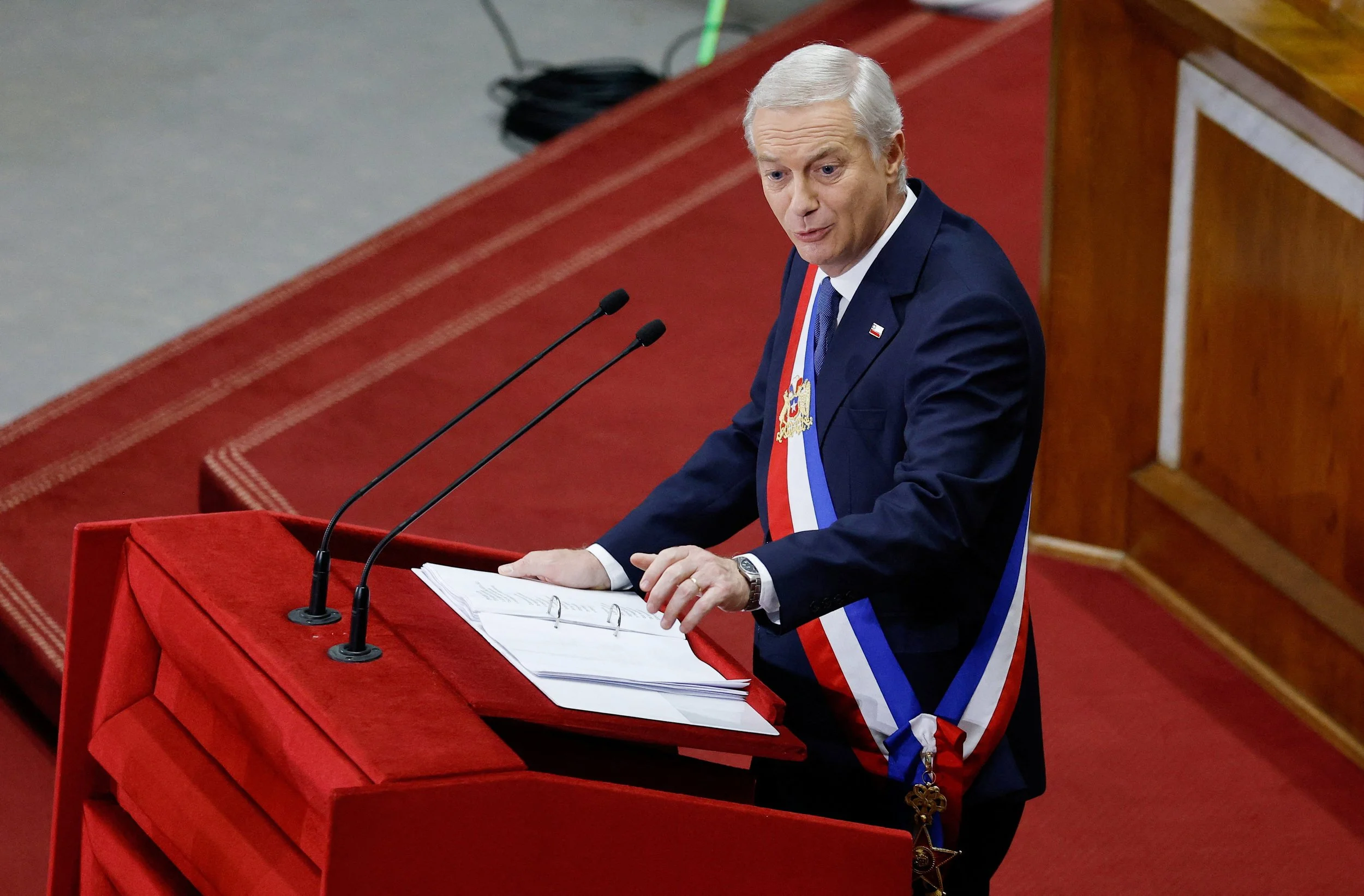
The most recent round of protests broke out in Chile on June 1, as Kast delivered his first State of the Nation address to Congress in Valparaíso. Labor unions and student groups took to the streets in Valparaíso and Santiago, accusing the administration of dismantling public healthcare, education, and social protections.
In the following days, thousands of students, teachers, and activists staged a national strike in the capital. The Chilean Student Confederation organized the demonstrations, which were supported by the Teachers’ Union and feminist activist groups. While the demonstrations began peacefully, they escalated into clashes with security forces. Police deployed tear gas and water cannons as protesters blocked roads and disrupted transport networks. At least 25 people were injured, including 12 police officers, while over 38 arrests were carried out by the authorities. Several metro stations in Santiago were temporarily closed and traffic across parts of the capital was severely disrupted.
Student leaders have warned that the current demonstrations could mark the beginning of a broader protest movement, and have been outspoken about their determination and resilience. “They want to silence us, but we are not going to stop," Magdalena Correa, a 21-year-old student, told Associated Press reporters. “They’re taking away our resources and rights, and we have to fight back.”
Kast’s Government And The Opposition
President Kast took office on March 11, 2026 after a decisive runoff victory against Communist Party candidate Jeannette Jara, where he recieved over 58% of the vote. Kast’s win was widely read as a rejection of the outgoing leftist president Gabriel Boric and his unpopular tenure.
Since taking office, the government has moved rapidly to implement Kast’s agenda – the policies he had campaigned on were fiscal discipline, law and order, and strict immigration controls. Finance Minister Jorge Quiroz announced a 3% budget reduction across all ministries, part of a plan to cut roughly $6 billion in public spending over 18 months. The administration has also promoted a sweeping National Reconstruction bill, which was approved by the Chamber of Deputies in late May, and is now headed to be debated in the Senate. The bill combines state spending cuts and investment incentives with measures like expanded police powers and restricting social benefits from those with criminal records.
Despite his commanding personal mandate, however, Kast’s Republican Party and the Chile Vamos coalition lack a functional congressional majority. The austerity measures have drawn criticism not only from opposition parties but from within the governing coalition itself. His approval rating, which stood at 51% at inauguration, has already slipped. A Cadem poll in March showed disapproval exceeding approval for the first time after a 32% hike in petrol prices.
That fuel price increase, announced in late March after the government activated an escape clause in Chile’s price stabilisation mechanism, triggered the first wave of protests against the Kast administration. In a similar fashion as the most recent round of protests this month, student demonstrations in Santiago were met with water cannons in Santiago, outside La Moneda presidential palace.
Echoes Of Chile’s History Of Protest
The current demonstrations draw on a longer history of social mobilization in Chile. For decades, disputes over social welfare and inequality have fuelled some of Chile’s most significant protest movements.
Many of these debates trace their roots to the economic architecture inherited from Augusto Pinochet’s military dictatorship between 1973 to 1990. A group of free market economists called the Chicago Boys influenced the privatisation of healthcare, pensions, and education, creating a model that delivered economic growth but also became associated with persistent inequality and unequal access to public services.
Students have repeatedly been at the forefront of challenges to that system. Major student uprisings in 2006 and 2011 demanded greater public investment in education and an end to the commercialisation of universities. The Chilean Student Confederation leading today's demonstrations is the same organization that spearheaded many of those earlier campaigns.
The most dramatic expression of public discontent came in 2019, when a wave of protests was sparked by a metro fare increase. Protesters rallied around the slogan: “It’s not about 30 pesos, it’s about 30 years.” Their frustrations extended far beyond transport costs to encompass a broader dissatisfaction with Chile’s economic and political order.
For many of the groups now opposing Kast, the current administration’s austerity programme represents a return to policies that previous protest movements sought to overturn. Kast has defended the market-oriented economic model of the Pinochet era and proposed pardons for military officials convicted of human rights abuses. He has therefore become a focal point for a coalition of students, unions, and social organizations that view Kast’s reforms as reviving economic and political model they have spent decades challenging.
What To Watch
The immediate focus will now be the Senate debate on the National Reconstruction bill. Its passage would give the government a major legislative victory and accelerate the implementation of its reforms. Failure, however, would expose the limits of Kast's governing coalition and strengthen an opposition increasingly willing to challenge the administration in the streets as well as in Congress.
Three months into Kast’s presidency, the confrontation has evolved beyond a dispute over budget cuts – it has become the newest chapter in a long-running debate over the role of the state, social protections, and the economic model that should underpin Chile’s future.