
In America: Pelosi’s Succession Race
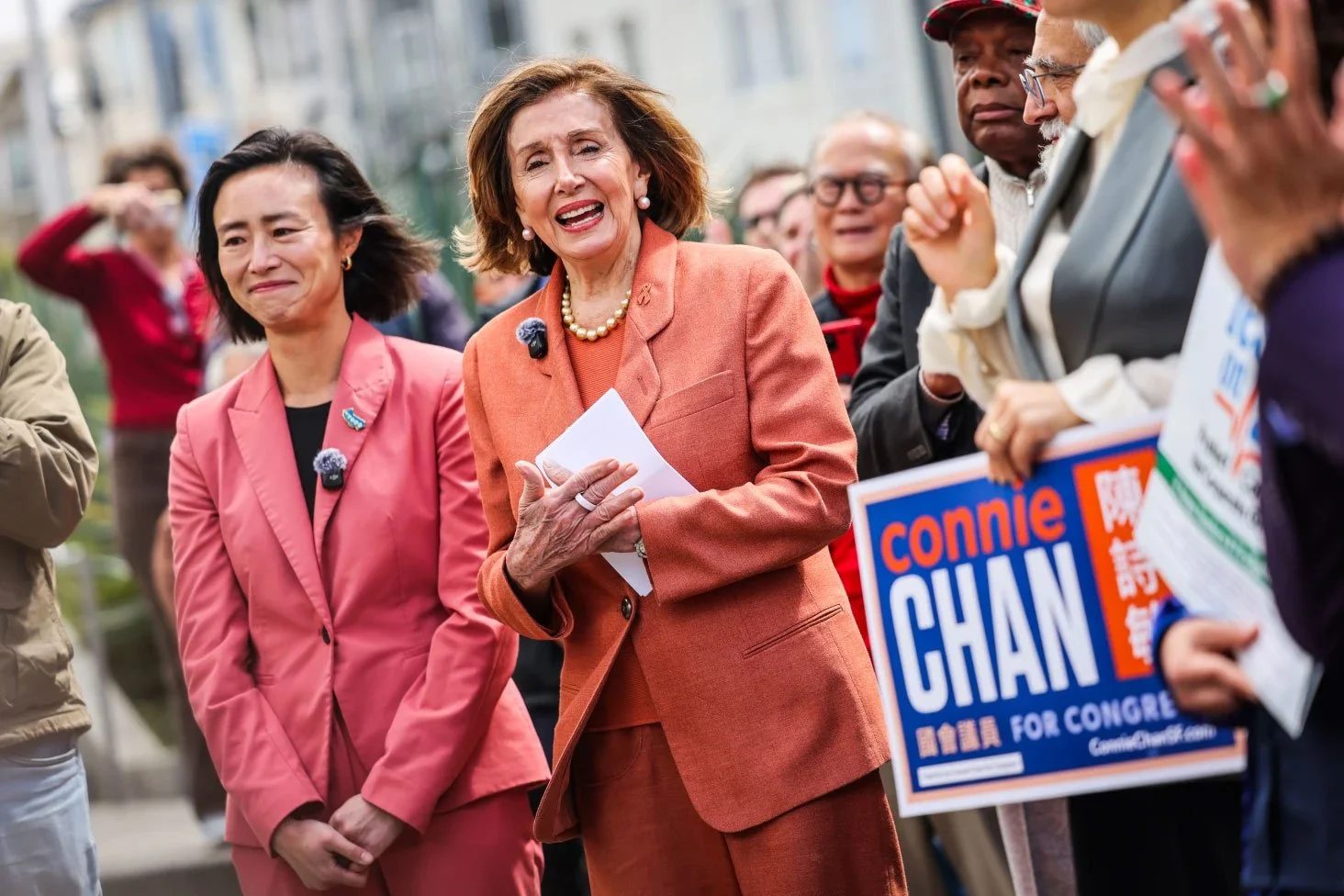
San Francisco Chronicle/Hearst Newspapers
After announcing her retirement last November, the race to succeed Pelosi’s House seat has established its final candidates. California State Senator Scott Wiener and Supervisor Connie Chan are slated to face off against each other following the withdrawal of Saikat Chakrabarti due to poor results during the primary election.
This historic election race for California's 11th congressional district marks the first time in nearly four decades where Pelosi is not on the ballot. Whoever will succeed Pelosi’s House seat will also have a difficult playing field to contend with while in office. Both of California’s Senators, Alex Padilla and Adam Schiff, are from Southern California, while the gradual shift of the tech industry into Silicon Valley has led to a looming San Francisco power vacuum.
This notion of a power vacuum in San Francisco emerges as the “old guard,” figures such as Nancy Pelosi and Gavin Newsom, begin to leave California politics. These changes have emerged as a new generation heralds its political ascension by electing “new guard” candidates who can defeat legacy incumbents. However, this specific election race emerges as more characteristic of a succession race due to Pelosi’s retirement announcement.
Pelosi’s political legacy and who she believes is best suited to fill her shoes will also influence how this election race plays out. As the first female Speaker of the House and one of the top Democrats on the Hill, Pelosi’s endorsement would carry significant weight. Indeed, Chan’s achievement of making it into the general elections could be partially credited to such an endorsement from Pelosi.
Jason McDaniel, an associate professor in the Department of Political Science at San Francisco State University, commented on how Pelosi’s endorsement may have influenced the primary results.
“I think Nancy Pelosi's endorsement was a big deal for her. I think it really caused a lot of movement towards her. And, I think, Chakrabarti's campaign at the end of the day didn't close the deal with a lot of left progressive voters.”
Before Pelosi’s endorsement, Chan had struggled to raise money with question marks surrounding her general election bid due to preliminary polling for the primary that showed her trailing Chakrabarti and Wiener. Pelosi had traditionally preferred to stay out of local politics. Still, the uncertainty surrounding Chan’s success in the primaries may have convinced Pelosi to help turn the tide in Chan’s favor.
Despite both Wiener and Chan running as culturally progressive Democrats, this label does little to clarify where they stand among “the left.” The concept of “left of left” becomes increasingly important to understanding how labels are projected onto political candidates and the messages or symbolism that become entrenched within that.
Wiener describes himself as “left” rather than “lefter.” A comment he made after canvassing around lower Pacific Heights underscores the divided nature of “the left” within San Francisco politics.
“We have the lefter segment of San Francisco politics, when you can never be left enough, and it just gets further and further out there.”
While being openly LGBTQIA+ may, for some, suggest more radical politics, Wiener’s comment reflects the more complicated reality of his political beliefs. Politically, Wiener has translated this sentiment as being the first elected official to demand the 2022 recall of San Francisco board members following delays over reopening schools post-COVID. Mainstream media has often framed a more conservative focus on actions involving recalling school board members or regulating education materials and content. Wiener’s support for this recall movement flips that narrative on its head and highlights the complicated reality of being closer to “left” rather than “lefter.”
Wiener has also publicly supported San Francisco Mayor Daniel Lurie, the Levi Strauss heir. Both Wiener and Lurie opposed a labor-backed ballot measure that would have imposed a wealth surtax on large corporations in the city where top executives earn 100 times more than the company’s median employee. This measure did not pass, yet candidate stances on whether to vote for or against this ballot measure served as a litmus test for support of Chan or Wiener.
San Francisco is often associated with tech innovation, rapid growth, and its strong economic impact globally. What is often forgotten is how the wealth brought to SF is actually distributed among the general population. A study by the Bay Area Council Economic Institute found that while the median household income increased higher than average in the Bay Area than the rest of California and the US, the difference between median household income for the bottom 10% of earners and the top 10% of earners in the Bay Area was higher than the rest of California and the US. This disparity highlights a key voting issue for San Franciscans.
On one hand is Connie Chan, who markets herself as a champion of unions and Pelosi’s chosen successor; on the other hand is Scott Wiener, who markets himself as something different yet similar to Pelosi’s style of politics and relationship with the community. Chan supports a more regulatory government with a stronger role in combating issues like income disparity, whereas Wiener supports a more “hands-off” style of government.
Rather than the dividing line of this election being political parties and partisan affairs, divisions stem from the dramatic infusion of wealth that San Francisco and the Bay Area have seen since Nancy Pelosi was first elected in 1987. An apt criticism that arises about San Franciscan politicians is that they embody this ironic combo of “leftist” and “elitist.” However, calling Pelosi “elitist” is questionable when much of her local political support comes through deep alliances with unions.
Perhaps continuing this legacy of local support through unions, Chan has adopted a similar campaign strategy to earn her the votes and support required to win the general election. Before a meet-and-greet with patrons at a farmer’s market, Chan described herself as someone who is “part of the labor movement” and supports “progressive taxation.”
These two attributes are hallmarks of Chan’s campaign messaging, with slogans like “A record that puts people first” and “Connie Chan has always worked for the people not the powerful” plastered across her campaign website. In contrast, Wiener’s campaign website centers on messaging like “Scott has the courage to stand up to Trump” and “Scott works day and night for San Franciscans."
It is too soon to tell whether Pelosi’s endorsement of Chan will help win Chan the election. Yet, the contested nature of the primary suggests that Chan needs to get more aggressive about securing financial backers going forward.
Overall, the stakes remain high going into the November general election. Chan and Wiener are both Democrats yet represent different aspects of the “left” that especially elevate class divide and financial disparities among San Franciscans. As campaign advertising warms back up for November, the people of San Francisco need to decide who will best represent their interests in Congress.