
South Pacific: Samoa’s Approach to Plural Governance
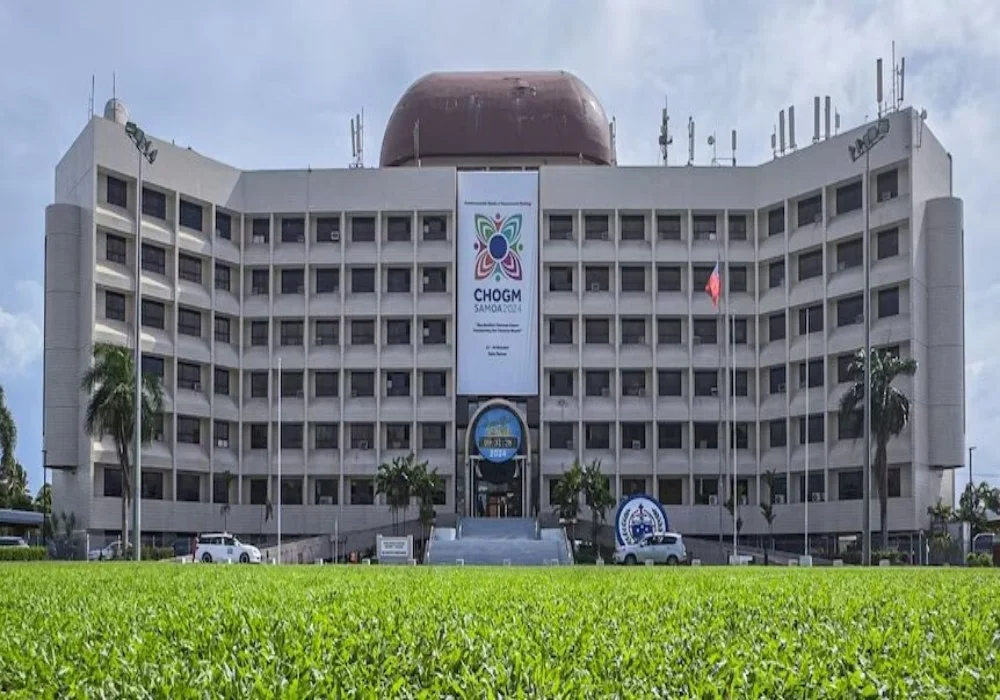
The Independent State of Samoa is located in a small archipelago in the South Pacific and it’s one of the smallest countries in the world, with an estimated population of 220,500 people. Their government is uniquely commendable, as they're often seen as an example of a democracy that mixes both modern and traditional authority. Alongside modern parliamentary institutions, Samoa’s political system blends representation with customary authority rooted in the fa‘amatai (way of chiefs). A structure that continues to shape land ownership, village governance, and political legitimacy.
This hybrid model, blending democratic procedure with customary power, does more than define Samoa’s domestic politics; it shapes how the country engages with the outside world. From negotiating foreign investment, to managing aid relationships, Samoa’s foreign policy reflects a political system in which external decisions must remain accountable not only to voters, but to villages, families, and chiefs. As with any country, however, Samoa faces its own challenges that come with a distinctive government. This includes the perceivance of hindering the administrative efficiency of the country when it comes to global topics such as economics, politics, land, and climate change.
Political Institution
Samoa’s constitution and legislative assembly operate in a parliamentary democracy alongside the indigenous fa’amatai chiefly system of governance and social organisation. Roughly 85% of Samoa is customary land supervised under the authority of matai chiefs for the agai (family/community), a system explicitly protected by the constitution. These protections extend not only to land tenure but to matai titles themselves (Samoan chiefs) and its complimentary authority, which therefore prohibits alienation of customary land.
The matai are still central to discussions and decisions focused on land use, social order and village governance, and, until the 1990s, dominated eligibility for parliamentary office as well as voting rights. Specifically, prior to 1991 only Matai could vote, and Matai title owners were the only people allowed to run for office. This decision was tied to guarantees that national politics remained closely aligned and tethered to local village leadership. As a result, Samoa’s foreign policy is shaped not only by national institutions, but by local communities whose consent remains politically and socially indispensable.
However, despite the matai’s involvement in parliament and decision making, another important aspect is to look at how, at times, their traditional system and modern law simply don’t blend. In 1903 the Land Titles court was set up to officially help land disputes using Samoan customs, but it actually reduced a lot of the village's authority. It essentially removed the village's power, transitioning it over to a central operation that decided everything. This led to a rise in matai titles, due to the court's central decision to split more land up. And as most Samoans still live in villages, the community comes before the individual, however their western constitution emphasizes the individual always comes first. This confusion becomes apparent when individuals are unhappy with the result of either systems’ decision and simply go to the other operation. The courts themselves have a hard time enforcing any ruling as their actual rules were never written down, thus their decisions are inconsistent and they technically have no written authority. In this sense there is much uncertainty as to how foreign investment and aid can begin to cooperate with Samoa if the people inside their country cannot operate their own laws.
Foreign Investment and Customary Authority
Unlike many developing economies, Samoa cannot easily convert political approval into commercial access. Most of the country is held under customary tenure by extensive familial communities and a matai chief at the forefront. A system not just customary but protected by the constitution. Therefore, unlike freehold property systems elsewhere, customary land cannot be sold, either foreign or domestically, forcing negotiations for leases, rather than purchases, and will usually involve family networks, not just government ministries. In addition to this, only 15% of the land is actually habitable, reducing opportunities for foreign investment.
Efforts to make customary land more accessible to development have proved contentious. In the mid-2010s, a group of matai village chiefs filed an official complaint against the Asian Development Bank (ADB), arguing that reforms intended to promote the economic use of customary land risked undermining communal ownership and were implemented without “meaningful consultation.” An internal ADB review later found evidence and concluded that this advice for these reforms fell short of operational standards precisely because it failed to incorporate local voices or respect established customary authority.
The practical effect is that even legally permissible leases often slow down or reshape as negotiations wind through village consensus processes and matai deliberations. For investors, Samoa’s land regime is not merely legal complexity but political reality, an expression of community consent that cannot be bypassed without political cost.
Aid Donors and Government Reform
Development assistance is a key priority in regards to Samoa’s economic resilience as it helps fund infrastructure, public services, and climate change resistance. But aid relationships have also served as a conduit for governance reform. Major donors may begin the process of encouraging changes aligned with liberal democratic norms, ranging from judicial independence to gender representation and land administration. These priorities, while broadly accepted on a national level, sometimes encounter limits when reforms intersect with opposing customary authority embedded at the village level.
International institutions such as the World Bank (within many of their pdf plans) and UNDP have acknowledged and explicitly stated that governance in Samoa operates through a plural system, where formal state institutions coexist with village councils that retain social and disciplinary authority. As a result, donor-backed reforms frequently emphasize “local ownership” and consultation, reflecting an awareness that policy changes lacking customary legitimacy risk resistance or uneven implementation. Australian aid programs, for example, have increasingly framed governance support around partnership rather than conditionality, seeking to align reform objectives with local norms rather than override them.
The growing tensions inherent in this approach became visible during Samoa’s 2021 constitutional and electoral crisis. The Human Rights Protection Party (HRPP) has only lost one election, with the 2016 election highlighting their dominance when they won 47 of 49 seats. However, in 2021 the opposition party, Faátuatua I le Atua Samoa ua Tasi Party (FAST), gained half of the seats, the other half HRPP retained . What followed was an unclear procedure that had to do with naming a government and how many female members of parliament were needed. It left the courts forced to step in and mediate a result. It not only drew international attention, but it distinctly revealed deeper tensions between constitutional law and customary governance, usually managed through consensus, not litigation.
The Future
Samoa’s constitutional system resists easy categorization as it blends traditional values with universal themes of democracy. Their institution continues to command social legitimacy, particularly in matters involving land, authority, and collective decision-making. The hybrid model shapes how Samoa engages with external actors, imposing political and social constraints.
With a system that respects two sources of authority, difficulties are bound to ensue as the systems are at times contradictory in their premises and assumptions. The dynamic has occasionally slowed development initiatives and frustrated external partners accustomed to centralised decision-making. On the other hand, it has also protected Samoa from the volatility seen elsewhere in the region, anchoring policy decisions in locally recognized legitimacy rather than short-term political expediency. Samoa’s experience offers a cautionary lesson: engagement that treats governance as purely institutional risks misunderstanding how power is exercised and sustained.