
Far East: From the Suppression of Intimacy in North Korea’s Cinema to the Anti-Divorce State
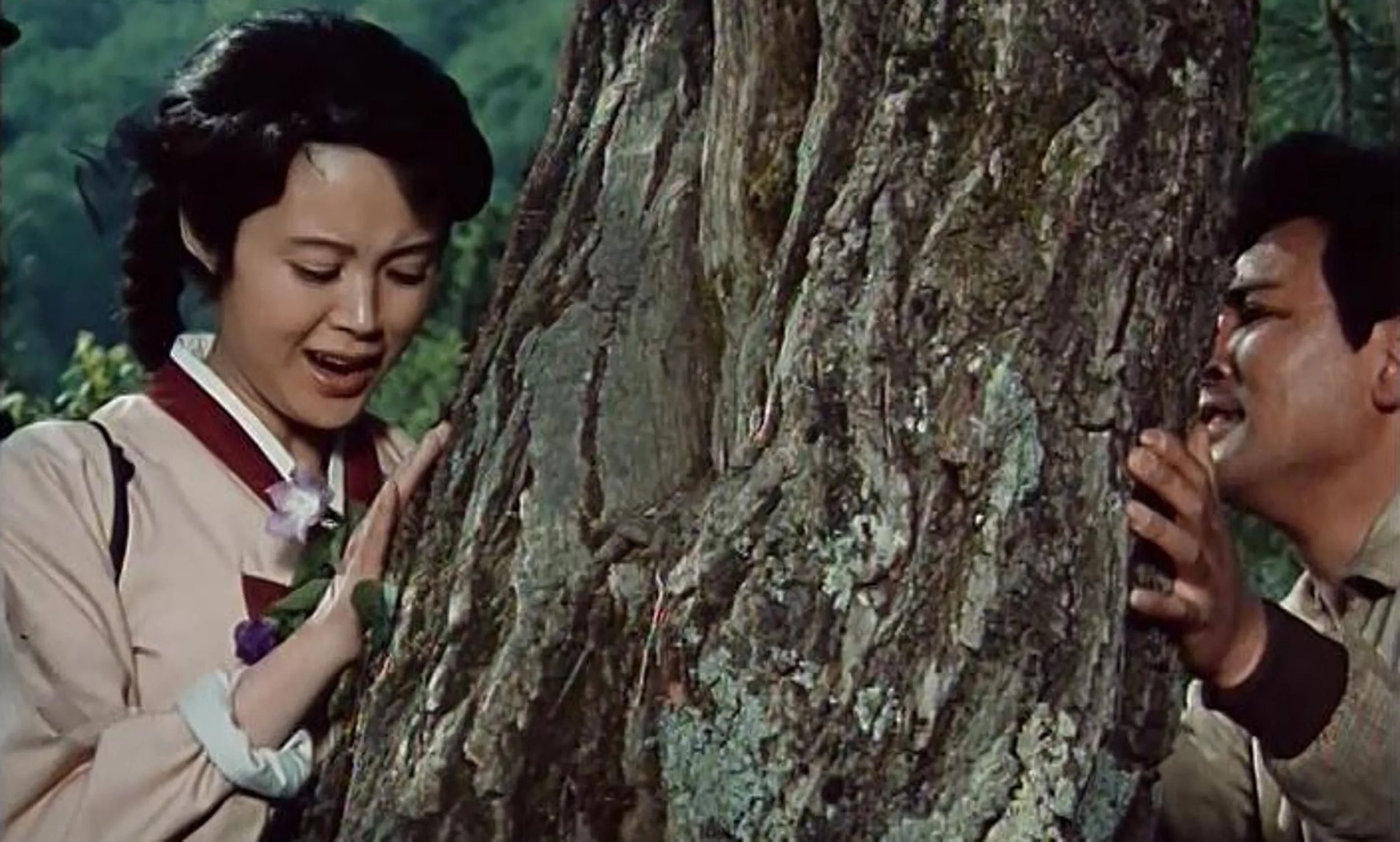
KCNA
Kim Il Sung, North Korea’s founding leader, believed in Vladimir Lenin’s maxim that cinema constituted “the most important of all the arts.” What happens to the cinema’s artistic and emotional possibilities when it is elevated above all other arts as a tool of political power?
North Korea's cinema industry lacks themes on ordinary personal life and romance, primarily resulting from the function of entertainment as a state instrument in the DPRK. All film production in the country is controlled by the Korea Film Studio and supervised by the Workers’ Party Propaganda and Agitation Department. Writers and directors are trained to prioritize conveying political messages over realism and portraits of complex emotional dimensions of people. In her book Illusive Utopia, Suk-Young Kim described the DPRK’s propaganda as a “never-ending machine for state power and a site of consistent misinformation”.
History
North Korea’s film output is extremely low. From 2000 to 2009, North Korea produced only about five films per year. In the film industry, the discussion of “love” is rare, or even completely absent, in depictions of romantic relationships. “Love” is frequently associated with patriotism, loyalty to the Kims family, or camaraderie, specifically the soldiers’ relationship developed in the military unit. In the film The Lieutenant of Those Days, “love” is framed as a socially sanctioned effect produced through the local community, positioning the military unit as the primary site of emotional and moral formation.
Similarly, in the movie series Unsung Heroes, an ambitious film project composed of 20 parts, love is portrayed throughout the storyline in unconventional ways. Love among comrades is being described as “the noblest form of love — beyond romantic love and friendship”, and the most important part of this “love” is hinted to be Kim Il Sung's love for the people. “Comradely love” is presented as the dominant emotional ideal, as recent films normally construct intimacy through collective life in military units, staged in spaces such as training camps, guard posts, and worksites. For instance, the two films, Silmido (2003) and Taegukgi (2004), both set in the background of the conflict between North and South Korea, emphasized the fraternal loyalty and love between the soldiers.
Kim Jong Il’s intervention in the film industry
Kim Jong Il was a member of North Korea’s Propaganda and Agitation Department and the director of the Motion Picture and Arts Division. During the 1970s and 1980s, witnessing the vivid contrast between how North Korean films and other films being released globally were received, he was frustrated and eager to find solutions. He was convinced that the fundamental problem lay in a lack of enthusiasm of actors and crew in the industry.
On January 14th, 1978, North Korean agents abducted South Korea’s most popular actress at that time, Choi Eun-hee. She was taken on private tours focused on Kim Jong Il’s achievements and the musicals and movies in North Korea. Six months later, Choi’s ex-husband Shin Sang-ok, a well-known director of South Korea, was kidnapped by North Korean operatives. He was first thrown in jail due to his disobedience, then was released by Kim, who requested that Sang-ok direct a film and enter it into an international contest. The international community condemned the kidnapping of Choi Eun-hee and Shin Sang-ok as both morally indefensible and horrifying, revealing the extent to which the regime aims to pursue cinematic legitimacy.
These historical interventions still shape contemporary North Korean film production where creativity remain constrained. A Day and a Night (2022) and 72 Hours (2024) are the most recent film releases in the country. While the former was released for the 110th birth anniversary of Kim II Sung, the latter is about the occupation of Seoul in three days during the Korean War.
The Concept for “Family”
Standing in front of a list of patriotic or propaganda films and documentaries, one can hardly find any romantic or intimate scenes in North Korea’s film industry. However, taking a few steps back, what about familial love?
The Schoogirl’s Diary, according to the anti-Japanese revolutionary fighter Chŏn Mun-jin, is an excellent work that shows the new aspect of North Korea’s cinematic art. According to him, the movie is “blossoming brilliantly in the new century under the guiding hand of a great leader.” The movie is about a North Korean teenage girl’s struggle to understand her parents’ devotion to the country, specifically his father’s scientific devotion at the expense of his own family’s happiness. Her father spends almost all his time at work as a computer engineer in a distant town, leaving his wife, two daughters, and mother-in-law in a rural home. The climax of the film occurs when the girl realizes how selfish she was to her father, when he achieved a breakthrough in his research.
Thus, family love is depicted as intertwined with one’s devotion to the nation. Though disregarding his whole family’s happiness, the father’s self-sacrifice for the nation is considered the most noble act. In this way, the film reinforces the emphasis on ideological instruction over realistic depiction of everyday family life in North Korean film, leaving little room for individual desire or autonomy. Furthermore, a recent documentary film released in 2019 called “A Great Harmonious Family” portrays a common North Korean propaganda motif of how a family should be, where the entire society is one extended family united under the leadership of the Workers’ Party and the Kim dynasty.
The State’s Ideal for “Family”
North Korea's divorce policy has shifted from a comparatively lenient administrative process to a much stricter system. According to first-hand accounts from residents, if a couple is granted divorce by courts, both spouses will be sent to labor camps. Divorce is discouraged by the state, aiming to preserve a “stable, "harmonious, and “united” family image. In addition, a sexist value can be seen in the treatment of individuals who desire an end to their marriage. According to a female who went to a labor camp in South Pyeongan province after her divorce, women imprisoned due to divorce decrees received harsher sentences than men, even though a majority of women were victims of domestic abuse by their husbands.
Additionally, according to Radio Free Asia (RFA), starting in 2023, North Korea launched an education campaign to specifically prevent women from getting divorces. Members of the Socialist Women’s Union, which is the nation’s largest women’s organization, were asked to attend lectures, stressing the importance of “eliminating the phenomenon of divorce and building a harmonious society”.
2008 was the most recent year in which North Korea conducted a published nationwide census. A census was only conducted once after that, but no data was released to the public. According to the 2008 census, the state documented only 0.3 % of the population as “separated”, which is an extremely small proportion relative to the total population.
Conclusion
From North Korea’s strictly controlled entertainment industry and coercive interventions in cultural production, to its regulation of people’s intimate life, one can observe a consistent logic underpinning state power and the erosion of personal autonomy. In this system,genuine emotional expressions are being suppressed or neglected, while state propaganda redefines personal relationships to serve political needs: love is being reframed as loyalty to the regime and and a willingness to sacrifice for its goals, and family ties are seen as duties to ideology rather than bonds of care or affection.
Divorce, in North Korea, is framed as morally irresponsible or an anti-socialist mistake that deserves punishment. From individuals who want to end their relationships to victims of domestic abuse or severe marital conflict or threats, they either end up remaining in their unwanted relationships or being sent to labor camps after their request is granted by the court, reinforcing the idea that individual needs and desires are entirely subordinate to the state’s ideal for harmony and stability.
In this way, North Korean cinema does not merely reflect an absence of romance or realism: it mirrors a broader system in which emotional freedom, personal choice, and the right to exit one’s own relationships are systematically denied.