
South Pacific: The Forgotten Nuclear Weapon Testing
Getty images
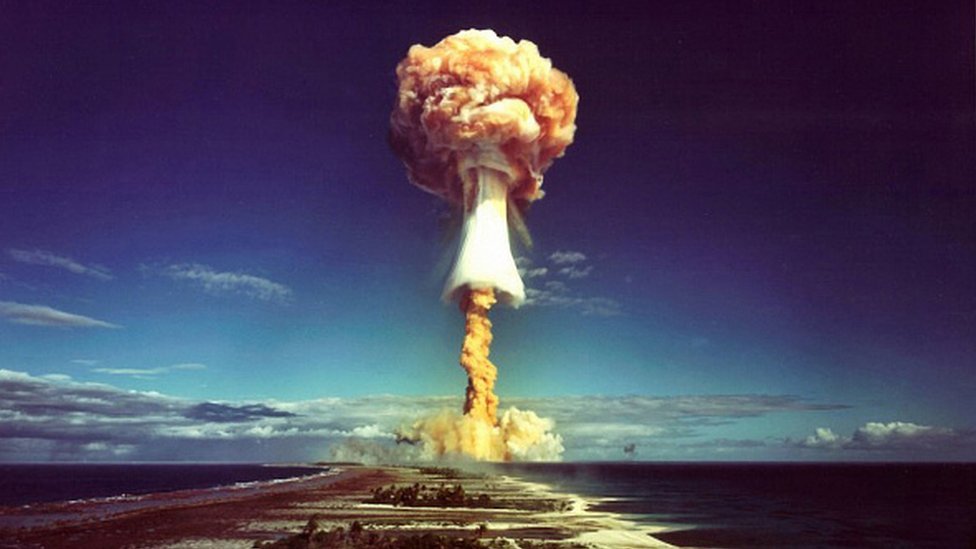
French Polynesia, known for its glamorous emerald isles and sapphire lagoons, is often pictured in the global imagination as a tropical paradise. However, barely covered is a global forgotten history of an environmentally abused overseas country of France. The landscape and society profoundly shaped by a history of nuclear weapons testing. Between 1966 and 1996, the French Republic detonated 193 nuclear weapons at the remote atolls of Moruroa and Fangataufa, transforming a region of scattered islands into a vital testing ground for France’s strategic arsenal.
For decades, the extent of environmental contamination and human exposure remained contested or obscured. Recent reassessments by investigative researchers indicate that fallout from atmospheric tests likely exposed nearly the entire Polynesian population to radioactive contamination, far beyond official estimates. According to these studies, radiation doses may have been significantly underestimated in earlier government assessments, meaning the health toll – including cancers and other radiogenic conditions – may have been far greater than recognized under prevailing compensation frameworks.
French political leaders have made gestures toward acknowledgement.
In 2021, President Emmanuel Macron conceded that Paris “owes a debt to French Polynesia” over its testing programme, and admitted that the tests “absolutely cannot say that they [nuclear tests] were clean – no”
Yet truth-telling and financial reparations have been slow and partial, leaving activists, researchers, and affected families calling for fuller accountability, environmental restoration, and justice decades after the last detonation.
Environmental and Health Impacts
Between 1966 and 1996, French authorities conducted 193 nuclear tests across the remote atolls of Moruroa and Fangataufa in the Tuamotu Archipelago, including 41 atmospheric tests carried out until 1974. These detonations sent plumes of radioactive fallout into the air and ocean, impacting islands and communities far beyond the test sites.
Recent investigative reassessments, drawing on declassified military documents, suggest that previous government estimates significantly underestimated the extent of radiation exposure. Researchers concluded that for the 1974 Centaure test alone, roughly 110,000 people – or nearly the entire population of French Polynesia at the time – may have been exposed to radiation doses above 1 millisievert, a threshold relevant for cancer risk and compensation eligibility.
These reassessments indicate that official radiation monitoring – based largely on historic Atomic Energy Commission data – failed to account for common local behaviors, such as the consumption of rainwater and traditional diets dependent on lagoon fish and sea life, which increased internal exposure.
The environmental toll was equally profound. At Moruroa and Fangataufa, decades of subterranean blasts fractured coral structures and created craters and waste repositories laced with long-lived radionuclides. Some independent assessments warn that rising sea levels or geological shifts could eventually mobilize these contaminants into broader ecosystems, posing a future threat to marine life and coastal communities.
Health data reflect these exposures. Although formal epidemiological studies remain limited and contested, researchers have documented higher rates of cancer and other illnesses in populations exposed during the test era. For example, thyroid cancer incidence in populations with potential proximity to fallout has been reported as markedly elevated compared with certain Pacific reference groups, underscoring ongoing concern about the tests’ health legacy.
Despite this evidence, official acknowledgement and remediation have been slow, leaving many Polynesians and activists – such as local organisations Association 193 and Mururoa e Tatou – calling for a fuller reckoning with the environmental, health, and human costs of the testing program.
Politics of Recognition and Compensation
While France has increasingly acknowledged the harm caused by its nuclear testing program, recognition has not translated into comprehensive accountability or reparations. Instead, compensation has been slow, narrow in scope, and burdened by high evidentiary thresholds that many Polynesian victims struggle to meet.
In 2010, the French government introduced the Morin Law, establishing a legal framework for compensating civilians and veterans affected by nuclear testing. Claims are assessed by the Compensation Committee for Victims of Nuclear Tests (CIVEN), which determines whether applicants’ illnesses can be causally linked to radiation exposure.
Since the Morin Law established a formal compensation process in 2010, thousands of nuclear-related health claims have been submitted to CIVEN. According to the committee’s own activity reports, of the roughly 2,846 claims submitted by 2023, just 1,026 individuals were recognized as qualified victims and offered compensation – a recognition rate of just over one-third. Many others have been rejected or remain unresolved, often due to stringent requirements that applicants prove sufficient radiation exposure under technical thresholds. A recent French parliamentary inquiry found that in 2024, as much as 70 percent of new claims were not approved, with approximately 1,000 total recognitions out of around 3,000 dossiers presented since the law’s inception, reflecting persistent obstacles to full redress.
Although reforms have since lowered evidentiary barriers, activists argue the system remains structurally restrictive. Many victims lack access to historical exposure records, while others suffer illnesses not explicitly listed under compensable conditions.
President of Association 193, Father Auguste Uebe Carlson, has even said, “The atmospheric tests impacted on all of French Polynesia, … The French state has difficulty admitting that radiation-induced illnesses have not only affected the Moruroa workers, but the whole population over many generations.”
Political recognition has also been carefully calibrated. During a 2021 visit to Tahiti, President Emmanuel Macron acknowledged that France “owes a debt” to French Polynesia and conceded that the tests had caused harm. However, he stopped short of issuing a formal state apology or committing to broad reparations, a decision that disappointed many local leaders.
Critics argue that this approach reflects a broader strategy of symbolic acknowledgement without legal liability – recognizing suffering while limiting fiscal and political consequences. As a result, the legacy of nuclear testing remains unresolved not only environmentally, but politically.
The Future: A Poisoned Legacy Without Closure
French Polynesia’s nuclear history reveals a contradiction at the heart of France’s post-colonial governance. The state has acknowledged the environmental and human costs of its nuclear program, however, it has resisted the full consequences of that recognition. Compensation remains limited, transparency partial, and accountability carefully constrained.
The nuclear tests conducted at Moruroa and Fangataufa were not isolated Cold War relics; they reshaped ecosystems, altered public health trajectories, and entrenched economic and political dependency that persists today. For many Polynesians, the issue is no longer about revisiting the past, but about securing dignity, truth, and justice in the present.
As climate change continues to pressure these low-lying atolls and regional Pacific states, it is only becoming more imperative for these small island nations to push for nuclear accountability on the global stage. France’s unresolved nuclear legacy in Polynesia grows harder to ignore. Without comprehensive environmental remediation and meaningful compensation, the promise of justice will remain as fractured as the atolls beneath which France once tested its bombs.