
Far East: Supporting Rural Women for Long-Term Resilience in Myanmar
Trócaire
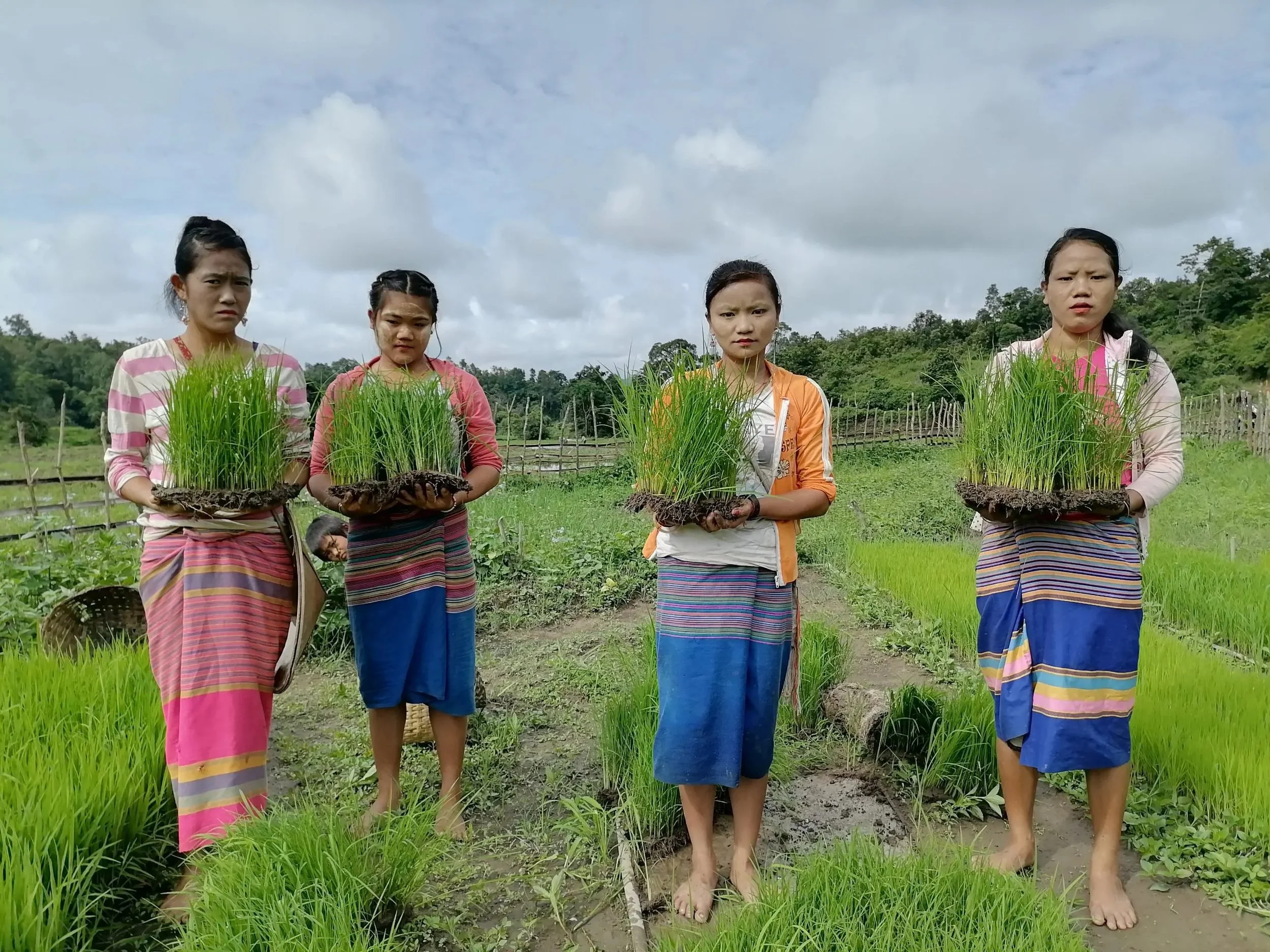
Across rural Myanmar, women commonly manage household farms, yet their contributions are rarely formally recognized. According to data collected by the United Nation’s Food and Agriculture Organization, the average farm wages women receive in Myanmar are 29% lower than men’s, and the number of adult men with land rights are 12% higher than the number of documented female landowners. Against this backdrop of unequal pay and land access, many women in Myanmar are actively seeking new primary sources of income.
Introduction
In the past, the concept of land was closely tied with rice production incentives, though its role has shifted with social and economic transformation. Now, “land” has come to center on the issues of inter-generational survival, redistribution, and care-provider systems in Myanmar. With the lack of effective state welfare systems, land serves as the household’s main form of social and economic protection.
A 2025 UNDP report stated that, by the end of 2023, 49.7% of the population is living below the national poverty line and an additional 25% is barely above it. The report further presents the rising rates of unemployment and poverty for women, demonstrating that women-headed households are 1.2 times more likely to live in poverty compared to male- headed households. A Cornell University’s study further demonstrates that, when encountering land issues, women in Myanmar are less confident to discuss and face the problem. This is largely due to two reasons: first, government offices in the nation are predominantly occupied by men, being perceived as a men's space unwelcoming and hostile to women; second, the female literacy rate is lower than the male counterpart — and these gender disparities increase in rural areas — whereas women have almost 50% less access to land policy and procedure information in Myanmar.
Even as Myanmar’s economy expands, rural women continue to be disproportionately marginalized. They face constant barriers to land ownership, wage equality, work recognition, and the education system, constraining their ability and chances to secure economic stability. Even amid persistent inequality, rural women are creating and discovering new opportunities through small businesses and corporate networks.
Rural Myanmar Women Farmers Building Nation-Wide Network
In 2024, only 48% of Myanmar’s population has access to electricity, positioning it as the country with lowest level of electricity in Asia. Its neighboring countries have substantially outpaced it, with Thailand, Laos, and Bangladesh achieving almost 100%, and Cambodia reaching around 82.5%. Limited access to electricity constrains both daily economic activities and communication and socialization. Rural communities therefore face heightened isolation.
Supported by the United Nations Development Programme (UNDP), the May Doe Kabar National Network of Rural Women built a network system that benefited a total of hundred thousand rural people in 2018. This organization, led by 31 rural women Chief Strategy Officer (CSO), designs tools and platforms for individuals to stay connected despite geographic isolation, under the circumstance of unstable or absent internet access. The network system continues to today, bringing together 22,000 rural women members from around 2,000 self‑help groups across eight states and regions in Myanmar.
The mobile phone application, iWomen Inspiring Women, enables women to stay in touch with one another across villages by sharing pictures, stories, and information. People can use chat boards and content feeds for encouragement and support, which foster mutual understanding and female empowerment. In addition, the application provides various resources including market opportunities, citizen rights, legal procedures, etc.
As the first rural women network system nationwide, the story and achievement of this group of people is remarkable and inspiring. Women remain extremely underrepresented among ward and village tract administrators in Myanmar. In 2025, women represented about only 18% of total registered candidates in the 2025 election, reaching the highest number in two decades. The rural female efforts in promoting mutual understanding reflects determination in reinforcing solidarity, confidence, and leadership among women, a powerful act in building more resilient rural communities across the country.
MEDA
Aiming to support rural women and women-owned businesses, Mennonite Economic Development Associates (MEDA) launched a 5-year project with a $2.4 million investment and assistance from Global Affair Canada (GAC) of $16 million. This project focused on two ethnic regions: Shan State and Kayin State. By enabling rural women to take on leadership roles in community services and the market, MEDA created two market chains: vegetables in Shan State and rice in Kayin State. The project targets to assist around 25,000 female individuals in participating in the market.
Via the Improving Market Opportunities for Women (IMOW) program, MEDA took advantage of Myanmar’s agricultural labor forces and rural economic development prospects, building market linkages between input suppliers, transporters, brokers, and wholesalers, and between rural and urban markets.
In 2021, MEDA started a partnership with Harmony Myanmar Agro Group (Harmony). Harmony recruit female farmers to improve with knowledge and experiences of agricultural practices for their business chain of natural farm inputs’ sale. Through this collaboration, Harmony aims to provide job positions for more than 2,000 women farmers. In Kayin, the company plans to partner with women dealers in three more locations, achieving the support for an additional 1,300 women farmers.
Women-led Solar PV Enterprises in Rural Myanmar
As one of the world’s largest energy corporations, TotalEnergies SE (TOTAL), launched a pilot solar lighting project in rural Myanmar, where six of the 14 entrepreneurs were female. Between 2014 to 2023, many local people were trained to become entrepreneurs, selling solar lamps and systems. This was a solar energy initiative that created tangible economic and leadership opportunities for women, laying the groundwork for future rural female involvement in national-scale renewable energy programs. At the same time, companies, local NGOs and international NGOs have also invested in solar technology industry in rural Myanmar, creating more economic possibilities for the rural populations. For example, completed in 2015, SPCG Public Company Limited (SPCG), a Thai company, installed 2 solar farms in rural Myanmar (Yangon and Mandalay). The UNDP, in collaboration with the Renewable Energy Association of Myanmar, started a rural LED solar lighting project in 30 villages. The most up-to-date data collected by the Electric Power and Energy Development Commission in 2025 shows that Myanmar is implementing 11 new solar and hybrid power generation projects, and of the 11 projects, 9 solar power plants.
Conclusion
Rural women in Myanmar nowadays continue to face substantial structural barriers and inequality. Data in 2023 published by Myanmar’s Ministry of Information showed a female employment rate of 43.8%, roughly 25% lower that of men in the netion. The stories of rural female leaders like members of the May Doe Kabar National Network remain under-reported, while their efforts in creating new pathways to economic opportunities and collective resilience deserve higher attention. Simultaneously, circumstances of rural women in Myanmar serve as a potent example for persistent gender gap and long-standing hierarchy system. As rural economies in Myanmar are going through shifts, women are increasingly stepping into entrepreneurial roles, actions that can’t be fully accomplished without support and recognition from both national and international levels.