
China View: In Gannan, Tibetan Buddhism Is Under Strict Monitoring
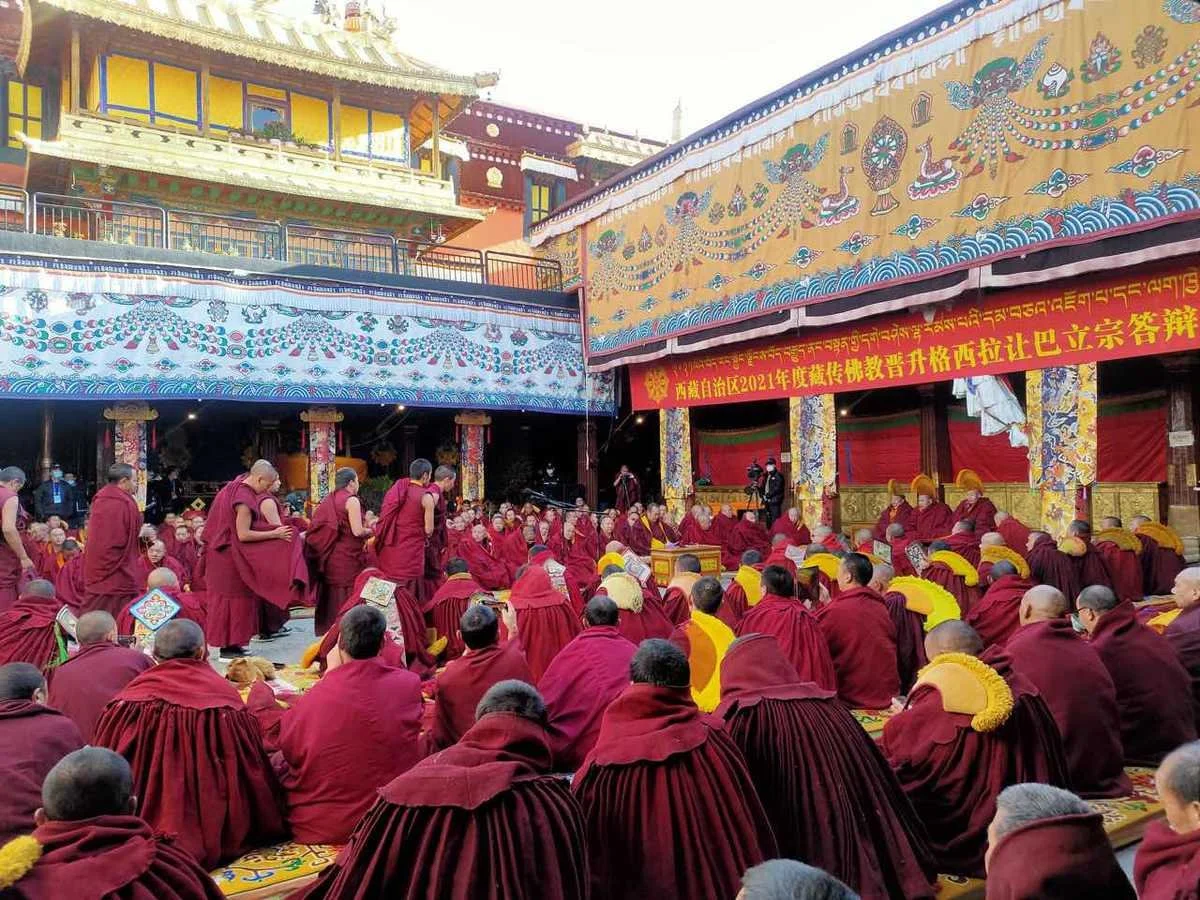
In September 2023, the Chinese government announced a prohibition on participating in the Buddha Exhibition Festival hosted by Tashilhunpo Monastery, a major Gelugpa in Gannan Autonomous Prefecture. Despite this ban, thousands of Tibetan Buddhists disregarded the restrictions and traveled to Gannan to take part in the puja collectively. Chinese police detained a former policeman and a member of the Communist Party of China, issuing a citation for violating the law. The local religious governance in western China significantly impacts religious practices and cultural transmission, especially among Tibetan Buddhist communities in Gansu and Qinghai.
The history of Tibetan Buddhism in China is significant.
In the seventh century AD, the Buddhism that emerged in present-day India came to Tibet, where it became a unique form. Tibetans mainly reside in Tibet, Sichuan, Qinghai, and Gansu, with Gannan Tibetan Autonomous Prefecture being one of the ten Tibetan autonomous prefectures in the country. Notably, Tibetans are the majority population, and Han Chinese are the second largest group.
Since 1947, the People's Republic of China has implemented regional autonomy for ethnic minorities for 79 years. In China, ethnic minorities are often closely linked with specific religious beliefs, and the missionary work under government restrictions affects the religion and education of these minorities. According to the 2020 China Seventh National Population Census report, the Tibetan population is 7.06 million, accounting for 0.5% of China’s total population. Additionally, Qinghai Province already has a Tibetan population of 1.51 million. The distribution of the Tibetan population in Gansu Province is nearly 490,000. This data demonstrates that Tibetans are densely concentrated in Gansu and Qinghai, which also means that it reflects the significance and education of ethnic minorities in these two provinces.
Chinese Surveillance of Religious Gatherings.
The Kalachakra Empowerment is a significant religious event in the Gelug school of Tibetan Buddhism that involves various rituals and practices. On February 3, 2023, Tibetans from Xiahe County in Gannan participated in the significant annual religious event known as the Prayer Festival at Labrang Monastery. During this time, the Chinese government deployed a large number of police to the event site to conduct immediate searches of the participants' mobile phone contents. Tibetans accuse the Chinese authorities of violating their human rights and attempting to eradicate their religious, linguistic, and cultural identity. Moreover, Human Rights Reports indicate that Chinese authorities monitor the speech of Tibetans through the internet and social media, such as monitoring monks' chat history. The Chinese government will arrest individuals on political charges if they criticize its educational reforms in Tibet.
From the Tibetan perspective, the Chinese government's restrictions on religious activities and reductions in Tibetan language courses in education demonstrate its oppression of ethnic minorities. The National Ethnic Affairs Commission of the PRC states that they enforce the separation of religion from education, ensuring that religious teachings are not part of the national education curriculum. Article 36 of the Constitution of the People's Republic of China does not detail the government's criteria for identifying religious activities that disrupt social order or impact the national education system, leading to ambiguity in enforcement. Conflicting interpretations of religious beliefs between the Chinese central government and domestic ethnic minorities compromise objectivity.
Should religion truly come under political management?
When the central government aims to assimilate ethnic minorities, the initial measure taken is usually educational reform. Rong Zeren Denzhu, a Tibetan historian and former international visiting scholar in the United States, has pointed out that contemporary Tibetan elementary school students in China exhibit low levels of Tibetan literacy skills. More supervision of important religious events could reduce chances for informal religious education in Tibetan communities, affecting the passing down of cultural and religious knowledge.
From 2023 to 2024, there was a decrease in the number of Tibetan primary and secondary schools by 0.71%, Tibetan bilingual primary and secondary school students by 7.34%, and Tibetan kindergartens by 0.96%, according to the latest data. However, in Gannan Tibetan Autonomous Prefecture, the number of boarding students decreased by nearly 10%, and the number of Secondary Vocational Education students significantly decreased by nearly 30%. Although not drastic, there is a noticeable decline in Tibetan education in Gannan.
Per data from the State Administration for Religious Affairs of China, there are currently just seven Tibetan Buddhist schools in the country. The Chinese government has been consistently enhancing national ideological unity. Article 20 of the Law on the Promotion of National Unity and Progress of the People's Republic of China, submitted in 2025, mandates that parents or guardians educate minors to support the Communist Party of China. Article 44 mandates that industry associations, foundations, and religious bodies not only adhere to but also actively promote the CPC ideology, influencing various sectors of society. In general, the Chinese government intervenes in religion by monitoring activities and implementing educational changes focused on ethnic minorities.
Conclusion
In a broader national context of religious freedom violations, Gansu and Qinghai reported seven incidents related to religious beliefs, accounting for approximately 23.3% of the 30 cases documented nationwide. This concentration of incidents in the northwest region highlights the conflicts surrounding religious freedom and government policies in areas known for their ethnic and cultural diversity. To address these challenges, it is crucial to consider approaches like dialogues between state and religious groups amidst restrictions on religious freedom and government assimilation policies.
