
Middle East: The Houthis?
Khaled Abdullah/Reuters
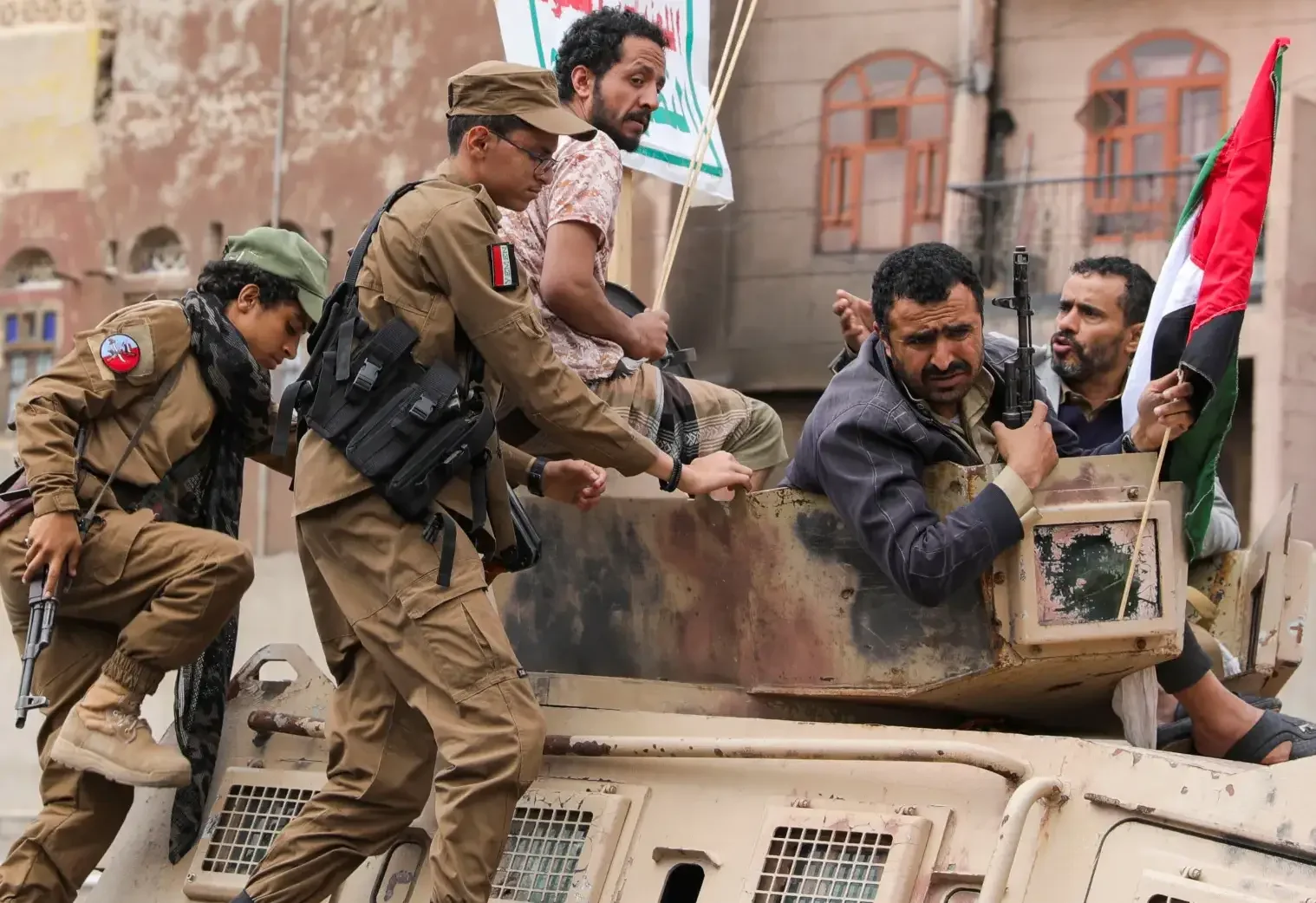
Formally known as Ansar Allah (partisans of God), the Houthis have recently gone through a radical transformation, from a peripheral ‘Zaydi Shia’ (a branch of Shia Islam) movement in Yemen’s northern mountains to a serious regional power and even a chess piece in Iran’s “Axis of Resistance”. Emerging as challengers to the Yemeni central government in the 1990s, they currently maintain de facto governance over significant portions of northern and western Yemen, including the capital, Sana’a, and control approximately 70% of the country’s population. Their ability to project force into the Red Sea and launch direct attacks on nearby countries has moved them up from a domestic rebel group to a disruptor in the broader Middle East struggle.
The Houthi movement emerged from a revival of “Zaydi” political activism in the early 1990s in the Saada Governorate of northern Yemen. Driven by a perceived political and economic disenfranchisement by their government, the spread of Saudi-funded Salafism in the Zaydi heartlands (located in Southwest tip of Arabian Peninsula), and the charismatic leadership of Hussein al-Houthi; founder of the Houthi movement. Initially, the group operated through civil society organizations like the Believing Youth group, which built school clubs and summer camps to promote Zaydi identity. The movement dramatically radicalized following the 2003 U.S. invasion of Iraq, adopting the infamous slogan “The Sarkha” (Arabic for “The Scream” or “Collective Outcry”), which calls for the deaths of America and Israel and a curse upon Jewish people. Between 2004 and 2010, the Houthis fought six wars (the Saada Wars) against the government of now-former President Ali Abdullah Saleh. Despite Saleh's tactics and Saudi Arabia’s eventual intervention in 2009, the government failed to suppress the Houthi rebellion, which ended up further galvanizing support in the north.
The chaos brought by the 2011 Arab Spring gave the Houthis the opportunity to expand their territory beyond the northern province, known as Saadah. By September 2014, in an unlikely alliance with their former enemy, Ali Abdullah Saleh, the Houthi forces seized control of Sanaa. This takeover eventually forced president Abdrabbuh Mansur Hadi to flee the country and triggered a massive Saudi-led intervention in 2015.
While the Houthis were an indigenous movement not originally founded in collaboration with Iran, their relationship with Tehran in recent times has evolved into a security partnership of sorts. This alignment has provided the group with training, intel, and advanced weaponry, including long-range ballistic missiles and drones such as the Samad-⅔, Qasef-1/2K, and the infamous Shahed-136. These are long-range, low-cost kamikaze drones designed to attack infrastructure and shipping. Mentoring from Lebanese Hezbollah and the Islamic Revolutionary Guard Corps has also helped to transform the Houthis from a local guerrilla force into a regional actor capable of globalizing conflict and exerting autonomy.
Unlike other regional proxies, however, the Houthis are often described as “willing partners” rather than simple proxies, as they do in fact maintain a high degree of autonomy and an independent religious andideological background. They’ve utilized this relationship with Iran to field-test Iranian made weapons against Saudi and Israeli targets, thus providing Tehran with plausible deniability regarding these operations. Since 2023, the Houthis have catapulted into the front ranks of the Axis of Resistance, being bolder and far more eager than their more established counterparts, like Hezbollah.
Inside Houthi-controlled Yemen, the group has implemented a “government by supervisor” system. This power structure places Houthi loyalists, known as Mushrifeen (Arabic for supervisor), within all government departments and districts to ensure faith to the regime. Real authority rests with these supervisors, most of whom have deep regional or marital ties to the al-Houthi family.
The Houthi administration in Sana’a operates as a theocratic police state, relying heavily on repression to maintain control. Professional classes of intellectuals, such as professors, judges, and civil society activists, have been specifically targeted for repression, while tribal sheikhs are cowed through violence and property seizures. Despite sitting atop a collapsed economy, the Houthis have shown some remarkable financial resilience. They extract an estimated $1.8 billion annually in taxes and levies, roughly equivalent to the revenues collected by the entire Saleh regime, and generate additional income through oil smuggling and fees on ships transiting the Bab el-Mandeb Strait.
The Houthis have changed their role in the Middle East by using Gaza to globalize their conflict. Since late 2023, they have conducted over 145 attacks on commercial and military vessels in the Red Sea, forcing major shipping firms to divert routes around Africa. This maritime harassment has caused a 90% decline in container shipping through the Red Sea and added billions of dollars in costs to the global economy.
Their strikes against Israel, including the use of ballistic missiles and drones targeting sites like Eilat and Beersheba, are regarded as serious acts of escalation. On March 28, 2026, the Houthis launched missile attacks on sensitive Israeli military sites, vowing to continue until “‘aggression’ on all fronts ends”.
The Houthis are now beginning to diversify their alliances beyond the traditional Axis of Resistance. They have established coordinating offices in Baghdad and announced joint military operations with the Islamic Resistance in Iraq. They have also formed alliances with Sunni militant groups such as Al-Shabaab in Somalia and Al-Qaeda in the Arabian Peninsula to facilitate weapons smuggling and intelligence sharing via the Gulf of Aden.
This group is also intensifying contacts with Moscow, which has reportedly provided satellite data to aid Houthi targeting of shipping and has discussed the provision of advanced anti-ship missiles. Houthi disturbance in oil shipping in the Red Sea is expected to mean more profitable oil sales for the Kremlin. These developments make it increasingly difficult for international stakeholders to disentangle the war in Yemen from the broader Middle East crisis.
The Houthis are likely to emerge from the current regional conflict as a more confident and ambitious military organization. They demonstrated extreme resilience in the face of U.S-U.K. joint airstrikes and appear encouraged by their global visibility and popularity among certain audiences. As they continue to integrate new drone technologies and hypersonic missiles, the threat they pose to regional stability and international navigation is expected to remain a long-term challenge. The Houthi movement is no longer just a rebel group; it is now a permanent fixture of the regional security landscape that has now proven to be “battle-tested” in ways few state-level actors can claim.
