
Far East: The Emotional Pulse of Kathmandu Festivals
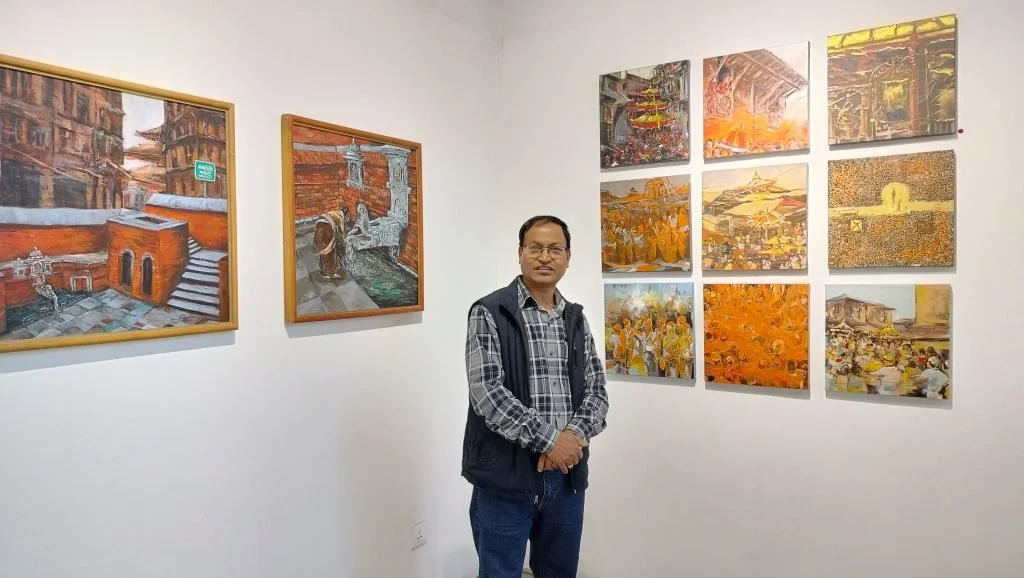
In May 2026, Nepali artist Pradip Kumar Bajracharya opened his exhibition “Festive Spirit.” His works endeavor to preserve the emotional memory of Newah culture, specifically at a time when rapid urbanization and modern life are reshaping Kathmandu Valley’s traditional identity in Nepal. Bajracharya’s exhibition, as a quiet resistance against cultural erosion, shows the use of abstracted art style used to provoke the human senses, particularly in relation to spirituality and rituals.
Kathmandu, Nepal’s capital and largest city, is known for its rich cultural heritage. It has UNESCO World Heritage Sites like Kathmandu Durbar Square and Pashupatinath Temple, one of the most important Hindu temples in the world. Research on spatiotemporal urbanization patterns in Kathmandu Valley found that, since the 1980s, urban built-up areas have expanded at an increasing rate, rapidly transforming agricultural land and traditional settlements into dense urban spaces. Consequently, Nepal is one of the countries in the Asia-Pacific region with the highest urbanization rates. Scientific Reports predicts that Kathmandu Valley’s fully constructed urban area could nearly double by 2050.
The Newah Culture
Newah culture was born in Kathmandu Valley. The Newars are the valley’s indigenous people, and from the 12th century to the 18th century, the Newar kingdom of the Nepal Mandala ruled the region and surrounding territories. The Newars speak their own language, Newari (Nepal Bhasa), one of the languages under the Tibeto-Burman language family. Furthermore, the Newah culture was developed through a deep blending of both Hinduism and Buddhism, which simultaneously influenced the architecture and art of the Nepali state. Many temples, monasteries, and courtyards often contain both Buddhist and Hindu imagery. For example, Swayambhunath, also known as the Monkey Temple, is an ancient religious complex where Buddhist stupas coexist with Hindu shrines and deities.
Because the Newars developed a highly organized urban civilization with their own language, culture, religion, architecture, and social systems long before modern Nepal was unified, unlike other ethnic groups in Nepal, they are regarded uniquely within the country as a nation community with a relict identity.
The Newah Art and Festive Spirit
Deeply influenced by Buddhist and Hindu elements, The Newars are celebrated for their exceptional skill in the visual arts. The Newa art is known for its rich connection with collective memory and community identity. For centuries, Newar artists transformed Kathmandu Valley into a living artistic landscape through architecture, sculpture, painting, and ritual performance. Bajracharya’s work, using a contemporary understanding of abstractions, draws from this heritage while responding to the rapidly changing realities of urban Nepal.
Bajracharya’s style is highly distinguishable. His strokes have a strong sense of movement and strength, reflected in their uneven distribution of lines, structures, and symbols and bold use of colors and paints. Instead of carefully outlining faces, figures, or buildings, he often dissolves crowds into flowing brushstrokes, layered colors, and blurred forms. Naturally, festivals and rituals under his imagination turned into memories in motion rather than fixed scenes.
To cultivate his tone, Bajracharya uses a lot of bright colors like red, orange, and yellow, covered sometimes in a smoky atmosphere. Regarding texture, he tends to create layered and ambiguous visual elements rather than depicting details, and is highly free-spirited and creative with his linework. In some paintings, the more than half of the piece comprises half-dots and short strokes.
A major theme in Bajracharya work is collective memory. According to him, quick and abstract painting is his way to preserve the original emotional energy for the memory and culture before it fades. In this sense, the nostalgia invoked from watching his work is not an easy journey or simple reflection – it ought to come through anxiety and realization about cultural transformation in modern Kathmandu. In the exhibition, “Festive Spirit”, Bajracharya portrayed some old alleys and temples into fading shadows or transient color composition, mirroring the gradual disappearance of older communal spaces under rapid urbanization.
The Artist: Pradip Kumar Bajracharya
Born in 1971, Bajracharya grew up in the old neighborhoods of Kathmandu, surrounded by the dense ritual life of Newah communities. Since his youth, Bajracharya has viewed Jatras as a valuable medium for cultural continuity, which has inspired him to tell their story through his paintings. In Newari, the word “Jatra” translates to “festival”, and is used to describe a wide range of street celebrations unique to the Newar population. Every year, Jatra transform regular city streets into colorful displays of culture.
Bajracharya attained his Bachelors Degree in Fine Arts from Tribhuvan University in 1997. The time in which he studied fine arts was also a period when contemporary Nepali artists were exploring modernism while connecting to their tradition and local culture. He began his expressive journey related to Jatras in the early 2000s. “Festive Moods”, “Festive Images” and “Heritage Panorama” are prequels to his current exhibition, showcasing correspondingly in 2003, 2004, and 2007, respectively.
Now presented at Gallery MCube, located within the Kathmandu Valley, Nepal, “Festive Spirit” aims to capture both the chaotic and warm sides of Nepal’s celebrations for culture and tradition. Bajracharya’s abstract forms dissolve familiar Newah scenes into movement, color, and atmosphere, serving as a visual bridge between what is remembered and what is changing. In the end, Festive Spirit is a precious reminder to people that culture is something that should be preserved in feeling. The ability to see festivals and rituals into emotional landscapes could become a substantial power in preserving one’s history, past, culture, and customs. Even as cities transform at a rapid pace, memory continues to move through them, quietly, vividly, and in the most creative and astonishing colors.