
South Pacific: Preserving an Endangered Language
pbs
Guam, a U.S Island territory in Micronesia, is facing a significant battle to keep alive the traditional language of the CHamorro Indigenous people. Currently, only 5% of the native Indigenous people under 30 can speak the language and is labelled an endangered language. This issue stems from the U.S. and Spanish’s approach to leadership and ultimately colonialism in the 20th century. There was an aggressive push from a subsistence lifestyle to a western economy and government, leading the territory to shift away from traditional culture in favor of Western . There were also strict legislations such as designating English as the sole official language of Guam and school policies through General Order No. 12 that allowed punishment towards practicing indigenous culture and language. In Guam’s society today, immersion programs, academia programs, campaigns, and government recognition are some of the few methods undertaken in attempts to preserve the endangered language, however, the question is not how but if the territory can restore their cultural language.
Guam’s Entanglement with Colonialism Throughout History
To understand why CHamorro is endangered, we must first trace a long history of colonial control. To begin, the CHamorro known today is already heavily influenced by the Spanish language due to colonial occupation. Following the Spanish-American War of 1898, the United States took possession of Guam and handed control to the U.S. Navy. The CHamorro people were not treated as citizens – they had no government representation and no judicial access. Almost immediately, naval administrators began systematically targeting the language. In 1917, Executive General Order No. 243 under Governor Roy Campbell Smith formally banned speaking CHamorro, designating English as the only official language, and ordering that the native tongue "must not be spoken except for official interpreting". By 1922, CHamorro had been banned in schools and workplaces entirely, and all CHamorro dictionaries were destroyed.
The damage was generational. As Guampedia records, CHamorro people were "encouraged or required by economic necessity to assimilate" and gradually came to view their own language as inferior – an internalized shame that outlasted the laws that created it. Japanese occupation during World War II brought a different colonizer but the same assault, and when the U.S. re-occupied Guam in 1944, school restrictions on CHamorro persisted.
The State of the Language Today
The consequences are now visible in stark numbers. According to the 2020 U.S. Census, only 21,390 people in Guam spoke CHamorro – down from 34,598 in 1990. In May 2025, researchers from the University of Guam delivered a public warning: without immediate community action, the language has five to ten years before extinction. The crisis is compounded by economic migration – more than 93,000 CHamorro people now live in Hawaiʻi and in the U.S. West Coast, where entry-level wages in Guam regularly fall below $10 per hour, pulling integral indigenous families away from the communities that help sustain the language.
Fighting Back: Initiatives to Preserve
The biggest response to the gradual erasure of the CHamorro language has been through immersion education. Namely, Chief Hurao Academy, established in 2005, is Guam's first full-immersion CHamorro school. Its founder, educator Anna Marie Arceo, believed that, "in order to keep the CHamorro language alive, it had to be given to the children", and when the school opened its inaugural summer camp, over 200 children enrolled. The Guam Department of Education has since launched its own Faneyåkan Sinipok immersion program, teaching all subjects through CHamorro to 50+ students from Kindergarten to Grade 4, with a new grade level added each year.
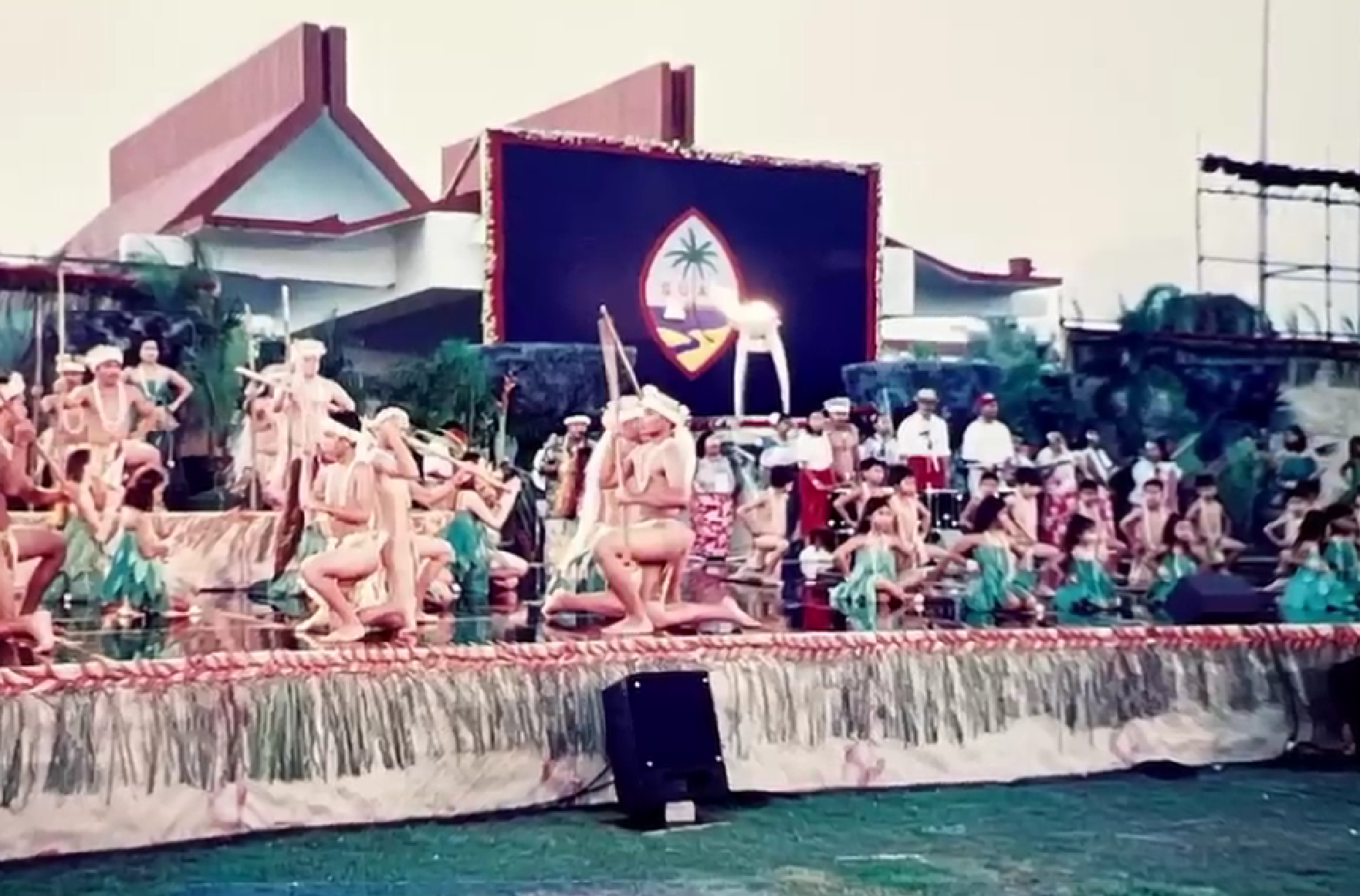
Music, as well, has long been CHamorro's most resilient cultural carrier. The recording industry began in 1968 with Johnny Sablan's Dalai Nene – an album made explicitly to revive pre-war songs. Today two local radio stations broadcast almost exclusively in CHamorro, and a revival of traditional dance – documented in the PBS Guam film Something to Call Our Own – has generated a new wave of accompanying music, creating a virtuous cycle: dance needs music; music needs language.
Digital platforms add a newer, more contested dimension. On TikTok and Instagram, bilingual creators produce language lessons, history, and cultural content reaching both Guam's youth and the diaspora. For some, it sparks genuine reconnection – CHamorro writer Michael Bevacqua describes finding his way back through a single nudge, his aunt asking why he was studying Spanish when he was CHamorro. A TikTok video can now deliver that nudge at scale.
Digital content rewards quick engagement and the shareability – reducing a language to a logo rather than a living system. The risk is that engaging with CHamorro culture online substitutes for the harder work of actually learning it.
Can the Language Be Saved?
The CHamorro language has survived Spanish missionaries and colonialism, American naval administrators, Japanese occupation, and decades of English-dominant schooling and policy. Whether it survives the age of technology will be determined not by social media, but in the classroom, homes, and communities where people choose to actively speak it. It depends on changing the stigma behind speaking an indigenous language as unuseful to necessary for preservation, and especially culture. Digital tools can inspire but they cannot replace the immersion programs and elder speakers doing the real work. Researchers gave the language five to ten years in 2025. The question is whether enough people will act before that window closes.