
Mideast: Further Crisis Facing A Depleted Yemen As Fighting Blocks Red Sea Ports
Ahmed akacha
It has been over a decade since the humanitarian crisis in Yemen began, and while several of its neighboring Gulf nations have been reshaped by economic prosperity in that time, conflict and catastrophe have continued to dominate throughout Yemen without any true relief. Now, as Houthi fighting leaves key Red Sea ports in disarray and supply lines in jeopardy, the people of Yemen are facing further shortages and an even greater need — one that does not look like it will be met in time to prevent further suffering.
The Yemeni crisis is not a new one; it began in 2014 on the heels of the Arab Spring, which saw power put in the hands of then-vice president Abdrabbuh Mansour Hadi, who inherited a deeply unstable central government marred by corruption, resource insecurity, and outside challengers. With the March 2015 exile of Hadi to Saudi Arabia at the hands of one of these challengers, the Zaydi-Shia militant Houthi movement, the stage was set for a crisis that continues to plague Yemen today.
Following Hadi’s ouster and his establishment of a temporary new capital in the southern city of Aden, the Civil War would go on to escalate into a much more brutal conflict when a Saudi Arabia and UAE-led coalition began a massive campaign of airstrikes and economic blockades on the nation to destroy the Houthis and restore the Hadi government.
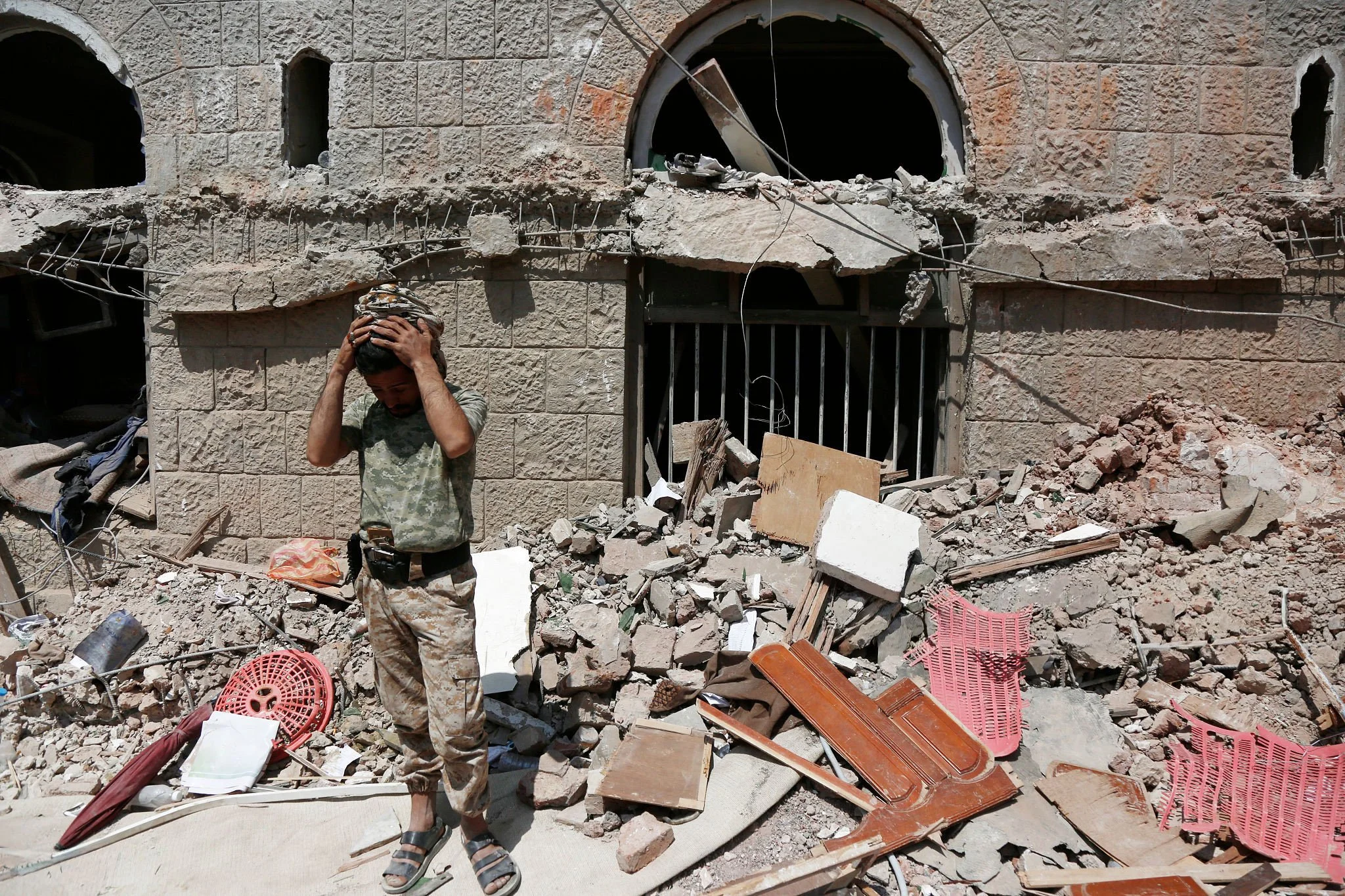
The involvement of outside nations in the conflict proved devastating for the Yemeni people, public infrastructure, environment, and economy. This anti-Houthi international interference would usher in a period of dual governance and split authority for the country, with the Houthis controlling the north and much of the Yemeni population and Hadi’s Saudi/UAE-backed forces controlling the south. They fought intense campaigns around the country for power, and in the process, destroyed a great amount of public infrastructure and private housing and killed tens of thousands of civilians, sending the country into a downward spiral of food, fuel, and shelter needs.
In the World Bank’s 2020 Dynamic Needs Assessment evaluating 16 cities accounting for approximately 60% of Yemen’s pre-war population, they found that 40% of the housing in these cities was either damaged or destroyed by the start of the new decade, as well as 29% and 39% of these cities’ transport and health sectors, respectively. In kind, levels of food insecurity throughout the population soared between 2020 and 2022, with severe economic collapse and aid funding gaps pushing “catastrophic” levels of food insecurity up to 161,000 people by mid-2022.
In April 2022, the internal situation grew even more tenuous when the unified Saudi/Emirati stance against the Houthis collapsed with the resignation of Hadi under pressure from Saudi Arabia. Hadi’s resignation formally passed power to the Presidential Leadership Council (PLC), a Saudi-sponsored 8-man governing body meant to unite anti-Houthi factions. Instead, a group of anti-Houthi separatists backed by the UAE known as the Southern Transitional Council (STC) rose and took control over much of Aden, the temporary capital meant to serve as the PLC’s base. It would not be until January of 2026 that PLC and Saudi forces would defeat the STC and cause its dissolution, only recently bringing southeastern Yemen firmly back under PLC control after four years of infighting in southern Yemen.
Between the international bombing campaigns, infighting between anti-Houthi movements, ground battles for control between Houthis and the PLC, and the overlapping of other conflicts onto Yemeni territory, the daily life of Yemeni people has continued to deteriorate, with no stable foundations to firmly stop its decline beyond temporary solutions and truces that do not last. Yemen, which imports as much as 90% of its food and fuel, has never returned to pre-war import rates, its supply lines crippled by more than a decade of fighting. As of March 2026, 19.5 million people need humanitarian aid, two-thirds lack access to safe water and sanitation, and healthcare services are unable to meet immense needs. And now, as fighting resumes around key Red Sea ports and Houthis target maritime vessels, aid and commercial alike, the rising costs and increasing scarcity of nearly all basic goods are threatening Yemeni lives and livelihoods.
With current blockades and attacks decimating the trading and import potential of crucial Red Sea ports, the prices of everyday food goods have been driven up as much as 24% in Yemen, slashing purchasing power along with it. As it currently stands, food costs remain well above even the averages of the past five years.
Exacerbating the situation is the inability of aid organizations to function in the north. The World Food Programme has been forced to completely shut down in Houthi-controlled northern Yemen following a harsh Houthi crackdown on aid organizations, which included razing UN offices and detaining and harassing aid workers at will. But even in the southern government-controlled areas where aid programs are still active, over half of the population continues to struggle with crisis levels of food insecurity, as a staggering 62% of Yemeni households are currently struggling to meet their most basic minimum food needs and 36 percent are facing severe food deprivation. All the while, 70% of the population is reporting a severe drop in their monthly income, leaving massive amounts of the population unable to afford to eat, to clothe their families, to maintain their homes and their access to clean drinking water, power, and hygiene resources. As such, the Yemeni people are stuck in a situation where the desperately needed items that do make it through the blockades may sit on the shelves, simply because few can afford to buy them.
