
The Commons: Tensions and Reconciliations with Ireland Amid Ongoing Conflict
Bloomberg
Amid escalating tensions in the Middle East and an increasingly fraught relationship with Trump, Keir Starmer has spoken again about the need for a renewal of closer ties with Europe. With this, he has also been making attempts to rebuild relations with the UK’s closest neighbor, Ireland, after speaking in a landmark Anglo-Irish summit last month on how relations with Ireland, like the rest of Europe, had been strained following Brexit.
Starmer visited both Northern Ireland and the Republic of Ireland over the course of the summit at the end of March. He spoke first in the Northern Irish capital Belfast, where, in an address to Northern Irish political leaders, he stated that he was “pleased” about the improvement in Anglo-Irish relations, having previously emphasized the need for a reset in relations that was focused on constructive engagement rather than escalating points of difference as, he argued, has been the case in the aftermath of Brexit.
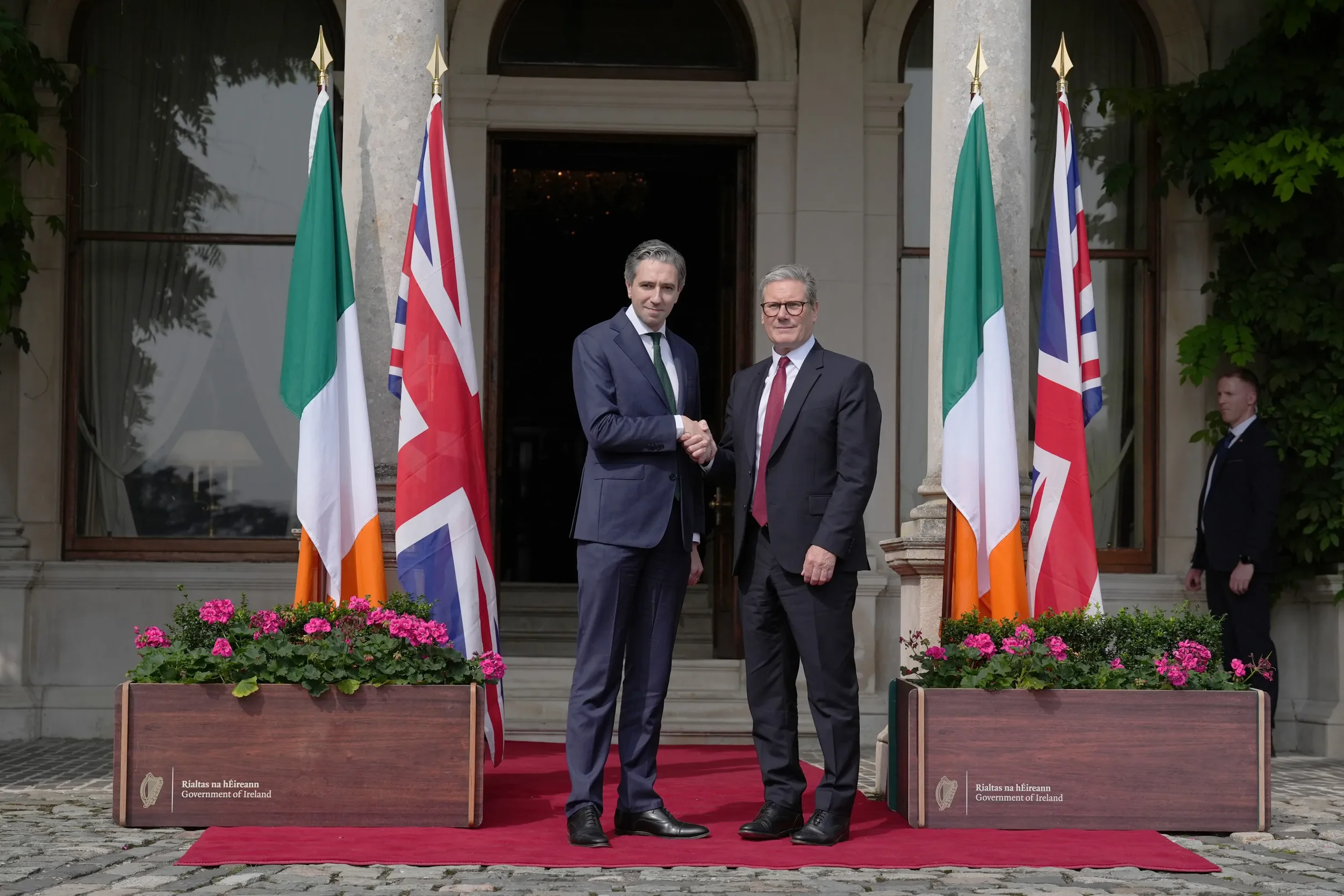
He then went on to visit the city of Cork in the Republic of Ireland, where he met with Irish Taoiseach (Prime Minister) Micheál Martin, and stated that Anglo-Irish co-operation was "more important now than it has ever been.”
The two leaders issued a joint statement on the need for greater cooperation on energy security and defence, which they said was, "more vital than ever, given current volatility."
"We recognise that our domestic priorities - from urgent delivery of critical infrastructure and clean power to investing in innovation and skills - are most effectively realised through cooperation,” they added.
The UK and Ireland have agreed a ‘memorandum of understanding’ (MOU) on shared security needs, with the two countries pledging to protect sub-sea cables, critical underwater infrastructure, and tackle cyber attacks.
There will also be new energy connector projects between Ireland and Wales, and Ireland and Northern Ireland, which is aimed at bringing down energy costs for both Irish and UK citizens. These new projects are to form part of a £937 million investment by Ireland into the UK alongside other energy projects and will also include investments in AI and the aviation sector, which Starmer has stated will create 850 new jobs in the UK. Further cooperation between the two countries is also expected on research into quantum technology and 6G, emergency preparedness, and opportunities around offshore energy infrastructure.
The Taoiseach described Anglo-Irish relations as, "one of the most important trading relationships and growing all of the time," adding that such cooperation was "very important to underpin and guarantee our economic security in a very challenging and uncertain world."
This was the second such summit that took place, after the first was held in Liverpool last year; the first annual summits between the two as part of Starmer's intended ‘reset’. The Brexit process had been widely seen as damaging to Anglo-Irish relations, with Ireland accusing the previous UK government of not properly considering movement across the Irish border and the Good Friday Agreement as part of the Brexit debate, nor of properly consulting with Ireland once the UK did pull out of Europe.
The Windsor framework was introduced by Rishi Sunak's government in 2023 to try and solve this, introducing separate “lanes” for goods moving from Great Britain to Northern Ireland to ease the traffic problems created by leaving the EU. This helped to alleviate some of the administrative problems created, with Sunak naming Northern Ireland “the world’s most exciting economic zone.”
However, there remained some issues for businesses operating with or in Northern Ireland, with some still complaining of greater levels of bureaucracy. The government has stated its aim is that it's reset with the rest of the EU, alongside with Ireland, reached over last year, including the removal of routine veterinary and phytosanitary (SPS) checks, will allow the Windsor framework to run more smoothly, lowering costs and removing red tape for business and trade across the Irish sea.
Some in Northern Ireland have nevertheless still raised concerns over the continuing challenges they are facing, which they state remain key issues. Michelle O'Neill, Northern Ireland's First Minister and Vice President of Sinn Féin, used last month's summit to challenge Starmer on the rising cost of living across Northern Ireland, in the face of growing energy costs. Numerous Northern Irish politicians have emphasized the specific problems faced by Northern Ireland in this area. Almost two-thirds of homes in Northern Ireland use oil for heating, which has resulted in spiralling costs following the Iran war.
"Every family or individual we have spoken to are really struggling,” stated O'Neill. “What is happening internationally is having a real life impact on their day-to-day lives. The approach that they have taken in London isn't the same here. Stop applying the same lens to our local scenario.”
Others have spoken about funds that have been raised but are yet to be allocated. The government had set aside £81 million for a scheme aimed at providing households in Northern Ireland with a £30 reduction in their energy costs. The Northern Irish Assembly, Stormont, has come under criticism for not moving faster on this issue however. Northern Ireland's Department for the Economy has stated that to actually introduce this scheme will require new legislation, meaning hold ups of potentially as much as a year.
Democratic Unionist Party (DUP) leader Gavin Robinson stated that Starmer, “was as aghast as I was to discover that £81 million is sitting there waiting to be dispensed to assist consumers in Northern Ireland.” Starmer has stated that he is keenly aware of Northern Ireland's reliance on oil, and is looking at further cracking down on “unfair” prices being charged by oil companies.
"If companies hike prices without justification the government will act," Starmer stated. "Global instability has real impacts on the lives of working people across the UK, and I know families in Northern Ireland are worried about what the war in the Middle East could mean for their finances.”
"I am acutely aware that the cost of living is the single most important issue probably for all of you and for many, many people across Northern Ireland and that's the thing that I focus on."
