
Esra Sen Kula
In 2023, Dr. Kanokporn Tangsuan went to dinner with her husband, Jeffrey Piccolo, at a Walt Disney World restaurant. Tangsuan, a New York physician with severe food allergies, had chosen a restaurant Disney’s website advertised as accommodating dietary restrictions. The couple repeatedly informed their server of her allergies before ordering. Hours after finishing her meal, Tangsuan died at a hospital from a severe allergic reaction.
Piccolo filed a wrongful death lawsuit, arguing that Disney bore some responsibility for advertising the restaurant as capable of accommodating food allergies. Disney's response to the lawsuit introduced an contract that seemed to have little to do with the restaurant, the meal, or Tangsuan's death.
Piccolo had signed up for a Disney+ free trial four years earlier. Like millions of subscribers, he clicked to accept its terms and conditions. Buried within the contractual framework was an arbitration provision, which Disney argued required him to resolve his claims against the company outside the courtroom. Suddenly, an agreement he made to watch movies four years prior had become part of the company's legal argument for denying him a jury trial over his wife's death.
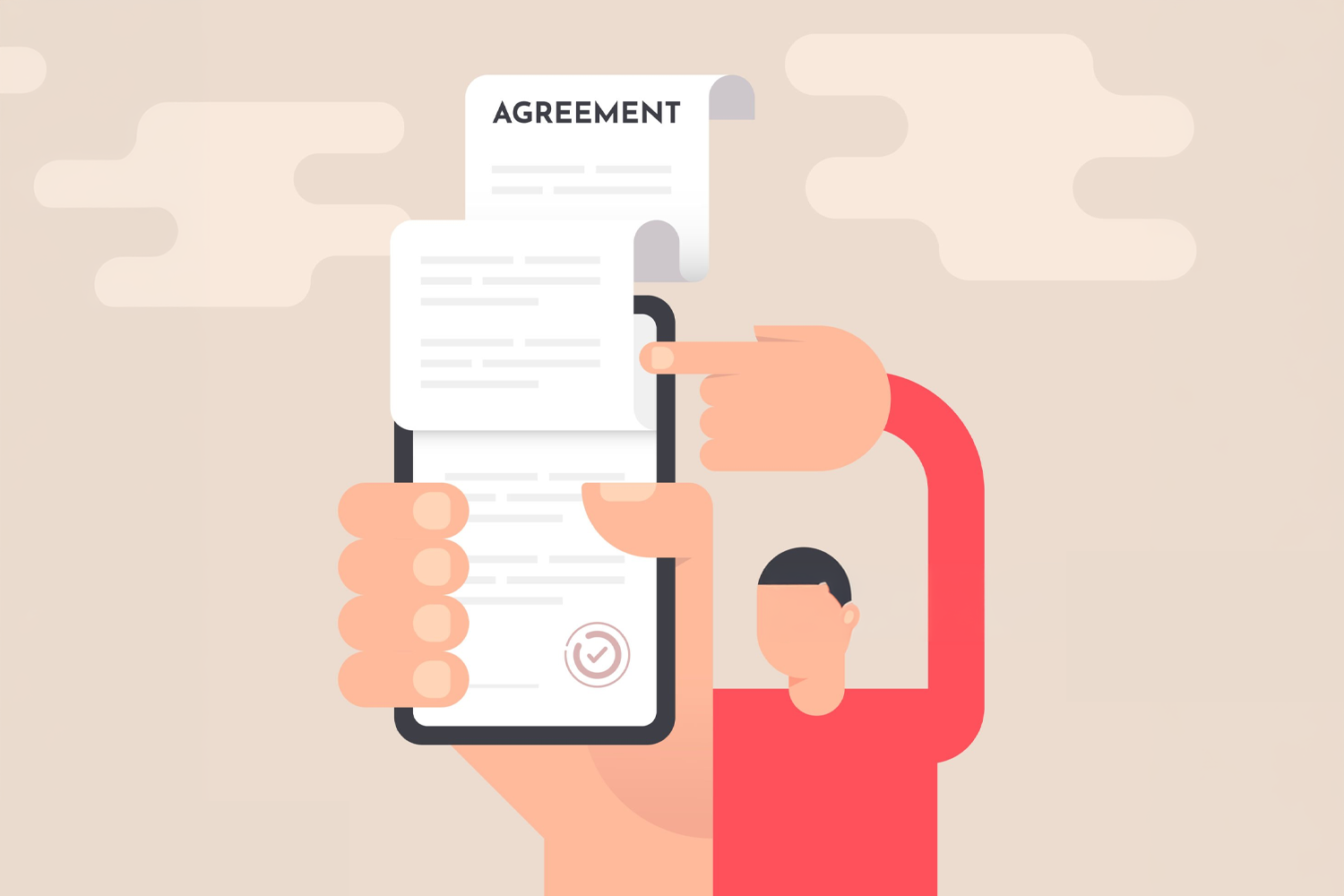
Disney withdrew its arbitration request amid public backlash before a judge could determine whether its interpretation was legally valid. But the significance of the episode lies in the argument Disney was willing to make and the mechanism behind it, which has become entirely ordinary. Every day, millions of people click the same two words to access the services through which they work, communicate, shop, and manage their lives:”I Agree.” Each click is treated as a legally consequential declaration that the user has accepted the conditions placed before them.
In a 2023 Pew Research Center survey, a majority of American adults reported frequently agreeing to privacy policies without reading them. One conclusion is that consumers should be more careful. But this explanation assumes that the fundamental problem is ignorance rather than the arrangement itself. A person could read every word of a contract, understand every consequence, and still have no meaningful ability to change–or even argue–a single provision. And in a society where digital platforms increasingly mediate employment, commerce, and social participation, the practical costs of refusing those terms can be substantial.
Increasingly, companies are not just dictating the terms of agreement, they are determining what counts as agreement in the first place. In March 2024, Roku users turned on televisions they already owned to discover that they could not access Roku's streaming interface without accepting updated dispute-resolution terms. Refusing meant losing access to the service; opting out of the arbitration provision required mailing a physical letter to the company.
Months earlier, following a data breach exposing information associated with millions of customers, genetic-testing company 23andMe revised its arbitration terms and informed users that unless they explicitly objected within 30 days, their silence would count as agreement.
Amazon went further: federal regulators alleged that the company used deceptive interfaces to enroll customers in Prime subscriptions and deliberately complicated the process of canceling them. In 2025, Amazon agreed to a $2.5 billion settlement.
For Roku, continued access was conditioned on agreement. To 23andMe, silence was tantamount to consent. And Amazon turned the process of withdrawing consent into an obstacle course. What these arrangements share is not merely fine print, but an extraordinary imbalance in who gets to determine the conditions of agreement.
We recognize in other areas of life that consent demands more than a signature. A patient cannot give meaningful informed consent to a medical procedure without understanding its material risks. Sexual consent must be freely given and specific to the activity in question. Yet in digital commerce, we routinely treat the click of a button as sufficient evidence of agreement to terms drafted by strangers and rarely read, governing consequences that may not become apparent for years. What is supposed to demonstrate an individual's freedom to choose can instead become the instrument through which that individual's choices are constrained.
Compared to any other standard of consent, the “I Agree” click fails every test. It is vague, because no one can know how a document written for millions of strangers might someday be interpreted for each marginal case. It is coercive, in the only way a market can coerce, by exclusion. The alternative to clicking is losing the account, the app, or the job that requires it. And it is effectively permanent. Disney reached back four years to a free trial agreement to find the consent it wanted.
The European Union takes a more demanding approach to consent under its General Data Protection Regulation (GDPR). When consent is used to authorize the processing of personal data, it must be freely given, specific, informed, and unambiguous. If an app requires users to accept unnecessary data tracking simply to access its services, for example, that consent is presumed not to be freely given. The law recognizes that when one party controls the terms and the other has little choice but to accept them, agreement alone is not proof of genuine consent. In essence, consent requires more than an affirmative. It requires a genuine opportunity to refuse.
The solution is not longer contracts or clearer disclosures. It is drawing limits on what companies can demand in exchange for access to everyday life. Disney never proved that a free streaming trial could restrict a wrongful-death lawsuit, but the fact that it tried exposes the danger of treating consent as a blank check. The question is no longer whether consumers simply agreed to the terms, but whether those terms were ever negotiable in the first place. Without meaningful limits, “I Agree” is less an exercise of freedom than an acknowledgment of who holds the power.
