
Checkpoint: When Polymarket Meets Politics
Bloomberg
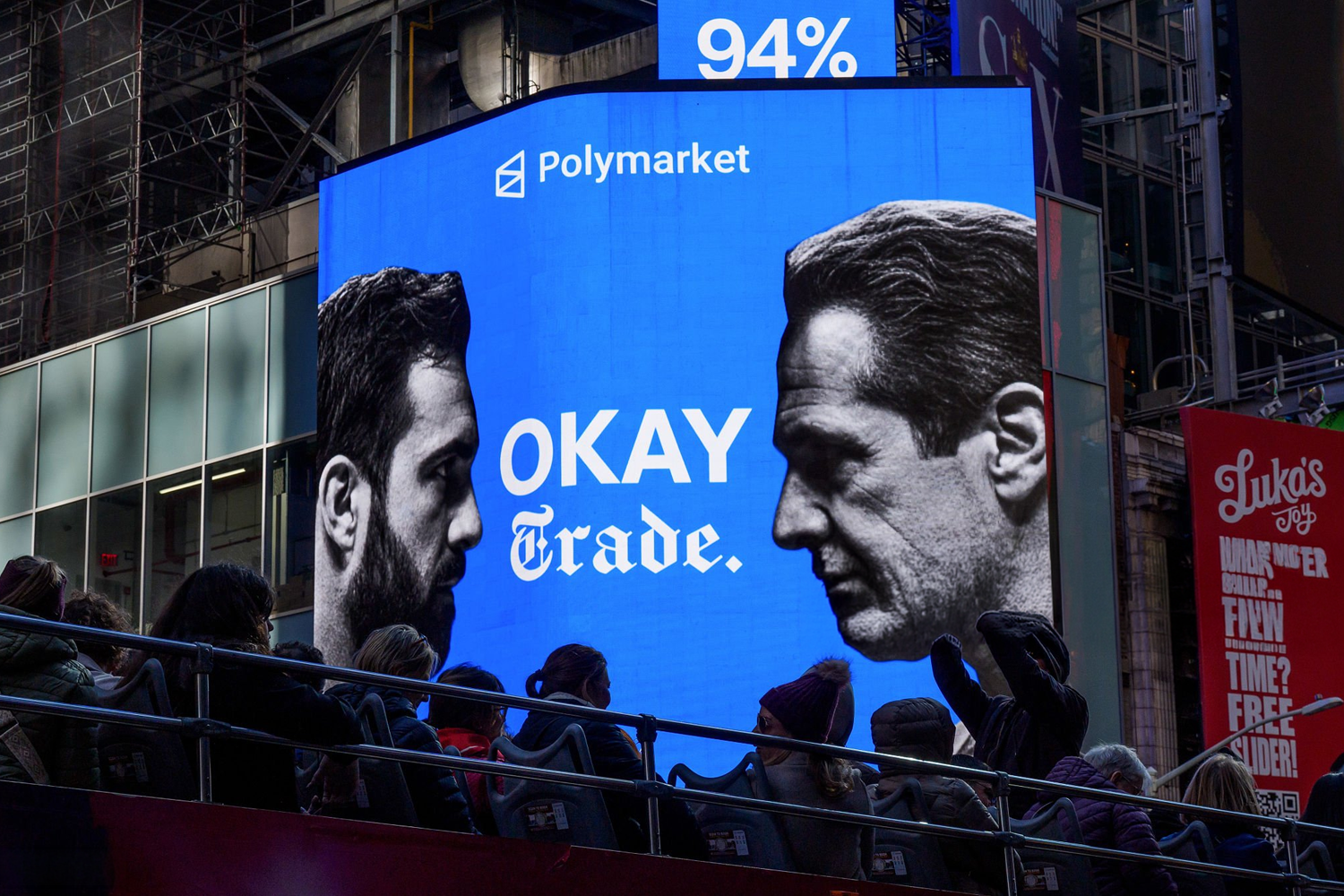
If you’re a social media user, a public transport commuter, or someone who spends any time online, watching television, or consuming digital media at all, you have probably noticed, maybe even been irritated by, constant ads for Polymarket or Kalshi, prediction markets. The prediction market phenomenon is very new. While there are other companies that allow users to trade in prediction markets, Polymarket, founded in 2020, and Kalshi, founded in 2018, are the largest by far.
In the last few years, these companies have become ubiquitous, or at least their ads have, with Celebrities from LeBron James to Timothée Chalamet promoting the prediction market. The amount of money being wagered is staggering. In September 2025, the trading volume of prediction markets was about $5 billion. In April 2026, it was $24 billion. It seems like these platforms through which billions of dollars are being funneled just came out of nowhere.
They didn’t come out of nowhere, though. The reason we have prediction markets, sports betting apps like DraftKing and FanDuel, and legalized gambling writ large for that matter, is because of the 2018 Supreme Court Decision in Murphy v. National Collegiate Athletic Association (NCAA). This landmark decision declared an earlier law, the Professional and Amateur Sports Protection Act (PASPA), unconstitutional. The PASPA outlawed state-sponsored sports betting, but the Court ruled that this commandeered state officials and was outside the jurisdiction of federal lawmaking. After the Murphy v. NCAA decision, many states immediately moved to legalize sports gambling. As of September 2026, sports betting is legal in 39 states.
Prior to Murphy v. NCAA, sports gambling had been banned in the United States for decades, and for good reason. Gambling in general is very harmful to addiction-prone individuals, and the addiction potential is multiplied when you don’t have to travel to Vegas or Atlantic City to do it. Murphy v. NCAA made it possible for people to gamble online and on their smartphones, so now it’s inescapable.
Next comes the rise of prediction markets. Apps like Polymarket and Kalshi allow gamblers to place bets on quite literally anything, from the weather next week to the date of a celebrity’s secret wedding, to the winner of the next presidential election. The rise of prediction markets has opened the arena for betting far beyond just sports; the ease of access and lack of regulation has created an environment that’s highly addictive, extremely lucrative, and perhaps most concerningly, very dangerous to our political system.
Because prediction markets are a novel phenomenon, laws around insider trading haven’t caught up to regulate the platforms. As Polymarket and Kalshi become more mainstream, they are opening up new avenues for political actors to take advantage of the trading platforms, placing individuals, the electoral process, and our national security at risk.
Earlier this year, U.S. Special Forces soldier Gannon Ken Van Dyke was charged by the Department of Justice with unlawful use of confidential government information for personal gain. VanDyke used classified information to place bets on Polymarket related to the top secret mission to capture Venezuelan President Nicolás Maduro. Van Dyke made over $400,000 in these wagers, placing $33,034 worth of bets on the timing and outcomes of the operation. This put Van Dyke’s fellow military personnel in great harm, and jeopardized the success of the mission. If Venezuelan authorities had noticed the suspicious trading activity, they may have been tipped off on the timeline and nature of the extraction mission, and been better equipped to meet the American Special Forces with more significant resistance.
In another instance of insider trading, President Trump’s teleprompter operator, Gabriel Perez, was ordered to pay $172,000 after an investigation by the Commodity Futures Trading Commission (CFTC) found that Perez had placed bets on Trump’s speeches on Kalshi. The $172,000 fine included a civil penalty of $65,000, plus the money Perez won from his bets. Perez was betting on Kalshi’s “Mentions Market,” a specific subset of the platform where users can place bets on specific words and phrases, run times, and other characteristics of public speeches. Clearly, a teleprompter officer for the President would have insider knowledge not available to the public on what the President might say and when. In Perez’s case, the outcome was relatively benign, and he was penalized accordingly, but in another world, he could have divulged much more serious and sensitive information. It’s dangerous when civilians can make money on divulging classified data. Platforms like Polymarket and Kalshi incentivize sedition.
In another shocking display of government officials (or former government officials) taking advantage of prediction markets, disgraced former member of the House of Representatives George Santos was banned from Kalshi for life after taking part in insider trading. In February 2026, Santos tweeted to his 242 million followers that he would be in attendance at the State of the Union address. He then placed bets against his own attendance, and proceeded not to attend. Santos made over $17,000 on those wagers. Santos was investigated and fined over $71,000 by the CFTC for his State of the Union trading activities, and he also threatened an NPR reporter with gun violence during the investigation. Before the CFTC investigation had concluded and effected Santos’ fine and lifetime ban, Santos was a paid partner and promoter of Polymarket.
So far, the intersection of prediction market trading has not yielded any major consequences. Sure, lots of people have been swindled out of thousands of dollars, but that’s the extent of the consequences. It’s not hard to imagine a near future, however, where the consequences are much more serious. Kalshi and Polymarket make their money through transaction fees. They don’t take a position in a trade. Unlike traditional casinos or other betting forums, prediction markets aren’t “the house.” Casinos will ban someone who’s counting cards because the casino, the house, is losing money as the card counter wins. Kalshi and Polymarket, on the other hand, make their money regardless of who is winning bets. This is significant, because it means that they have a far less vested interest in preventing insider trading. It’s likely why we’ve seen so many prominent examples of insider trading already.
2026 is a midterm election year, and there are lots of House and Senate seats up for grabs. More and more news media platforms are showing prediction market odds along with polls and other analytics. This means that the Kalshi and Polymarket odds are seen as reliable predictors of voters’ sentiments or of potential actions. Consider, in this environment, billionaire figures like Elon Musk, who has already spent hundreds of millions of dollars to help Republican candidates win their elections. What’s to stop Elon Musk from placing massive wagers on the outcome of an election? He and ultra-wealthy individuals and PACs like him have the funds at their disposal to change the odds reflected on prediction market platforms. This, in turn, will be picked up by pundits and presented as a genuine reflection of popular support of certain candidates. If you’re a billionaire, Kalshi and Polymarket present easy ways to influence elections, and they exist outside the more regulated arenas of campaign financing.
The only surefire way to prevent the insider trading and potential for election influence already starting to stem from prediction markets is for the Supreme Court to overturn Murphy v. NCAA. Given the Court’s current conservative majority, this is highly unlikely, so in the meantime, laws must be implemented to regulate the rapidly growing platforms. Gambling platforms should be found negligent when gamblers are taking part in insider trading. If not, we’re likely to see apps like Polymarket and Kalshi continue to allow and even incentivize dangerous insider trading, and for prediction market odds to influence our future elections.
