
Latin Analysis: El Salvador approves life sentences as Bukele faces international backlash
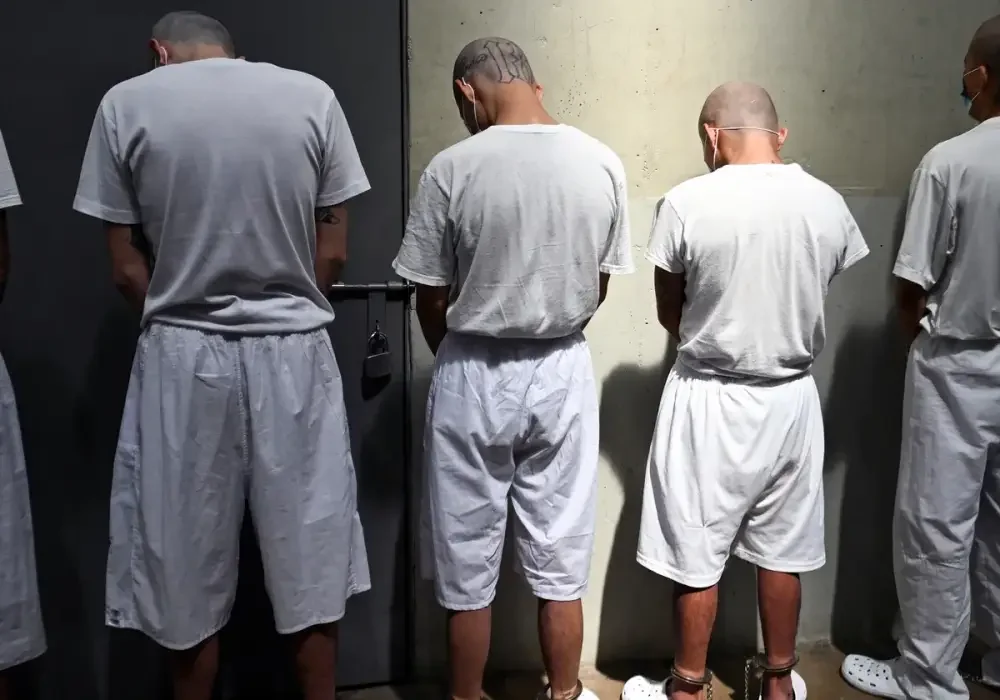
Marvin Recinos/AFP
El Salvador’s recent constitutional reform is the latest escalation in President Nayib Bukele’s sweeping security agenda. By formally introducing life sentences for crimes such as murder and terrorism, the reform to Article 27 underscores the government’s movement towards an increasingly punitive model rooted in mass incarceration. It also raises deeper questions about the trajectory of human rights and democracy in El Salvador, as the state of exception, international backlash, and the durability of Bukele’s popularity shapes the political landscape domestically and regionally.
What The Constitutional Amendment Changes
On March 17, the Legislative Assembly of El Salvador passed a constitutional amendment that permits life sentences for “murderers, rapists, and terrorists,” as stated in the reform. The amendment, which was approved with the support of 59 lawmakers to one, comes amid the government’s continued crackdown on gang activity in El Salvador.
The reform was made to Article 27 of the constitution, which previously prohibited life sentences with the objective of “correcting offenders, educating them and instilling work habits, seeking their rehabilitation and the prevention of crime.” Under these original stipulations, there was a maximum sentence of 60 years.
The Crackdown On Gangs And The International Response
Bukele’s crackdown on gangs has been carried out under a state of exception that has been in place since 2022, when the leader suspended constitutional rights and deployed security forces to combat the infamous MS-13 and Barrio 18 gangs. In that time, between 80,000-90,000 people have been arrested. The government reported that around 8,000 have been released in the years since 2022, potentially as evidence of a self-correcting system. This is a point of contention among human rights organizations, who decry that thousands of innocent people – with no ties to gangs – were caught up in those sweeping arrests and made to do time in prison under inhumane conditions.
Human rights groups further report that over 450 people have died in prison during this timeframe, under the state of exception. Many prisoners are held in a mega-prison called the Terrorism Confinement Center, which was built by Bukele’s government specifically for gang members, and where the Trump administration sent more than 252 Venezuelan migrants expelled from the United States. The state of exception makes the arrest and imprisonment of innocents more likely by suspending fundamental constitutional rights and stripping away legal safeguards, the imprisonments occurring without due process.
A high-profile report by a group of international lawyers at the International Commission of Jurists (ICJ) – an NGO based in Switzerland specialized in human rights and the rule of law – is at the center of the contentious amendment. The study argues that Bukele’s draconian incarceration policy under the state of exception may have led to crimes against humanity, given the widespread crackdown that, as they document, has led to arbitrary imprisonments, murder, torture, and forced disappearances.
The amendment to Article 27 came a week after the publication of the study, and as the constitutional reforms were presented to parliament on March 17, officials outwardly acknowledged and criticized the rights organizations who have been outspoken on the issue. Justice and Security Minister Gustavo Villatoro said in his speech in parliament: “Now we’re going to see these organizations defending, as always, violent criminals, rapists, murderers of men and women, terrorists, and representatives of criminal organizations: your vote doesn’t count because you have no sovereign legitimacy over this country. And I would like to tell you this as a citizen, but I have to respect the office I hold. I can simply tell you: Go to hell.”
On X, President Bukele himself wrote: “These ‘human rights’ organizations, which are receiving extensive coverage from many national and international media outlets [The Guardian, France 24, EL PAÍS, Open Society media, among others], and which are being picked up by thousands of local and foreign journalists, activists, and politicians, are demanding that the State of El Salvador release 100% of the gang members captured since the beginning of the State of Emergency.”
The United Nations has urged El Salvador to review the amendment, in particular due to its inclusion of minors. The reform allows life sentences to be approved for those under the age of 18 who commit murder, rape, and take part in terrorism. In a statement to the government spokesperson for the UN human rights office Marta Hurtado urged Salvadoran officials to review the legal changes that would be applicable to children aged 12 and above, saying it conflicts with the Convention on the Rights of the Child.
The Bukele Model As A Regional Blueprint
Despite the warnings by various international human rights organizations, Bukele enjoys a high approval rating of roughly 73%. There are several reasons for this, the primary one being that the crackdown on gang activity has seen tangible results in the streets of El Salvador. Both gang violence and murder rates have reduced under his tenure, in a country where gangs used to dominate large areas. As Harvard Professor Jocelyn Viterna says in this interview, “People now feel a sense of security; they can go out at night, because Bukele has reduced gang violence in El Salvador.”
This sense of restored security is central to the appeal of what has come to be known as the “Bukele model.” At its core, the model combines mass incarceration, the suspension of civil liberties, and the aggressive use of state force to dismantle organized crime networks. It prioritizes immediate results – like lower murder rates – over legal safeguards.
The model is also reinforced by Bukele’s extensive control of media outlets and use of social media, allowing him to control the narrative and paint a flattering picture of his policies to the public. This publicity could also contribute to his high approval rating, as the mass arrests and imprisonments are depicted as both effective and necessary measures.
Beyond El Salvador, the implications are already being felt. Bukele’s approach has attracted attention from leaders across Latin America, especially countries grappling with similar issues with gangs and criminal activity. Some governments have begun adopting similar tactics, including states of emergency and increased military involvement in domestic security. In countries such as Honduras and Ecuador, these measures have been explicitly linked to the perceived success of Bukele’s crackdown. However, while Bukele’s example offers a politically attractive blueprint, it raises concerns about the erosion of democratic institutions – analysts warn that the spread of the Bukele model could hinder international efforts to uphold human rights standards, as more governments justify extraordinary measures in the name of security.