
Latin Analysis: Venezuela’s Earthquakes Test a Fragile Government Response
Ariana Cubillos/AP
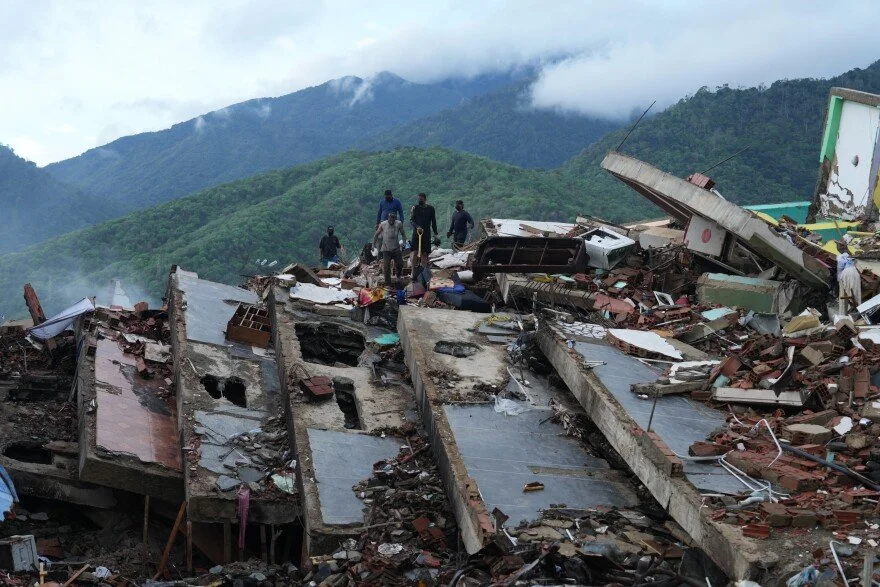
The twin earthquakes that struck Venezuela this June have become one of the country’s worst disasters in decades. The damage, still being assessed more than a week later, amounts to a humanitarian catastrophe, and poses a serious test for a fragile government, barely six months into its transition and already struggling with weak state capacity and public trust.
What Happened
On June 24, 2026, two earthquakes struck Venezuela’s northern coast within 39 seconds of each other. The first was magnitude 7.2, followed almost immediately by a stronger 7.5, in a scenario known as a “doublet”. This meant buildings faced a longer and more chaotic period of shaking than in an ordinary earthquake. The second rupture moved east along the San Sebastián fault, toward heavily populated areas like La Guaira, Catia La Mar, and Caracas. The earthquakes were shallow, beginning around six miles below ground, which meant the shaking was especially intense at the surface. The fact that coastal and urban areas had soft sedimentary ground also likely amplified the impact.
A week after the earthquakes, interim president Delcy Rodríguez’s government declared a week of national mourning. The official death toll stands at 2,295, with more than 11,000 people injured – however, President of the National Assembly Jorge Rodríguez suggested the number of deaths could be far higher. Some officials warned it could reach 10,000 once those missing are included in the numbers. Official figures put the number of damaged buildings at 855, including 189 total collapses. Other assessments suggest the destruction may be much wider, with satellite analysis estimating that nearly 59,000 buildings could have been damaged.
Recovery Efforts In The Aftermath
A week on, search-and-rescue efforts continue alongside a parallel effort to recover and identify bodies. In some cases, bodies have been exposed for days in the heat, making identification even harder. Aftershocks have kept residents sleeping outdoors, even where buildings remain standing. Many have been unable to properly mourn because their relatives are still missing or trapped.
The UN estimates that up to 6.76 million people could be affected in some way - measuring both physical trauma and the indirect structural fallout. The UNHCR warns of shortages of shelter, water, and healthcare. The WTO also warns of a heightened risk of disease outbreaks, including measles and diphtheria, given already-strained hospitals and low vaccination coverage. In La Guaira, gaps in maternity care have also emerged because health workers themselves remain missing.
The government has attracted criticism for a slow and disorganized response. Residents in some of the worst hit areas accused authorities of arriving too slowly and failing to provide the machinery needed to clear heavy rubble. International assistance has provided some search-and-rescue teams and thousands of personnel from 27 countries, alongside U.S. naval and logistical support, and a sanctions exemption for earthquake-related aid. Rodríguez’s government has also reported the arrival of thousands of foreign rescuers and more than 7,800 Venezuelan volunteers. Even so, aid workers describe logistical chaos, and displaced families report uneven access to shelter and supplies.
Implications For Venezuela
Venezuela entered this crisis with weakened public services, economic hardship, and fragile governmental institutions. Many Venezuelans already had low confidence in the government’s ability to meet basic needs. The earthquakes and their aftermath have now exposed that weakness further. If the government response is widely felt to be disorganized, the crisis could deepen public anger rather than rebuild trust in a political transition period. Some worry the earthquakes could slow or reshape that process – the immediate priority is saving lives and rebuilding destroyed communities, but some analysts caution the government may also use the scale of the crisis to delay discussion of elections or democratization.
Paradoxically, the crisis has also opened diplomatic doors for Venezuela. Governments that recently severed ties with Caracas over the disputed 2024 election, including Argentina, Chile and El Salvador, have sent rescuers and re-established contact with President Rodríguez. Whether this disaster diplomacy produces lasting normalization or simply a pause in hostilities remains in question.
For ordinary Venezuelans, the earthquakes have layered a new emergency atop years of existing hardship, and the government’s recovery management is likely to shape public sentiment going forward.