
In America: Abdul El-Sayed Wins Michigan Primary
Bloomberg
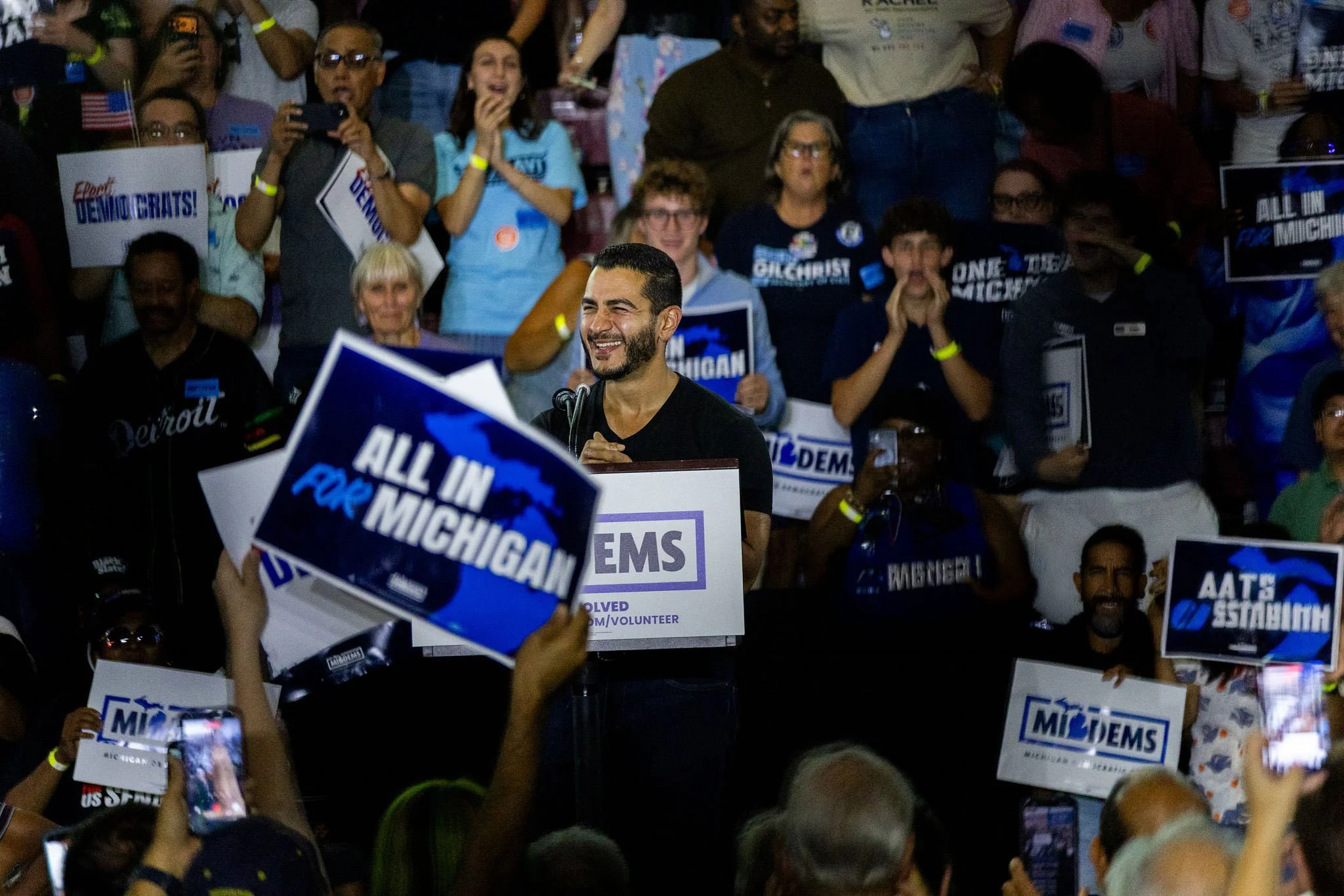
Abdul El-Sayed, a former public health official from Michigan, comes out ahead in a close primary race with his Democratic competitor, Haley Stevens. Now the official Democratic nominee for the general election in November, El-Sayed has overcome the first major hurdle to his Senate aspirations. Uniquely, El-Sayed won while campaigning as a progressive, democratic socialist; a movement gaining popularity and confidence following a string of primary victories throughout this year.
Beyond the fact that Michigan remains a contentious battleground state for the 2028 presidential election, Michigan’s Senate race between Democrat Abdul El-Sayed and Republican Mike Rogers has gained national popularity because of El-Sayed’s charisma and blatant opposition to the American Israel Public Affairs Committee (AIPAC). Indeed, a major campaign promise for El-Sayed has been ending US aid to Israel.
Some news organizations, such as the Jerusalem Post and Fox News,have labeled El-Sayed as a “danger” to US Jews. These remarks are reminiscent of the surge in Islamophobia against NYC Mayor Zohran Mamdani during and following his mayoral campaign victory. The Center for the Study of Organized Hate released a report that studied online hate before and after New York City’s mayoral primary. This report indicated that of the 1,933 posts the researchers analyzed, 39.4% contained explicit anti-Muslim language targeting either Mamdani or Muslims broadly.
Contrary to these claims, El-Sayed remains committed to serving all members of his community, including Jewish people.
Another challenge to El-Sayed before his primary victory was AIPAC’s and Michigan Democrats’ support of his main opponent, Haley Stevens. One source reported that outside spending was upwards of $60 million. Factors like this contributed to El-Sayed's monumental primary victory and will prepare him for similar challenges that may arise closer to November.
El-Sayed is not just a unique candidate because of his ethnicity or political beliefs. Rather, what makes El-Sayed stand out as a politician is his political background and experience (or lack thereof). Before this campaign, El-Sayed’s only campaign experience was the 2018 Democratic primary for governor in Michigan. Following his electoral defeat, El-Sayed bided his time by starting a podcast, writing a book, and amassing a social media following on YouTube. By leveraging combined new and old media sources, El-Sayed was able to stay politically relevant without winning a more high-profile elected office. These efforts have now culminated in the momentum and popularity of El-Sayed’s campaign and his political messaging.
El-Sayed’s campaign priorities identify three problems that Michiganders face. Stated simply, El-Sayed promises his voters to “get money out of politics, put money in your pocket, and Medicare for all.”
El-Sayed’s campaign focus on Medicare especially reflects his background working for the city of Detroit and Wayne County as a health official. He plans to translate this experience restoring health agencies in Michigan to the federal level by advocating for high-quality, affordable healthcare for every American. At the policy level, this means that Abdul generally wants to expand Medicare and the government’s role in supporting the healthcare industry. For example, this includes lowering the cost of prescription drugs, expanding funding for Veterans Affairs hospitals, and empowering the Federal Trade Commission to regulate big healthcare better.
Healthcare has become a hot topic issue for Michigan electoral campaigns due to soaring prescription drug costs, an inefficient healthcare system, and an aging population, among other things. An especially alarming issue is Michigan’s designation as a Health Professional Shortage Area (HPSA), with 72 of the state’s 83 counties receiving this designation. Research also indicates that low-income individuals and households are disproportionately affected by these shortages. Research also indicates that low-income individuals and households are disproportionately affected by these shortages. Looking ahead to November, it would not be unreasonable to assume that Michigan’s healthcare crisis will continue to remain a key campaign issue for both candidates.
On the contrary, Mike Rogers presents a more traditional political background with state and federal political experience dating back to 1994 and military experience with the US Army, characterizing himself through his dedication to service. Rogers’ political portfolio is more representative of a traditional candidate for elected office. Something unique about this Michigan Senate race is that the voters that remain to be “swayed over” by Rogers or El-Sayed are the more moderate Democrats that supported candidates like Haley Stevens. Now for November, El-Sayed and Rogers need to shift their campaign messaging to win over these voters.
Part of Rogers’ strategy to appeal to the more moderate left is by making housing a centerpiece of his political messaging, invoking the “American Dream” through the notion of making housing more affordable and accessible for the average American. Policy-wise, this housing plan would entail assistance with down payments, less restrictive zoning laws, fewer regulations, and lower interest rates.
Another element to Rogers’ appeal to moderate Democrats in Michigan is discrediting El-Sayed’s healthcare experience and insinuating Islamist tendencies. Rogers claims that El-Sayed has never had a medical license and has no clinical experience despite branding himself as a doctor. In reality, El-Sayed graduated from Columbia’s Med School and took on a career as a health care official rather than a clinical practitioner. Rogers also claims that El-Sayed is a member of the Muslim Brotherhood, which is an organization that is designated as a foreign terrorist group by the federal government. There is no evidence to support Rogers' claim that El-Sayed is a member of the Muslim Brotherhood. With that being said, the Council on American-Islamic Relations (CAIR), which donated to El-Sayed’s campaign, has faced unfounded allegations of being linked to the Muslim Brotherhood.
Ultimately, El-Sayed has a tremendous uphill battle to continue fighting if he seeks to realize his Senate aspirations. More broadly, El-Sayed needs to secure more high-profile endorsements from top Democrats and obtain more funding in the mere three months until November. Looking forward, primary victories like El-Sayed’s are immense wins for the progressive and democratic socialist movement in America; however, the longevity of this movement will truly be tested with the general elections in November.