
Mzansi Now: Police Fire Teargas and Rubber Bullets Into Anti-Immigration Protest in Durban
RAJESH JANTILAL/AFP
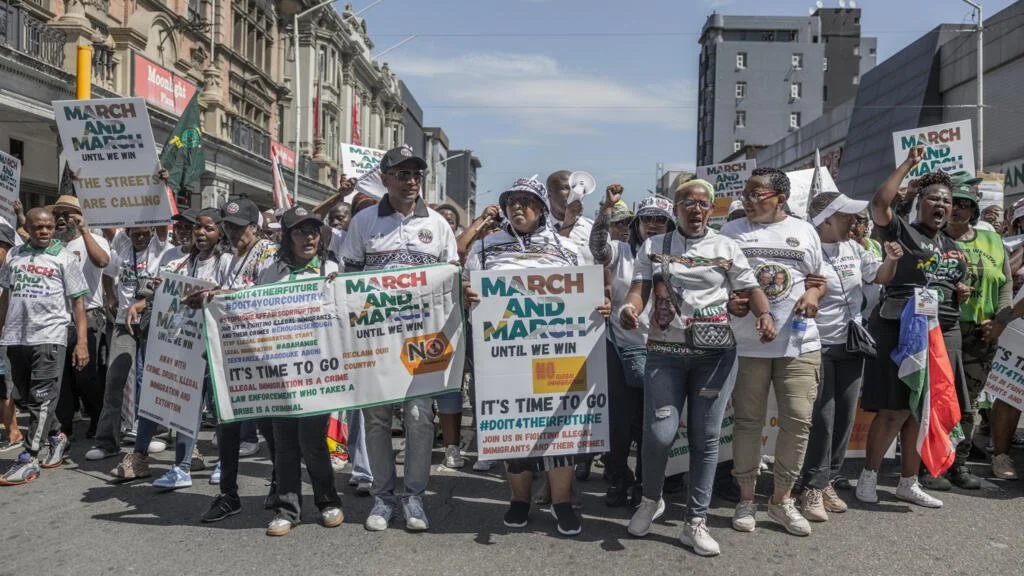
On Wednesday, March 25, hundreds of protesters gathered in Durban in an anti-immigration protest that escalated into a confrontation with law enforcement. The demonstration was organized by a civic group called March and March, a civic group advocating for stronger immigration enforcement and border patrol. The primary motivation for the protest was frustration over unemployment, economic hardship, and fear that job opportunities in South Africa are going to more migrants than to native South Africans. What began as a peaceful march turned volatile when demonstrators clashed with police, prompting the use of teargas and rubber bullets to disperse the crowd.
The protesters were joined by members of ActionSA, the Patriotic Alliance, the Inkatha Freedom Party (IFP), and uMkhonto we Sizwe, four political parties that promise to tighten immigration controls ahead of the 2026 municipal elections. The immigration debate has become politically salient; with unemployment sitting at 31.4% nationwide, South Africans and politicians are looking for someone to blame and a clear solution to the problem. While economists have found that immigration typically creates more employment opportunities for locals, rather than shrinking said opportunities, public perception often links the two during times of economic strain. But the reality of whether immigration helps or hurts employment opportunities becomes insignificant when politicians can exploit the issue to rally voter support.
Police Intervention
The protest took place in a waterfront area of Durban, where many shops and stores are owned by foreigners. Some of these stores had closed down for the day in anticipation of the protest, fearing violence and looting. Police initially directed the marchers away from the storefronts until a smaller group broke off and reportedly began harassing bystanders and looting shops. Police then issued orders to disperse, and when said orders were not followed, they deployed teargas and rubber bullets into the crowd to keep the protesters away from the storefronts. There were some injuries, but no reported fatalities.
Operation Dudula
The anti-immigration movement in the country gained attention with the onset of Operation Dudula, one of the civic groups that joined the protests on Wednesday. Operation Dudula began in 2022, with the primary goal of forcing immigrants out of the country using vigilante-style tactics like blocking immigrants from healthcare clinics, conducting workplace raids, and directing community patrols. Their primary targets are businesses that allegedly hire undocumented immigrants to pay them lower wages than they would pay native South Africans. The group, alongside March and March, held a similar protest in Durban in November and again in January.
In October 2025, the South African Human Rights Commission (SAHRC) took legal action against Operation Dudula and March and March, citing their actions as "unlawful and discriminatory". A spokesperson from the SAHRC said, "Our Constitution does not allow for vigilante enforcement of immigration laws, nor does it permit anyone to deny medical services to another person based on their nationality.”
Although the Durban High Court rejected the SAHRC’s application to initiate legal proceedings against the organizations, the Gauteng High Court accepted the motion and later ruled in favor of the SAHRC. The court ruling ordered Operation Dudula to stop interfering with immigrants’ access to healthcare, schooling, and employment, and to stop unlawfully evicting immigrants from their homes. Despite this ruling against them, Operation Dudula remains politically active and popular amongst anti-immigrant groups. The Durban High Court’s refusal to accept the SAHRC case against Operation Dudula signaled to the organization that Durban residents remain concerned about immigration policies and that they could use the city as a mobilization base, as exemplified by their protest last week.
Anti-Immigration Sentiment In An Election Year
The political parties amongst the demonstrators this March have echoed the motivations of Operation Dudula. The leader of ActionSA, Herman Mashaba, said he joined the protest to show the constituents of KwaZulu-Natal that his party cares about these issues.
"We are seeing our government allowing our country to be flooded by groups from all over the world as far as Pakistan, Bangladesh, Nigeria, Mexico, all over the world,” he said. “So we are saying to our government this is unacceptable.” Last month, Mashaba announced he was running for mayor of Johannesburg in municipal elections that will take place across the country this upcoming November.
The IFP eThekwini secretary Joshua Mazibuko was also at the protest, and said his party’s participation was to fulfill promises made ahead of these elections. “In our manifesto, we indicated that we would ensure that people who are in this country illegally are rooted out,” he said. “Even if they were causing no issues, being in the country illegally is an issue on its own.”
South African political analysts like Goodenough Mashego and Dr. Lubna Nadvi have cautioned that these parties may be using anti-immigrant sentiment to boost voter turnout. Only 5.1% of the country’s population is made up of foreign nationals, but with increasing anti-immigrant rhetoric spreading worldwide, immigrants become an easy target for natives to blame for issues like unemployment and crime.
A far more substantiated reason for the persistently high unemployment levels in South Africa is due to the legacy of apartheid. Restrictions on who could receive an education and where individuals could work created a dynamic where, once apartheid ended, the job market was flooded with individuals looking for higher-paying work. The rate of job creation could not keep up with the rate of those seeking employment, creating a private sector with a low absorption rate. This reality still exists today, where higher-paying jobs require years of experience that cannot be gained due to abundant barriers to entry-level jobs.
Due to the complex nature and slow resolution of this issue, those anxious to find work find it much easier to blame illegal immigrants for their struggles — especially when political parties face elections and have cause to identify themselves as the ones who can resolve the problem.