
China View: The India-China Border, Pride At The Top Of The World
engin akyurt
Along the Himalayan mountains, survival is a constant struggle. The treacherous altitude, freezing temperatures, and absolute isolation are treacherous alone, save the 50-year political struggle between the two largest nations on Earth. The Indian-Chinese border has been a conflict in the halls of governments and on top of the world, some fight with rhetoric while others battle with sticks or bulldozers. The shifting lines are far from any major cities or natural resources, but both sides are, unsurprisingly, adamant about victory. The border was originally an arbitrary line between a British-controlled India and effectively a wasteland. Now it has become a flashpoint between two occasional allies, the People’s Republic of China and the Republic of India. Why would these neighbors risk escalation over a dozen miles of valueless territory? As usual, the answer comes down to pride, prestige, and history.
History
The Indian-Chinese border has undergone several transformations in the last 200 years. As China annexed Tibet in 1959, the former Tibetan border was now patrolled by Chinese forces. With the Dalai Lama fleeing to India, relations between the two nations began to worsen. The tension culminated in a Chinese attack on Indian border posts, starting a brief war from October to November 1962. The battles in the high mountain passes were difficult, but the Chinese forces enjoyed greater numbers and better preparation, which proved decisive in the clashes. In 1967, there were additional clashes along the border, and Indian troops destroyed several Chinese outposts as a result of the fighting. The final major confrontation between India and China was in 1987 at the Sumdorong Chu Valley. This mostly non-violent clash led to increased de-escalation measures for preventing future skirmishes. Additionally, the 1987 incident created deconfliction lines between the military commanders of both nations so that clear communication could be established in case of low-level violence between border guards.
The border had remained relatively quiet in the decades after 1987. Occasional confrontations would occur along the disputed zones, but the measures created after the 1987 clashes mitigated escalation. In May 2020, a new wave of clashes rocked the region. The trouble began in 2019 when India revoked its special administrative status of Kashmir and Jammu. These regions are historically contested with Pakistan and have also been the site of political upheaval for the Indian government, as the local population is majority Muslim.
The Chinese government saw the revocation as a sign of Indian political expansion in the disputed region, given Kashmir and Jammu border the disputed territories. In response to the tightening political control of Kashmir and Jammu, the Chinese military (PLA) began to mass forces near the border. India had previously built infrastructure to support higher numbers of troops in existing outposts and large paved roads to support movement in the mountainous regions. As the region swelled with military forces, confrontation was inevitable. One hotspot was the Pangong Lake, a disputed region that hosts military forces of both nations. Military boats of the PLA and India began to face off on Pangong Lake, firing hundreds of warning shots.
The largest and deadliest clash in 50 years occurred at the Galwan Valley, on June 15th, 2020. This battle allegedly involved 600 Indian soldiers and resulted in the deaths of at least 20 Indians and up to 30 Chinese border forces. The source of the violence appeared to be grudges and resentment between the local forces, rather than orders from military leadership. Phunchok Stobdan, a former ambassador who served in the National Security Council Secretariat, stated to the Guardian newspaper, “There were no higher-level commanders involved in this, the instruction was to de-escalate. But this tension has been building up for quite some time between the soldiers. There were grudges against each other, and so I think, on the troop level, both sides have not maturely handled de-escalation.”
As a result of decades of negotiations, border forces often do not carry firearms. The Galwan Valley clashes were fought with riot shields, clubs, iron bars, and other improvised weapons, at times resembling battles from antiquity.
Terrain & Significance
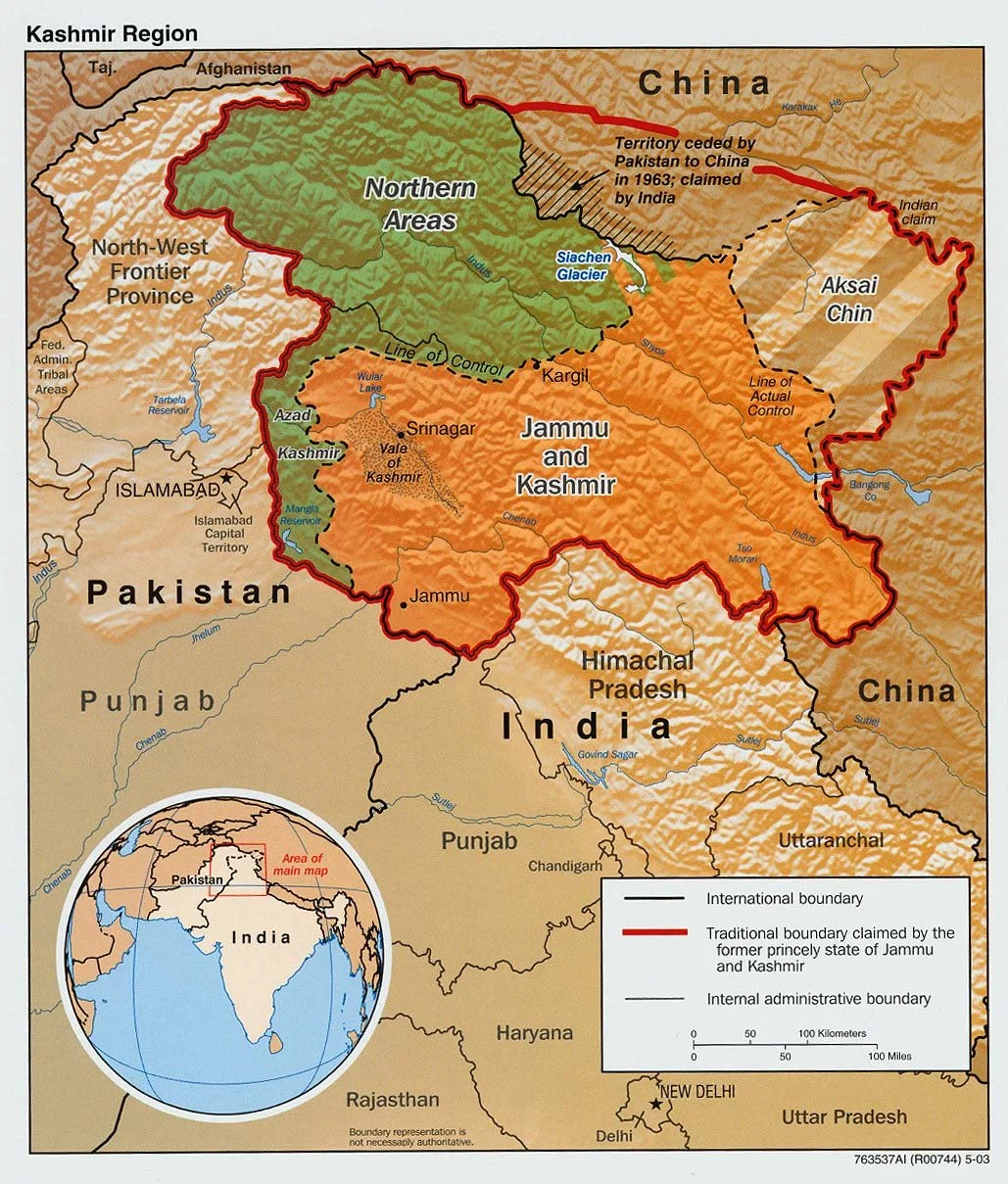
The two regions at the center of the dispute are Ladakh and Aksai Chin. Ladakh is de facto controlled by India, yet is also partially claimed by China through its greater claims on Tibet. Aksai Chin is de facto controlled by China but was historically part of the Kashmir region and is subsequently claimed by India. The unofficial border between the disputed regions is called the “Line of Actual Control” (LAC). The LAC is effectively the 1959 border between Tibet and India before the Chinese annexation of Tibet.
University of texas at austin
As this is an unofficial border understood by military projection and decades of tradition, it is the source of most clashes between India and China. Additionally, due to the rough terrain and sparse population, the LAC is almost impossible to see from the ground. The LAC crosses mountains, rivers, and lakes, far from a clear legal or political border. India and China seek to determine the border through infrastructure projects, such as all-weather paved roads or bridges. The sites of border violence are also often the few areas suitable for construction or passage into disputed territories. Pushing the LAC for either nation could be followed up by construction projects to cement their claim and increase mobility for border forces.
As the only direct land border between China and India, the clashes along the LAC are largely driven by national pride or in response to greater international relations between the two nations. Fighting for prestige or national pride is as ancient as the shields and clubs wielded by opposing forces at the top of the world.
