
Far East: A Three Person Wedding Raises Questions About Marriage in Thailand
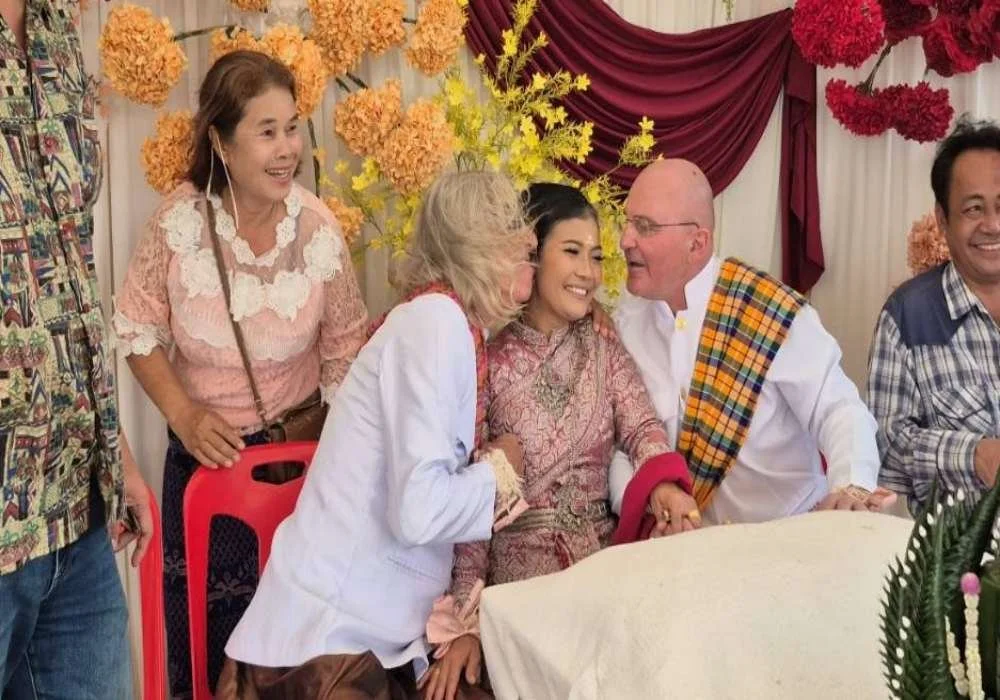
On March 1, 2026, in Thailand’s Prakhon Chai district, a Thai woman married two Austrian men at a single ceremony.
Dujduan Ketsaro, who is a 37-year-old singer and song writer, married Roman and Macky. Roman is a retired Austrian police officer, and Macky is currently serving in the Austrian police force. Roman and Macky are close friends who both fell in love with Dujduan; Roman and Dujduan had been dating and living together for five years before Dujduan met Macky, who was travelling to Thailand as a friend of Roman and developed feelings for her. Based on a discussion of open relationships, all three people reached a consensus to build a life together.
The wedding drew attention quickly because it challenged conventional expectations of marriage in Thailand. The unusual relationship structure involving three partners with public celebration fueled public discussions on changing values and social norms. In this sense, this news is not only a highly publicized report of an three-person relationship but also reflects Thailand’s evolving attitudes toward unconventional marriage, consent, and family acceptance.
Thailand’s Traditional Attitudes Toward Marriage
Traditional attitudes toward marriage in Thailand have historically emphasized social harmony and defined gender and social roles. Marriage is sometimes viewed as an alliance between families and communities. Collective responsibility in family relationships is vital in Thai society.
A key facet here is Thailand’s deeply rooted tradition of “sin sod”, which translates to the “bride price” in Thailand. Sin sod is a payment that the groom is required to pay to the bride’s family upon marriage. Many see the financial transaction as an act that monetarizes the relationship and the female. Yet, some view sin sod as an act of respect and gratitude toward the bride and her parents. In simple terms, the tradition uses the groom’s financial capacity to acknowledge the bride’s worth.
The dowry amount is usually determined by three factors: education or career background, marital status, and family expectations. A bride with a higher education or a more established career may command or is expected to receive a higher dowry. A bride who has been previously married or has children may receive a lower dowry than someone who’s marrying for the first time. Sin sods usually range from 100,000 THB to 1,000,000 THB or more, which is roughly $3,000 to over $30,000, depending on the bride’s education, family status, and regional customs.
In recent years, the practice has increasingly generated reluctant attitudes among some Thai men and women alike. As a result, a number of couples have chosen to abandon the dowry tradition in their marriages, while some couples still keep the dowry system.
Monogamy As the Legal Standard
Polygamy in Thailand was legally recognized before October 1, 1935, when the Civil and Commercial Code Book V was implemented. Before 1935, there was a wife classification system in Thailand, classifying women into three hierarchies: Mia Klang Muang, the wife who is officially married; Mia Klang Nok, the wife who is taken as a secondary wife; and Mia Klang Thasi, the wife who was bought or rescued from slavery.
In Thailand, wedding ceremonies can be held without necessarily creating a legally recognized marriage. Under the nation’s Civil and Commercial Code of Thailand, a marriage is considered legally invalid if either party is already married to another person. Thus, despite the public ceremony reported in the news on Dujduan Ketsaro’s wedding, only one of the marriages can be recognized legally. This phenomenon similarly highlights the contrast between evolving social attitudes toward unconventional relationships and the country’s existing legal framework
The Gender Perspective
Dujduan Ketsaro;s story and polygamous marriage also opens up important discussions about gender and social expectations in Thailand. In the Thai context, the public celebration of a woman marrying two men challenges long-standing assumptions about female agency and autonomy. Many observers have noted that reactions to the news might differ if the roles were reversed, or if one man were marrying to two women. However, do these reactions truly matter?
Studies on Thai femininity and Thai marriage fiend a strong association between women and the role of “maeban” (แม่บ้าน), meaning the “mother of the household”. Women are normally primarily responsible for household care and family well-being. According to the 2024 OECD Social Institutions and Gender Index, women in Thailand spend about three times more time on unpaid domestic and care work than men, reflecting persistent gendered expectations within households. Specifically, women and girls spend about 11% of their time on unpaid care work compared with 3.3% for men. Under the ideology that shows women are expected to fulfill domestic and care-giving roles within marriage, one observes a persistent and visible gender inequality in Thailand.
Additionally, according to the 2024 OECD report on Thailand, 39% of people in the country agree that children suffer if mothers work outside the home. These numbers reflect a long-standing social expectation and perception of motherhood and family roles.
Therefore, the news of a Thai woman who overtly makes decisions for herself - decisions that challenge convention - reflects a subtle cultural shift in which women’s desires and decision-making power are increasingly visible and debated in the public spheere.
At the same time, the story has also generated controversy. The fact that Thai law recognizes only monogamous relationships raises further questions on the gap between evolving social practices and the long-standing legal institutions. In the end, the event not only draws attention because of its unusual nature but also facilitates broader discussions on how marriage, gender, and family values may continue to evolve in contemporary Thai society.