
Middle East: NEOM, Its Rise, Its Fall, Its Current State
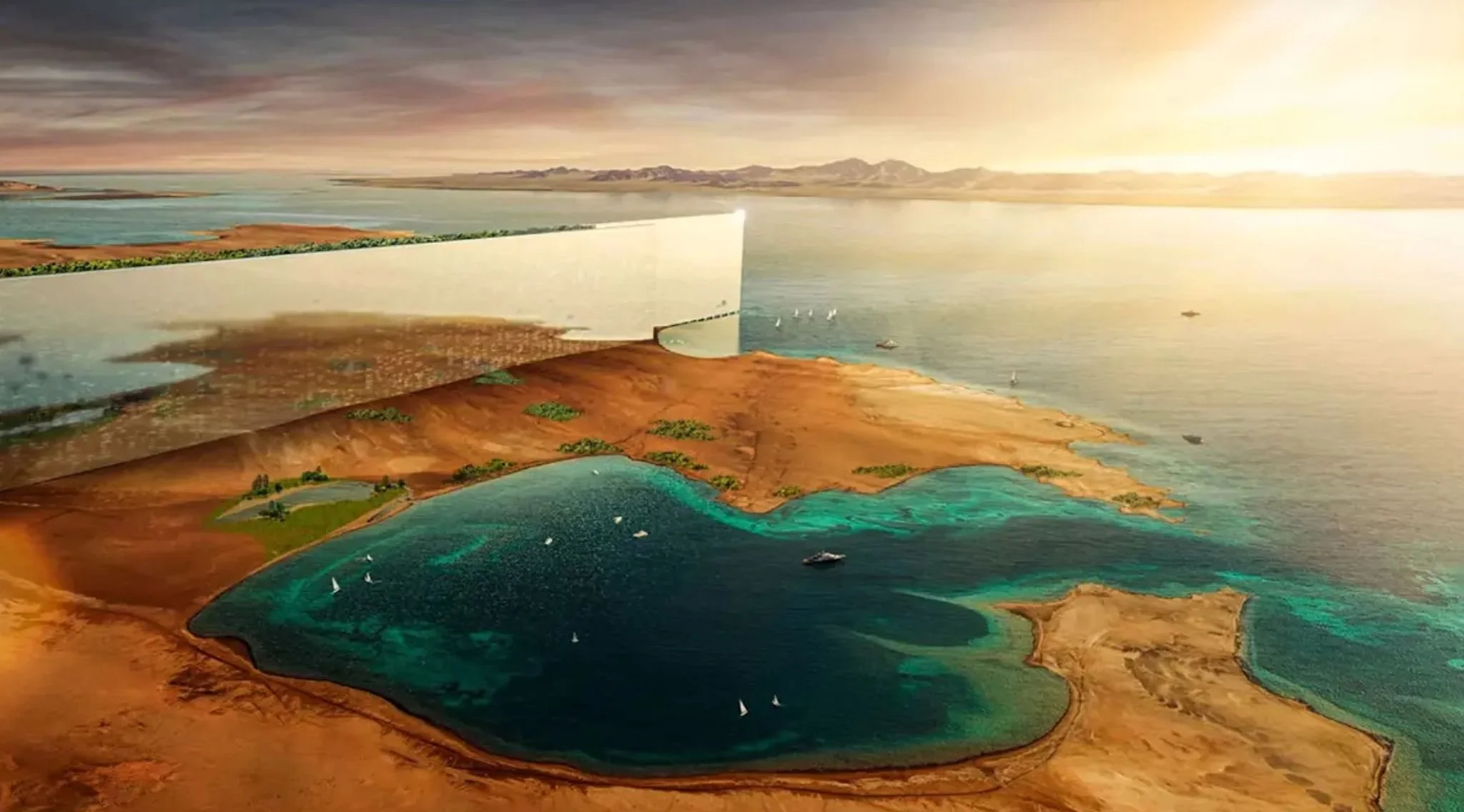
Launched in 2017 by Saudi Crown Prince Mohammed bin Salman, NEOM is the centerpiece of the Kingdom's Vision 2030, a plan to reduce dependency on oil and diversify the national economic portfolio. The project's name combines the Greek prefix for “new” and the Arabic word for “future,” reflecting its aim to be a global model of innovation and sustainable living. Spanning 26,500 square kilometers in the Tabuk region along the Red Sea, NEOM is planned as a vast jurisdiction with its own regulatory and judicial systems, separate from the rest of Saudi Arabia. However, as the project moves further into its development phase, it has garnered intense scrutiny over its extreme engineering challenge, extreme surveillance infrastructure, and severe human rights violations.
The most well-known and controversial feature of NEOM is “The Line,” a planned linear smart city originally envisioned to stretch 170 kilometers across the desert. The design consists of two parallel, mirrored skyscrapers standing 500 meters tall and 200 meters wide, intended to house nine million residents in a car-free, carbon-neutral environment. In this “cognitive city,” basic services are designed to be within a five-minute walk, and a high-speed underground rail is promised to connect the city's ends in just 20 minutes. However, by 2026, reports indicated that the project had been drastically scaled back, with construction suspended in September 2025 and the initial target for 2030 reduced from 170 kilometers to just 2.4 kilometers of habitable structure.
Beyond “The Line”, NEOM includes other regions with their respective specializations, like Oxagon, an octagonal floating industrial port city. Oxagon is intended to be a hub for advanced manufacturing, logistics, and blue economy ventures (sustainable aquatic and maritime-based economic growth), featuring the world's largest proposed green hydrogen plant, which was reported to be 80% complete by early 2025. Another major project is Trojena, a mountain resort designed for year-round skiing and luxury hospitality. Trojena was selected to host the 2029 Asian Winter Games, though the event was postponed indefinitely in 2026 due to construction delays and budget deficits. Coastal luxury is also a focus, with developments like Sindalah, a high-end island resort featuring an 86-berth marina, and the Magna regions, which emphasize sustainable ecotourism.
NOEM is marketed as the world's first “cognitive city,” where artificial intelligence is integrated into every aspect of urban life. The city's core operating system, known as NEOS (derived from the ancient Greek word for “new”), aims to utilize over 90% of available data generated by residents and infrastructure (compared to the 1% typically captured by current smart cities).This data is harvested through an extensive mesh of facial recognition cameras, biometric sensors, drones, and IoT devices. While planners argue this allows for hyper-personalized services like automated check-ins and predictive healthcare, critics warn of a "surveillance city” where privacy is rendered obsolete.
Ethical concerns center on "continuous biometric addressability,” where the human face becomes a continuously monitored data point. Scholars argue that this architecture collapses the distinction between public and private spheres, allowing the state to potentially preemptively evaluate and categorize behaviors. There are also concerns regarding data ownership and the potential for “surveillance capitalism,” where resident data could be monetized or used for political repression.
The human cost of NEOM is perhaps its most troubling concern. The project area has been inhabited for centuries by the Huwaitat tribe, approximately 20,000 of whom were ordered to leave their ancestral lands to make way for construction. Many members of the tribe peacefully resisted these forced evictions, leading to a brutal state crackdown. In April 2020, Abdul Rahim al-Huwaiti was shot and killed by Saudi security forces in his home after posting videos protesting the eviction and describing it as “state terrorism”.
The aftermath of al-Huwaiti’s death saw the arrest of dozens of tribe members for protesting or simply mourning his death on social media. By 2023, at least 15 Huwaytat members had been sentenced to prison terms of up to 50 years, and five were sentenced to death by the Specialized Criminal Court for resisting displacement. United Nations experts have expressed alarm over these imminent executions, noting that the accused were prosecuted under draconian counter-terrorism laws for exercising their right to freedom of expression.
Furthermore, the very construction of NEOM relies on a massive force of migrant workers who face what human rights groups have described as “alarming dehumanization”. Investigations have documented 16-hour workdays, unpaid wages, and dangerous conditions in extreme desert heat. A 2024 documentary reported that roughly 21,000 workers from India, Bangladesh, and Nepal have died in Saudi Arabia since the start of Vision 2030, with many of these deaths linked to the grueling demands of giga-projects like NEOM.
The financial and engineering feasibility of NEOM has long been questioned by global experts. While the project was initially budgeted at $500 billion, an internal audit leaked in 2025 revealed that full completion could cost as much as $8.8 trillion and might not be finished until 2080. This astronomical figure is more than 25 times Saudi Arabia's annual government budget. Fiscal pressures, including fluctuating oil prices and declining cash reserves in the Public Investment Fund (PIF), forced the Saudi government to record an $8 billion write-down on its giga-projects in 2025.
Engineering challenges also remain unsolved, especially for The Line. Experts note that a mirrored structure of its scale would face massive wind loading forces, unique aerodynamic tunnel effects, and expansion stresses caused by extreme desert temperature cycles. Environmentalists warn that a 170-kilometer-long mirrored facade poses a risk to migratory bird species, as it sits in a major bottleneck for over 2.1 billion birds migrating between Europe and Africa each year. The construction of coastal resorts and industrial zones like Ozagon also threatens super corals in the Northern Red Sea, which had previously been considered thermal refugia against climate change.
By 2026, the grandiose vision of NEOM as a futuristic residential utopia has collided with fiscal and physical reality. The project seems to be moving towards a more pragmatic industrial and energy infrastructure, such as green hydrogen production and hyperscale data centers. While the Saudi government maintains that no projects have been “canceled,” the restructuring of major projects suggests a major recalibration of the Crown Prince's earlier ambitions.
