
Across ANZ: Indian Prime Minister’s Visit to Australia deepens bilateral relations
Asanka Ratnayake
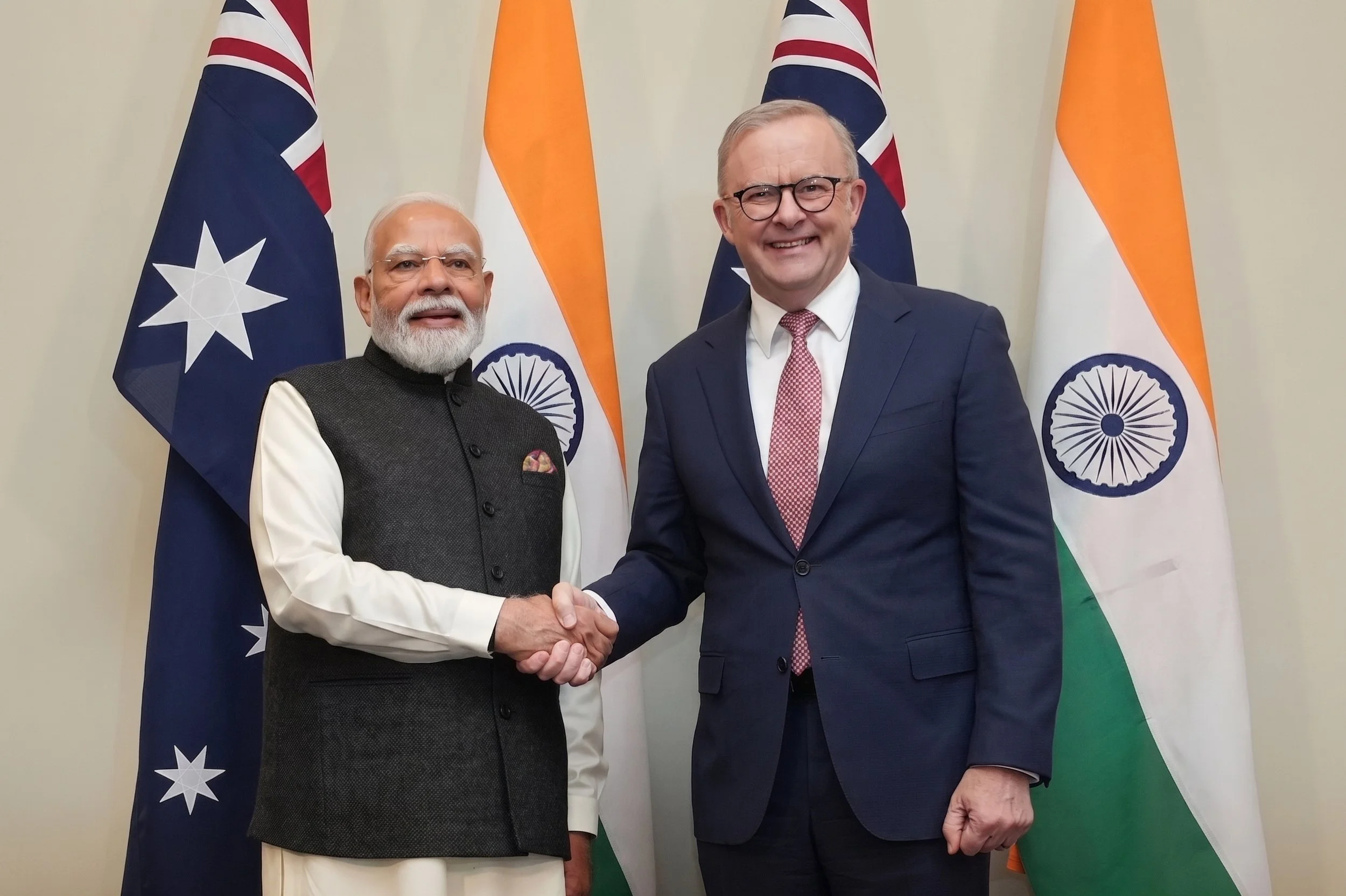
On July 9th, 2026, Indian Prime Minister Narendra Modi visited Australia during his tour of the Indo-Pacific. During this visit, he met with Australian Prime Minister Anthony Albanese, and the two came to a number of mutual agreements over the relations of their respective countries. The most notable of these agreements would be the exportation of Australian uranium for use in Indian nuclear energy facilities, as well as the investment of A$500 million into India’s National Investment and Infrastructure Fund by AustralianSuper, the largest pension fund in Australia. During their meetings, Albanese referred to Modi as a “living bridge” between Australia and India, crediting him for reshaping the bilateral relationship between the two.
This advancement in Australian-Indian relations helps to progress both of the nations’ long-term goals. Australia has long sought to diversify trade in order to decrease reliance on China, its main trading partner. Deepening relations with India aids in this goal, and the newest agreements also see major strides in India’s long-term interest. India aims to achieve 100 gigawatts of nuclear energy capacity by 2047, with the main bottleneck to this goal being access to uranium. The two also agreed to increased trade of renewable resources and critical minerals, as well as cooperation towards clean hydrogen power generation.
One key reason for India’s interest in Australian cooperation is Australia’s sizable Indian diaspora. Australia is home to nearly a million people of Indian descent, many of which having migrated to the country in the last few decades. Following his meeting with Albanese, Prime Minister Modi held a rally for Australia’s Indian diaspora, where he spoke to approximately 30,000 people about the importance of a deepened connection between the two countries. The rally saw thousands of Indian Australians celebrating their shared cultural identities, further strengthening the international ties between Australia and India.
Opposition to Australia and India’s Partnership
Some Australians have expressed disapproval of Australia’s increased partnership with India for various reasons. One common complaint was that AustralianSuper should be invested domestically rather than overseas. In Australia, all people are required to pay into a retirement fund, and the funds are meant to fund their post-work life, as well as support the public benefit of all contributors. AustralianSuper is a private company; however, the government has intervened in its funding pool, setting some of it aside for foreign investment. Paul Schroder, the CEO of AustralianSuper, described government intervention in superannuation funds as an “utter disaster”. AustralianSuper has warned the government that taking from its A$4.5 trillion fund could severely drag down retirement balances, potentially impacting future Australians.
The decision to invest funds from AustralianSuper was largely made by members of Australia’s Labor Party, the current majority party in Parliament. Some have described Labor’s actions as “buying the votes” of the nearly one million Indian-Australians. While the idea that this action would sway Indian voters is not without reason, to say that Australia’s investment in Indian infrastructure was done for that purpose alone is false. Australia has long sought to deepen its international trade relations in order to diversify, and India happens to be a rising economic power also in need of new trading partners.
Another common concern amongst anti-immigration Australians was that this cooperation would lead to an increase in Indian immigration to the country. Since 2025, those born in India have become the largest overseas-born group residing in Australia. In recent years, Indian migration to Australia has increased significantly, with approximately 1 in 8 foreign-born Australian citizens being from India. Those in favor of decreasing immigration have been outspoken about this matter, with some attending Modi’s rally and shouting racist remarks towards the Prime Minister and the crowd.
As the Indian migrant population continues to soar in Australia, anti-Indian sentiment has soared across the country. As the topic of immigration became increasingly politicized in Australian media, online spaces in Australia became hotspots of racism towards Indians. Since Indians are one of the largest minority groups in Australia and have only recently taken this position, they have faced the brunt of anti-immigration rhetoric. Many have warned that allowing this sentiment to grow in Australia will only serve to undermine social cohesion and increase political polarization. Additionally, the current situation Indian-Australians face risks putting other migrant groups in the crosshairs as well, as people blame these communities for broad issues that they are not at fault for.
The Lowy Institute, an independent Australian think tank, described the Indian diaspora in Australia as “a diverse cohort whose internal stratifications shape its members’ experience in distinct ways”. With nearly a million Indian-Australians, no all-encompassing label can be placed on the group without it being a broad generalization. The Lowy Institute also points out how those who express anti-immigration sentiments typically have a blind spot towards how members of the Indian community contribute to and interact with Australian society as a whole, instead considering them an entirely separate group. Indian-Australians are not one group and are instead composed of students, business owners, workers, and more, each individually adding one thing or another to Australia’s overall society.
