
European Central: Swiss Voters Reject Immigration Restrictions In A Recent Referendum

Stephen Leonardi
Switzerland holds referendums more frequently than any other country in the world, and oftentimes on issues that would be handled solely by the government in any other democracy. Nevertheless, Switzerland’s June 14 referendum was certainly unprecedented. Voters were asked to approve or reject a proposal to enshrine in the constitution a population cap of 10 million. The so-called “Sustainability Initiative”, sometimes also dubbed “the Swiss Brexit”, was brought by the Swiss People’s Party (SVP); it would have required the Federal Council, Swiss governmental body, to introduce sweeping measures in the case that the 10 million person threshold was exceeded before 2050. While the SVP, a right-wing party currently holding a majority in the parliament, had insisted the cap was necessary to prevent immigration — particularly from the European Union (EU) — and improve the country’s infrastructure, housing, and social services, it wasn't enough to flip the vote that ended with 54.79% against and 45.21% for. Is immigration really an issue in the country known for Alpine sceneries, chocolate and the annual Davos World Economic Forum?
The Politics Of The Proposal
According to Switzerland's system of near-direct democracy, beyond government-triggered referendums on issues that would normally be voted on by the lawmakers, political parties or even individual citizens can also propose referendums if they gather at least 100,000 signatures. The government is then forced to issue that referendum no matter its position on the issue at hand.
SVP, Switzerland's largest political party, well-known for its anti-immigration politics and advocacy for a more limited relationship with the EU, holds two out of the seven seats in the Federal Council. Lacking the support from the other parties in the government, the SVP started collecting signatures in favor of the population cap in 2023 in order to launch a popular referendum that the government must accept as long as the proposal passes a 100,000 signature threshold within 18 months. The SVP managed to reach that number of signatures in the spring of 2024 and managed to meet the timeframe. In line with the Swiss referendum system, the Federal Council verified the authenticity of the signatures and scheduled it for a nationwide vote for June 14. Although two members of the Federal Council, Guy Parmelin and Albert Rösti, belong to SVP, they had to follow the procedure and unite behind the government’s recommendation to voters to reject the SVP’s proposal.
The 'No to Switzerland of 10 million! (Sustainability Initiative)', also dubbed Swiss Brexit on account of similarities with the British vote to leave the EU in 2016, would have required the Swiss government to take action if the population exceeded 10 million before 2050. Now a country of 9.1 million, the measures to “take action” or enforce the cap could have included tighter residency requirements, restrictions on family reunification, changes to asylum policy, and a termination of Switzerland’s agreement on the free movement of people with the EU under the Schengen Agreement.
For the SVP, the proposal was about preserving Switzerland's quality of life, particularly public services, housing and crime rate, which they allege have been put under pressure due to mass immigration. During the referendum campaign, party representatives argued that immigration was driving rising rents, worsening traffic congestion, overcrowding public transport and placing increasing pressure on schools, healthcare and infrastructure. The party maintained that Switzerland could no longer absorb continued population growth without damaging living standards.
Opponents of the cap, together with business groups and trade unions, criticized the initiative, stressing that the country’s economy depends heavily on foreign labor, particularly in sectors such as healthcare, construction and services, and warning that limiting migration would lead to labor shortages and threaten Switzerland’s competitiveness and growth prospects.
Already as the voting was taking place on Sunday, June 14, early predictions indicated that the proposal would be rejected, and the final count after the polls closed confirmed it with 54.79 percent against to 45.21 percent for. Turnout was 58.86%.
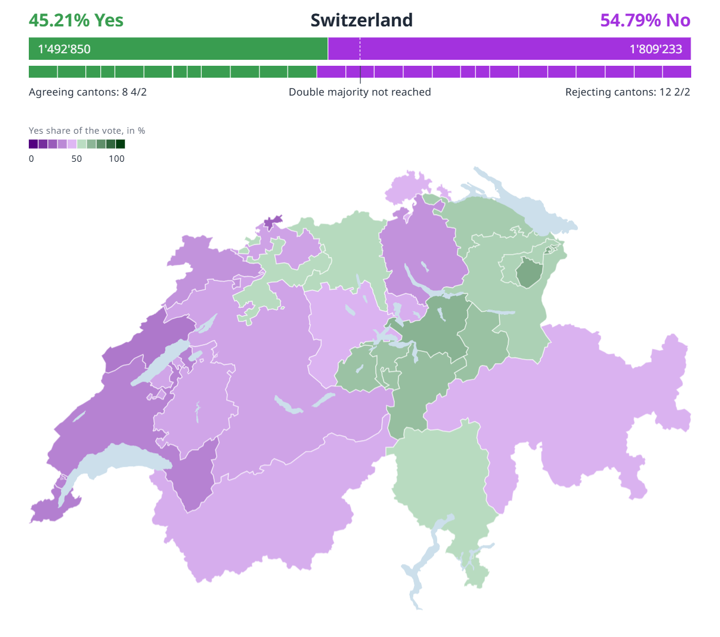
Government release on the referendum results
However, following the low margin of the vote, the SVP and even the government insisted that the immigration debate doesn’t end here. Marcel Dettling, SVP President, said pressures caused by immigration would continue to grow despite the referendum's defeat, noting that a “a very, very large part voted yes”. The government reacted to the results by saying that while it takes immigration growth seriously, it is counting on targeted measures to manage the population, citing its commitment to further mobilize the country’s workforce potential, build affordable housing, and reduce the number of asylum applications.
Immigration As An Issue
So, how did the immigration debate in this mountainous country begin?
Switzerland has one of the highest shares of foreign residents in Europe, with roughly 27 to 28 percent of its population holding foreign citizenship, and since it joined the Schengen Area of free movement with the EU in 2002, the overall population has increased by around 23 percent. The country's strong economy continues to attract workers from all across Europe, and foreign employees have long played a crucial role in healthcare, construction, hospitality, scientific research and financial services.
At the same time, rapid population growth has become increasingly visible in everyday life. Housing shortages have worsened in major cities, rental prices have increased, and transportation infrastructure is under growing pressure. These developments have pushed immigration to the top of the most debated issues in Swiss politics in recent years, even among voters who recognize its economic benefits.
The June 14 referendum wasn’t the first time SVP sought to take political action. In 2014, Swiss voters narrowly approved a referendum calling for limits on immigration from the EU, but the implementation was softened by the government to avoid breaching standing agreements with the EU. In 2020, another SVP-backed initiative seeking to end free movement with the EU was rejected by nearly 62 percent of voters.
Combining the history of similar proposals with the growing frustration around immigration, the result of this recent referendum was difficult to predict.
Voters Are Uncertain
Had the initiative passed, the consequences would be substantial, especially for the country’s relations with the EU and the bilateral agreement that made it easier for both Swiss citizens and EU citizens to travel, work, live and move around with little restrictions.
Although voters ultimately rejected the proposal, concerns about immigration remain. At the same time, the result suggests that Swiss public opinion is divided, and many voters are unsure whether a population cap is the right solution.
