
Checkpoint: Blanche Was Always The Plan
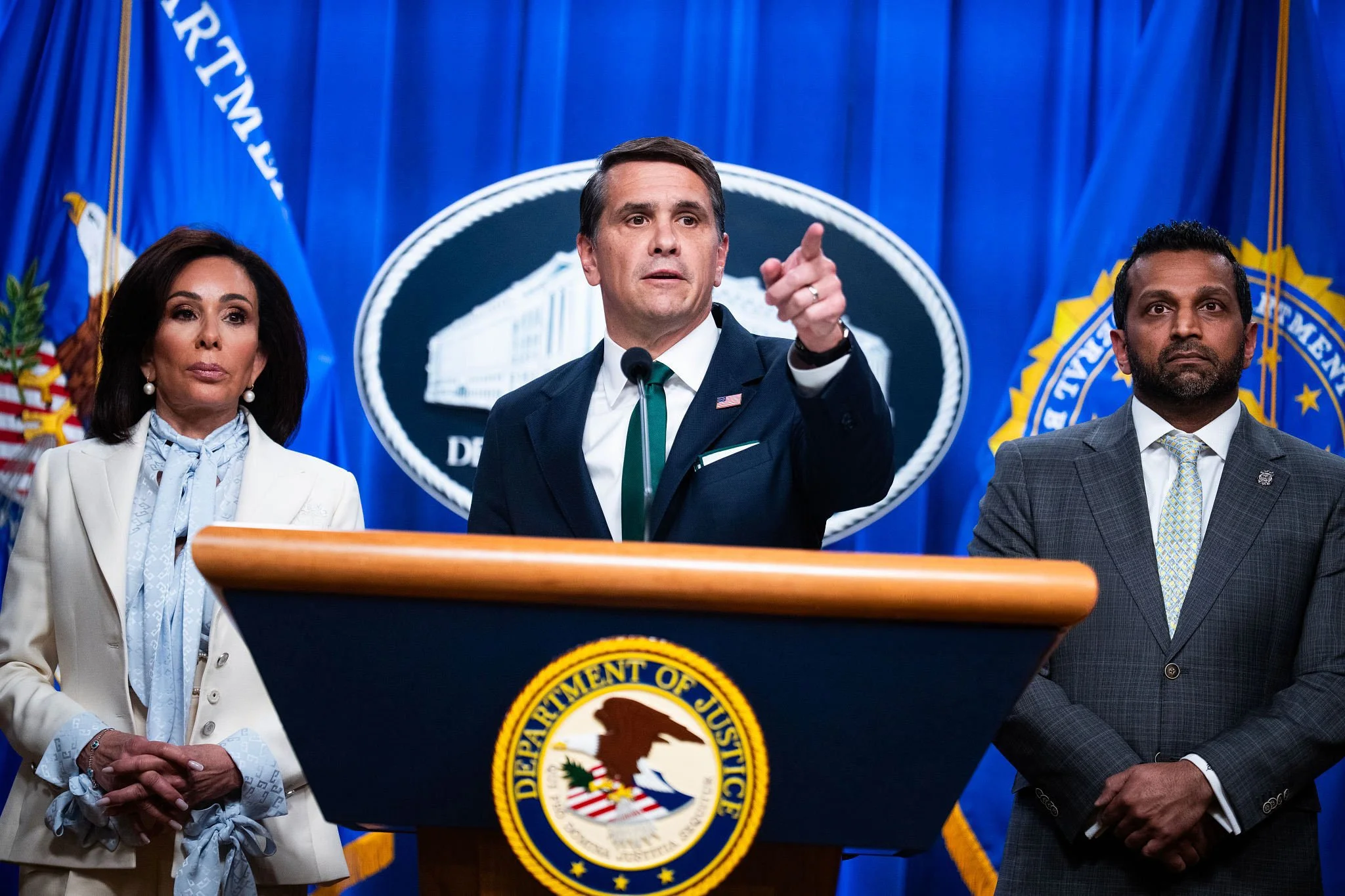
Tom Williams
At the time of this article’s writing, the Senate Judiciary Committee just postponed the vote on whether to advance Todd Blanche’s nomination for Attorney General. Blanche has been the acting Attorney General since April of this year, when he was elevated from Deputy Attorney General to replace Pam Bondi, who was dismissed by President Trump. Pam Bond spent her time in the Department of Justice (DOJ) carrying out some of the most unpopular aspects of Trump’s agenda. Blanche, on the other hand, flew under the radar, carrying out equally unpopular measures without being the face of the Department. Trump got to assuage public outcries by dismissing Bondi and, now that the opposition got their scapegoat, Blanche can continue wreaking havoc on the Justice Department.
From Liberal To Loyalist
Bondi’s career had a fairly traditional leadup to her appointment as Attorney General. She spent twenty years as a prosecutor in Florida, then eight years as the state’s Attorney General. Blanche, on the other hand, took an unconventional route. He attended American University and then Brooklyn Law School, where he took night classes while working as a paralegal. After that, he spent eight years as a prosecutor for the Southern District of New York’s Criminal Division. He then moved to private practice, working at two prestigious law firms, Cadwalader, Wickersham, & Taft and WilmerHale over the course of eight years. Colleagues who know Blanche during this time have described him as a committed Democrat, who actually “shed a tear” when Hillary Clinton lost the 2016 election.
While he was a partner at Cadwalader, Wickersham & Taft, Blanche represented Trump’s former campaign chairman Paul Manafort in a mortgage fraud case. After receiving a call from Trump himself in 2023, Blanche left his white shoe firm to join Trump’s personal defense team. At the time, many of Blanche’s colleagues in the liberal New York milieu refused to work for Trump. The President was running out of options, and Blanche proved not so principled as his peers. In the first case where Blanche represented Trump, the hush money case involving Stormy Daniels, Trump was found guilty on all 34 counts.
Nevertheless, Blanche’s and Trump’s working relationship was solidified, and Blanche went on to represent Trump in cases involving election obstruction and possession of classified documents following the investigation conducted by Special Counsel Robert Mueller. In court he included long rants in his arguments, started interrupting judges, and pushed boundaries of legal discourse in his briefs. Blanche had begun to adapt to the Trump mold. In one of his key moments, while cross examining Michael Cohen, Trump’s former personal attorney, Todd Blanche attacked Cohen with vehemence, calling him a liar and destroying his credibility. In this first case together, Blanche endeared himself to Trump, who appreciated Blanche’s aggressive and tenacious style. Between court dates, Trump, in his usual fashion, would berate Blanche, who would respectfully speak his mind in turn. The two had a candid but fiery relationship that enabled mutual respect.
In 2024, Blanche switched his party registration from Democrat to Republican. In his arguments, Blanche fully embraced Trump’s rhetoric that he was the victim of a national witch hunt, that all the indictments against him were the results of a weaponized Biden Administration government. Blanche still follows this approach today. On April 27, 2026, he signed a motion asking a federal judge to allow the White House ballroom construction to move forward. The filing mimicked the writing style of President Trump, with accusations of “TRUMP DERANGEMENT SYNDROME.”
Fealty Tests And Department Shakeups
Todd Blanche was nominated to be the Deputy Attorney General after Trump won the 2024 election, and his fealty was immediately put to the test. In his confirmation hearings, Blanche refused to say that he would disobey President Trump if he asked Blanche to do something illegal or immoral, though he later conceded that he would “follow the law.” As Deputy Attorney General, Blanche oversaw the controversial piecemeal release of government files relating to convicted sex trafficker Jeffrey Epstein. Blanche’s department botched the files’ release, failed to redact survivors’ personal information, missed release deadlines, and withheld other files in what many claim is a plot to protect Trump and other powerful people. Blanche maintains that the three million unreleased documents are duplicative, irrelevant, or privileged. Blanche also approved Epstein’s accomplice Ghislaine Maxwell’s transfer from a maximum security prison to a minimum security one. Despite the files’ investigation and release being under Blanche’s purview, his image hasn’t been hurt by the ensuing controversy the way then-Attorney General Pam Bondi’s was. She was the head of the department, so she was the sacrificial lamb.
Once he became Acting Attorney General, Blanche instituted immediate changes. He has overseen the termination of hundreds of employees, including agents, attorneys, and professional staff who worked on January 6 cases and the Special Counsel Jack Smith investigations. Under Blanche’s leadership, more than 16,000 DOJ employees have left, including a quarter of its attorneys, some of whom were fired or forced out, while others resigned in protest. He indicted former FBI director James Comey for making and transmitting threats against the President after Comey posted a photo on Instagram with seashells arranged to read “8647.” Blanche’s team alleges that Comey is encouraging someone to 86, a slang euphemism for “kill,” number 47. 47, of course, is Trump, the 47th President of the United States.
Blanche’s most controversial move, however, and the one that may cost him his confirmation, is his role in creating the $1.8 billion “Anti-Weaponization Fund” for people claiming to be victims of a weaponized DOJ, like those who took part in the January 6, 2021 attack on the Capitol. Trump and Blanche have planned to set aside this fund as part of a $10 billion settlement to resolve Trump’s claim against the IRS for leaking his tax returns. This slush fund has proven incredibly unpopular, and Blanche has tried to abandon the plan and distance himself from the settlement. Blanche now claims the bill is moot, but the President has not confirmed. Now Senators Thom Tillis (R-Texas) and John Cornyn (R-North Carolina) want further assurance that the Trump Administration will abandon plans for the “Anti-Weaponization Fund,” and the two are withholding their votes for Blanche’s Attorney General confirmation. The vote is now postponed, and President Trump has threatened to pull Blanche’s nomination until after Tillis and Cornyn leave office after this year’s midterm elections to ensure Blanche’s confirmation.
Out of The Shadows And Into The Spotlight
It is clear that, after years of working with him, Trump really wants Blanche in office. Blanche's immediate structural maneuvers— expanding targeted investigations into political opponents, reinstating harsher federal penalties, and reshaping DOJ priorities— have already shown his approach is more targeted and dynamic than Bondi’s was. Costas Panagopoulos, a professor of political science at Northeastern University, has attested that Blanche is “willing to do more than others to push forward the president's retribution agenda, even if those actions take a personal toll.”
Trump fired Pam Bondi amid scrutiny over the Epstein files and because she was too slow to prosecute his enemies. Blanche clearly won’t have that problem. Pam Bondi was the Attorney General first. She was the face of some of the most controversial events of Trump’s second term, including the release of the Epstein files, threats to free speech, and retribution against Trump’s perceived enemies. Her tenure as Attorney General set up Todd Blanche as the strategic insider who executed the Department of Justice’s agenda from out of the spotlight. The Trump Administration's opposition was then placated with Bondi’s firing, and now Blanche is poised to pick up where she left off.
