
Public Interest: Where Do the Liberal Democrats go next?
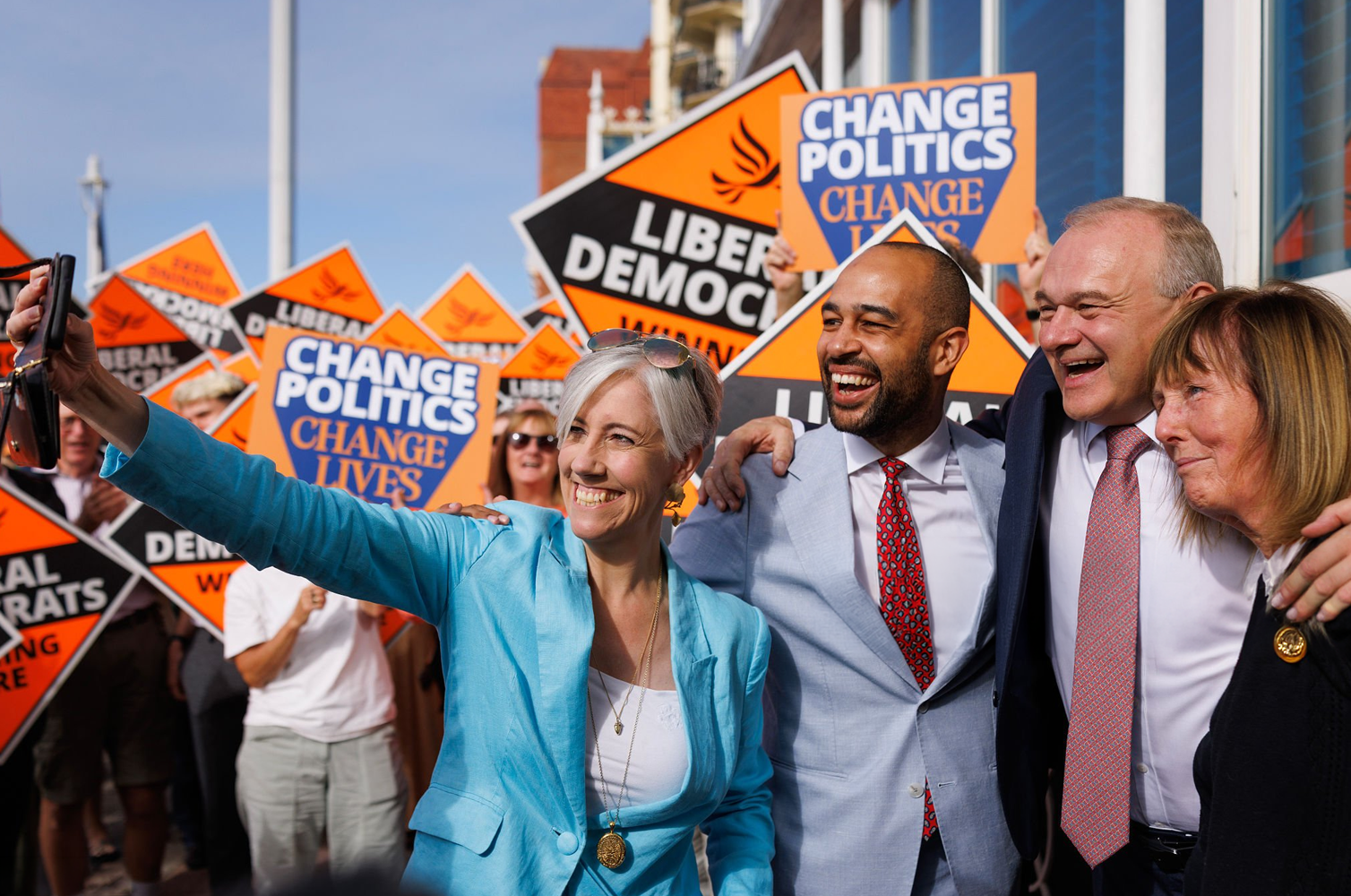
Dan Kitwood
The Liberal Democrats held their latest party conference in Brighton late last month, where they and their leader, Ed Davey, made a number of headline-seeking announcements, in an attempt perhaps to capture some of the national attention that has largely gone to other political parties recently. However, some of Davey's statements also raised questions around whether his party would go in a more right-wing direction which would make them more closely aligned with the Conservatives, arguably a mistake if so.
The Liberal Democrats have long been the party that most clearly occupies the center ground in UK politics, combining progressive social policies with a largely orthodox economic worldview, and generally being seen as appealing to the middle classes, those in the south of England, and - particularly during the Blair years - to students, thanks to their opposition to the Iraq war and Labour's introduction of tuition fees. The party traces its roots to a merger, in the 1980s, between the Social Democratic Party - a centrist grouping forming after a split in the Labour Party - and the old Liberal Party, which had been one of the two main parties governing Britain alongside the Conservatives, before universal suffrage and the rise of Labour.
Though mostly out of government since then, the Liberals still enjoyed a status as the “third party” in the UK's two-party system, after the Conservatives and Labour, and was a status the Liberal Democrats had, for most of their history. For decades, they were the third largest party after these two, and the only other capable of consistently winning more than a handful of seats - that was, until the election in 2015, when, having finally got into government at the previous election after entering into a coalition with the Conservatives, voters quickly turned on them due to their apparent betrayal over policies such as tuition fees, which were trebled under the coalition after Liberal Democrats had campaigned to cut them. This resulted in several years where they were supplanted by the Scottish National Party (SNP).
After a turbulent few years, it seemed as if the Liberal Democrats may have recaptured their status as the UK's third party at the last general election in 2024, where, through a combination of tactical voting, a careful targeting of seats, and widespread dissatisfaction with the Conservatives, they went on to win 72 seats in total - a record number for them, and the highest number of seats for any third party in more than a hundred years.
Since then, however, it seems the Liberal Democrats have been left unable to capitalize on this. In previous eras where there was growing dissatisfaction with both Labour and the Conservatives, this had greatly benefited the Liberal Democrats, as seen in the Blair era.
This time round, however, despite historic losses for both Labour and the Conservatives during the recent local elections, with Labour losing nearly 1,500 councillors nationwide, much of the momentum appeared to have been captured by the other insurgent parties, the Greens on the left, and Reform on the right. Whilst the Liberal Democrats did make gains, the results generally prompted discussions around the prospect of a Reform Government and Nigel Farage in No.10, after Reform won almost as many councillors as Labour had lost. Meanwhile, the Greens saw an increase of more than 400 councillors, next to the Liberal Democrats’ 155, who appeared to be increasingly forgotten at fifth place in the polls.
According to recent findings by the pollster More in Common, the Liberal Democrats have largely failed to break through to the general public, losing left-wing supporters not only to the Greens but also to Burnham's Labour, whilst not doing enough to capture the support of those on the Center-Right. More in Common found that Britons were four times more likely to have heard of Reform and its key figures than the Liberal Democrats, and as many as 61% said they did not know what the Liberal Democrats stood for.
There has been widespread speculation about the reasons for this, with many blaming leader Ed Davey, who it seems, has made little impression on the public, and is only mostly known for his various public stunts. But in an increasingly polarized political landscape, the Liberal Democrats simply lack the immediate pull of the other more populist parties.
In any case, Davey and others are clearly aware of this. At the Brighton conference recently, Davey proclaimed that the Liberal Democrats would be the party of “tax cuts,” railing against the level of tax imposed by the government. Davey went on to state that he wants to see the threshold of tax-free personal allowance raised to £15,000, "taking two million more people out of paying tax altogether.”
This was immediately picked up on by the media, with much speculation as to whether this signals a shift rightwards by the Liberal Democrats, in an attempt to pick up votes from disenchanted, one-nation Conservatives - that is, those who were previously attracted to the Conservative Party when it was under the leadership of figures such as David Cameron, standing for low tax, pro-business policies, but who were turned off by the likes of Brexit, the leadership of figures such as Boris Johnson, and the continued apparent chasing of Reform votes by the Conservatives under Kemi Badenoch, as seen, for example, with her call for Britain to leave the ECHR.
Whilst he has since appeared to decide against a possible coalition with Badenoch, stating that she is “preparing to give the keys to No 10 to Nigel Farage,” this could, on the face of it, be a canny move from Davey. Based on More in Common's research, there is a strong amount of support in the so-called “blue wall” - the Conservatives’ former heartlands in Southern England - for a moderate, center-right opposition, whilst most of the seats the Liberal Democrats are targeting, as well as a majority of those they won at the last election, are former Conservative strongholds. According to More in Common, “Liberal Democrats have more to gain, and lose, from the Conservatives.” It may make sense, to many of the higher-ups in the party, to move further right, and to try and present themselves as a more moderate, one-nation party, rather than the soft-left position represented by many of its activists.
The Liberal Democrats would do well to consider, however, how well jumping into bed with the Conservatives worked out for them last time. Ed Davey, who had been a cabinet member during the Coalition, ought to recall that the results were disastrous for the Liberal Democrats, as they lost many of their erstwhile supporters, with moments such as the hiking of tuition fees being seen by practically a whole generation as their having broken their promises, leading to their disastrous results in 2015.
Whilst indeed the Liberal Democrats have always been a centrist party, they have often performed best, under leaders like Charles Kennedy, when moving further left of center, and it's here, arguably, where the party is most naturally at home. Whilst More in Common found that a repeat of 2010 would be popular with Conservative voters in the blue wall, they also concluded that such a prospect would be incredibly divisive among many of their activists, as well as others on the left who still associate them with 2010-15.
On the contrary, it is with Labour that the Liberal Democrats would most naturally be suited - it is this prospect, at least, according to More in Common, that is the more favoured option for 29% of the public, and half of the Liberal Democrats’ 2024 voters.
The notion of a ‘progressive alliance’ goes back quite far in UK political history, going right back to the Liberal-Labour pacts that existed at the beginning of the 20th century when the Labour Party was first starting as a movement, and then again during the latter half of the 1970s when Labour became dependent on the Liberal Party for keeping their majority.
The idea has been put forward at different points since, especially in the 1980s and 1990s when it seemed Labour would struggle to win an election on their own. The idea gained further traction in the immediate period after Brexit, when parties discussed not standing against each other, or forming loose alliances to block a hard Brexit. And whilst Keir Starmer had dismissed the idea of working with parties like the SNP, and indeed, had seemed not to need them after winning his resounding majority in 2024, such an arrangement might be much more likely going forward, with Burnham having already talked about the need for a less confrontational politics.
It is in this direction, therefore, that would by far be the more natural fit for the Liberal Democrats, rather than with the Conservatives. And, with recent polls showing a near-even split on the right between the Conservatives and Reform, as well as only the narrowest of leads by Labour, such a union may well prove the only means of keeping out the far-right - something on which both old-school liberals and the left must unite.
