
In America: The Department of Education Looks To Improve Education Outcomes For Students
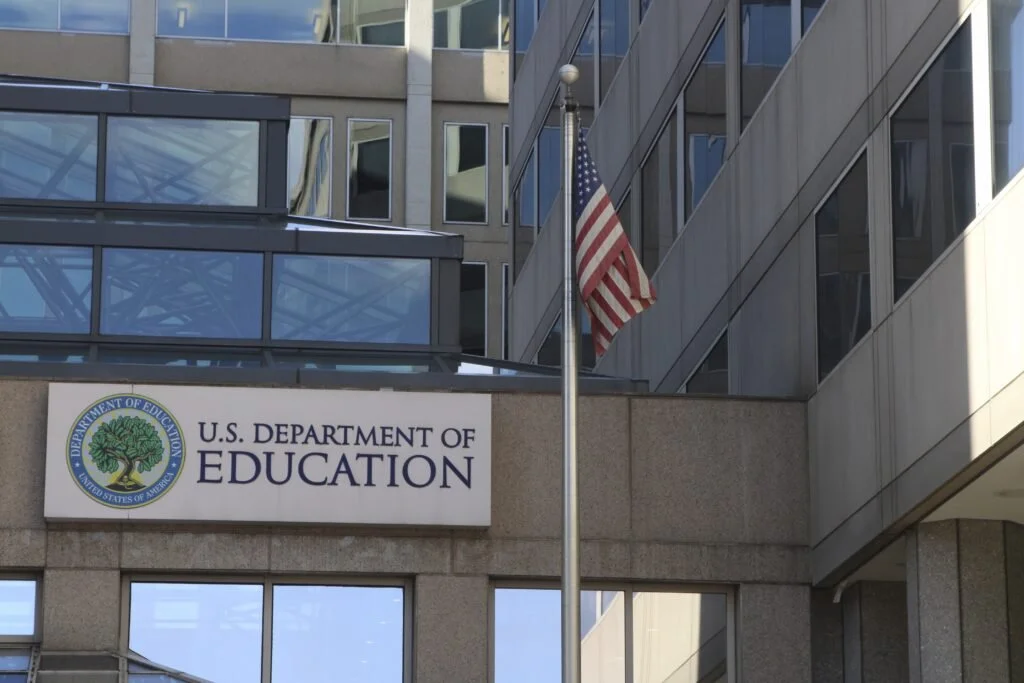
Since its creation, the Department of Education (ED) has pursued the mission of promoting student achievement and preparation through educational excellence and equal access in the U.S. education system. In 46 years, the ED has spent $3 trillion pursuing this mission. More students are now finishing high school than in the previous decade, but the outcomes from their learning have regressed. Studies show sharp declines for test scores in low-performing students (including minority and low-income families), overall proficiency with math and reading has dropped, and the integrity of academic standards are questionable according to scholars. President Trump and U.S. Secretary of Education Linda McMahon are attempting to challenge these issues by breaking up the “federal education bureaucracy,” prioritizing students and families, and returning education to the states.
Current Trends With Student Performance
The National Assessment of Educational Progress, referred to as “the Nation’s Report Card” or NAEP, is a government assessment tool of U.S. students’ knowledge and skills in academic subjects. It has also been used as an aid in education policy and practice. The NAEP provides scores from the overall level of performance of students nationwide. When compared to past data, students today have mostly regressed in their performances.
12th grade students’ performance scores in Math and Reading have decreased from the last 20-30 years while Science hasn’t changed. Performance scores in Civics, Geography, and US History for eighth-grade students have stayed the same as scores from decades ago; however, there were noticeable decreases between pre- and post-pandemic scores. The NAEP suggests that the COVID-19 pandemic has affected learning outcomes for students. The NAEP provides five percentiles to represent the lower (10th and 25th percentiles), middle (50th percentile), and higher (75th and 90th percentile) performing students based on average scores. From 2019 to 2024, the 10th, 25th, and 50th percentiles of scores from fourth grade, eighth grade, and twelfth grade students have regressed in Math, Reading, and Science. In a 2024 survey, 46% of eight-grade teachers reported providing social-emotional support to most or all students due to gaps in learning from the COVID-19 pandemic.
The NAEP has studied other possible influences on student performance. In the Experiences and Opportunities in Education Grade 8 study, 29% of students were absent for three or more days in the previous month, 35% students attend schools that provide in-school tutoring to most or all students, and 24% attend schools with “high-dosage tutoring.”
Low-performing students experienced the highest rates of decline in performance over time. The NAEP has determined that low-performing high school seniors do not meet basic proficiency level of reading or mathematical skills. The average Reading score from the 10th percentile has regressed by 10% while the 25th percentile has regressed by nearly 5.9% from 1992 to 2024. The average Math score from the 25th percentile has decreased 5.5% while the 10th percentile has decreased 4.8% from 2005 to 2024.
POTUS & ED Wants To Dismantle The “Federal Education Bureaucracy”
President Trump puts blame on the administrative structure within the Department of Education for the current U.S. educational experience. The ED’s offices, regulations, compliance systems, grant-management processes, and rulemaking framework overseeing national education programs has created what the President believes is a bureaucracy negating education in America. By giving responsibility to the federal government for the education system, states are provided “one-size-fits-all” mandates and solutions. Trump believes giving administrative power to the states will better handle issues experienced with the education system and promote improvement in students’ performance.
President Trump has tasked Secretary McMahon with truncating the centralized federal oversight downsizing the Department of Education to reduce federal standards and allow states to have different educational approaches for their students. The ED is supporting states to freely use their education funding through waivers and provisions within federal laws (ESEA & ESSA) and is exploring ways to restructure IDEA rules.
“ED Took Concrete Steps to Return Education to the States and Empower Parents in Their Child’s Education By:
- Partnering with several agencies to break up the federal education bureaucracy and refocus programs and activities to better serve students, including: workforce development programs, and K-12 programs, and postsecondary programs;
- Touring a variety of public, private, charter, magnet, and micro schools in 24 of 50 states to empower families and hear from students, teachers, and leaders on best practices in their own communities;
- Awarding $500 million to the Charter Schools Programs, the largest investment in the program ever;
- Championing the largest federal expansion of education freedom in history;
- Urging states to expand education choice by using up to 3% of their federal Title I allocation to support education choice initiatives;
- Encouraging states to continue to maximize parent options for choosing the safest school setting for their children.
- Providing guidance to states so that they can prioritize school improvement dollars to districts that will turn around underperforming schools and give students school choice options;
- Advising states to use waiver to maximize opportunity and improve students’ academic achievement;
- Releasing additional guidance on how states might provide equitable services for students enrolled in private schools in more efficient and effective ways to best meet students’ needs; and
- Issuing guidance to states on the Ed-Flex option to encourage local innovation.
ED Removed Bureaucratic Barriers and Invested in Education By:
- Realigning the federal government’s investment of taxpayer dollars in education to evidence-based literacy, school choice, and meaningful learning;
- Awarding over $208 million directly to states and school districts for increasing the number of credentialed psychologists in schools;
- Awarding over $167 million to states and school districts to improve literacy nationwide;
- Withdrawing two burdensome and misaligned Notices Inviting Application (NIA) for charter school programs;
- Reversing a Biden-Harris reporting scheme that burdened states and local Career and Technical Education programs to comply with unnecessary reporting requirements; and
- Reining in the federal government’s influence over state Charter School Program grant awards.”
Are There Consequences Returning Education To The States?
The negative view of bureaucracy is rooted in beliefs about federalism, efficiency, and the proper role of government involvement in the education system. Critics of these changes see federal oversight as essential to protecting students’ rights, providing transparency in school/student performance, and ensuring equal care for students.
Applying federal education laws like the Elementary and Secondary Act (ESEA)/Title I, Individuals with Disabilities Act (IDEA), and the Every Student Succeeds Act (ESSA) generates high compliance costs and complex implementation requirements which diverts attention and resources from instruction. However, ESSA and IDEA programs have been shown to have positive effects. ESSA retains federal expectations like standards, assessments, identifying low-performing schools while giving states more discretion in the design of accountability systems, what indicators to use, and how to intervene when schools are struggling. ESSA even warns that if federal educational policy improperly functions, it could lead to divergent effects negatively impacting students.
Civil-rights scholar Kimberly Jenkins Robinson advocates for central authority to ensure educational equity. States have a long history of unequal treatment of minority students, students with disabilities, English learners, and low-income communities. Having federal enforcement of civil rights in the education system provides mechanisms to measure inequalities and monitor if states are supporting schools with low-performing students.
Federal rules have created a national baseline for transparency and holds states accountable for low performance. It requires annual testing and public reporting of student outcomes to ensure improvement plans are implemented with underperforming schools. A national education system creates a base of coherency. Without federal coordination, states could create curriculums and standards that are incomparable to one another. This could undermine comparability of student outcomes and ability to identify and handle systemic problems.
